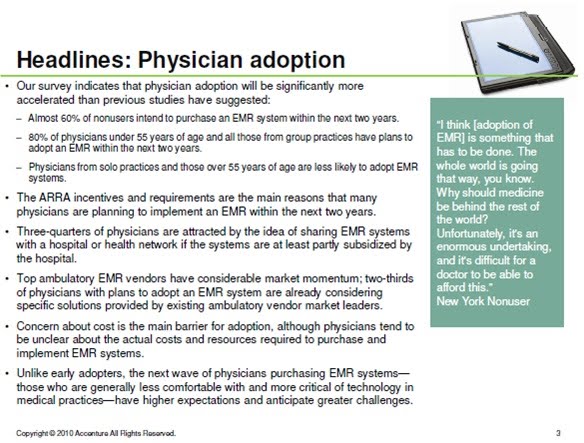
A recent study on physician plans for adoption of health IT systems found that ARRA and hospital incentives will drive rapid adoption, with 80% of physicians under 55 year of age (and 58% overall) planning to implement an EMR within the next two years.
Healthcare Technology News sat down with Greg Parston, the lead researcher and director for Accenture’s Institute for Health and Public Service Value.
HTN: This study is focused on the 10 and under physician market in US?
Greg Parston: That’s correct.
HTN: The physicians have pretty aggressive plans.
Greg Parston: Because of what’s happening with incentives provided by ARRA and sometimes being provided by hospitals we are at a tipping point. There have been many physicians who appear to have been looking into what EMR can do for them. They’ve been reluctant for many reasons that we identified in the study. But because of these incentives and in part because they can anticipate minor Medicare reductions for non-use, they are becoming more interested. The indications of aggressiveness, if you can call it that, are pretty astounding.
80% of physicians under the age of 55 we talked so say they are going to adopt an EMR system within the next two years and that’s a pretty big shift. Right now we’re talking about a physician population of about 15% using on EMR and now we were talking about much bigger numbers within 24 – 36 months.
HTN: There’s always been a prediction that the EMR adoption was right around the corner.
Greg Parston: Physicians have been looking. It’s not as if they’re coming to this totally uninformed. Many practices have been taking a look at different kinds of systems. They’ve been considering the benefits. They’ve been talking to people who have a system today. I don’t think they’ve been doing enough of that. But they’ve been doing enough of it to indicate that they been thinking about it. So if we’re talking about 58% now, a good portion of that would have been thinking about adopting it in the coming years. What ARRA has done is to provide the tipping point to make a much larger percentage of small-group practices decide that they're going implement a system. But also because of the deadlines it’s brought their plans closer. You’re right to say that there was a time we thought this was going to happen and there was going to be a big surge. What ARRA has done is to provide the added push and the timetable for that.
What’s most interesting is the difference in attitude amongst those physicians under 55 and those over 55. These systems are not inexpensive. For very small packages it’s a sizable amount of money. For the older guys they’re there taking a look at when are these reductions going to come in. How much is it going to cost me? When am I going to retire? Those sorts of questions are making them in some cases perhaps a bit more skeptical of it. More wary of it. More reluctant. When you take a look at the younger guys, 2015 (when the penalties kick in) is still within their working lives. They’re taking a look at how they can avoid any penalties now and put in place a system which potentially has great benefits for them.
HTN: Your study cited a key driver for EMR adoption being federal legislation - 61% cited penalties for non-adoption and 51% cited federal incentives.
Greg Parston: You can’t just look at their reaction to ARRA. You also have to take a look at their reaction to the potential of local hospital subsidy. Many local hospitals are offering support of one type or another and some of that support is actually financial. There’s also aftercare – we’ve heard of doctors who have had a systems crash and have waited up to three weeks for the geek squad to fix it. Hospitals are offering 24x7 services. Hospitals are offering training. Hospitals are offering assistance in transition from written records to electronic records. All of those things along with ARRA are providing a basket of benefits for clinicians.
And while the study does cite the penalty as the single most importat thing, when you combine the benefits of both the government and their potential networked hospitals, these incentives seem to be the overwhelming influence.
If doctors move to full functionality EMR systems, however meaningful use is finally defined, and if they negotiate well with their local hospitals this could be a rather inexpensive investment for them. As they’re thinking about this, they’re thinking about how they could network in to hospitals. This brings them advantage, not just in terms of billing but in terms of patient flow through their referrals. In another study we found that 75% of the American public want their doctors to have electronic medical records and that must put pressure on practices as well. They’re sitting there saying: “This looks pretty good - I can get up to X thousands from the government to put in the system and my local hospital is willing to put in training and support for me - Now is the time.”
HTN: The study found a strongly held belief in the value of an EMR system to the practice. The summary in the study was about changing the way the practice works for the better. I hear various arguments: Are the majority of of practices using it just to comply with billing and payment requirements for reporting outcomes? Or are they really into this for better patient care? What is your insight on how this changes the way the practice works for the better?
Greg Parston: Patient care came up but it wasn’t the top. What was top was trying to develop more streamlined administrative systems within the practice. And that’s fine. These guys run businesses and they’ve got to make sure that those businesses are giving them the kind of support and administrative ease that allows them to focus on their patients.
When we ask doctors who currently have systems whether the systems benefitted them, 90% said they did. There wasn't any one thing that was identified as the overwhelming benefit. Doctors use these systems in various ways for various advantages in various places. Places that have used systems for a very long time like Kaiser Permanente have learned how these systems can not only streamline administrative practices but can also streamline and improve the quality of the patient care process. There are organizations that really know how to use the EMR. I’m not sure that doctors who are in small practices are cognizant of all the potential benefits and changes possible with an EMR system in place.
HTN: The study noted the exaggerated perception of the difficulties in using EMR systems. How did that manifest itself?
Greg Parston: It manifested itself in the fear and hesitancy about the systems. There is another important observation here that came out of the research. Many of these physicians self-report themselves as being less conversant and less comfortable with computer and Internet technologies than their predecessors. So the first wave who are already using it – the 15% who are already there - they identify themselves as more IT literate. Some develop these systems because they want to be on the edges of modernity. You and I have friends that have every piece of technology around the house because they have to have it. There are doctors like that too.
The next generation if we can call it that – the people we were talking in that 58% (or under 55, that 80%), they’re more fearful. They don't feel as comfortable with these technologies. They certainly don't feel able to service it themselves. So they raise bigger questions about how difficult is it going to be implement it or how difficult it’s going to be to get service. Am I going to find that it’s going to crash and am I going to run into real problems in my practice? Those questions don't come from looking at the systems. Those questions come out of their own personal lack of total comfort with new technologies. That’s something that’s going to have to be overcome through learning more and through use of these systems. And here I think that vendors and hospitals that are trying to network doctors in can be of enormous help in providing much more education and support and understanding to make them much more comfortable more quickly.
HTN: What was the timing of your survey? Was this pre- December 30, before the meaningful use rules were issued?
Greg Parston: Yes it was. It was also right during the height of the health reform legislation. We had been timing this study to occur in the Autumn and we took a judgment about whether or not we should do it during the midst of that debate. We decided we should because people would be even more cognizant and sensitive to the issues. Healthcare reform legislation is going to change American healthcare.
HTN: What do you think would be the impact of the meaningful use rules on physicians planning to adopt an EMR?
Greg Parston: There’s 600 pages there and I only know one person who’s read all 600 hundred. And they’re still being modified as we speak. Meaningful use is essentially about trying to get people to use the system to full functionality, cognizant that people are concerned about privacy issues and lots of other things. Meaningful use will drive people to take a look at what they get from that next step of functionality. By linking the incentive payment to increased meaningful use physicians will begin to explore more.
They’re not going to jump all the way into whatever the top level of meaningful use is simply to get the money. But knowing that the money is there, they’ll begin to explore further the edges of their systems. And they’ll begin to think about how they can use them in a new ways.
I’ve already mentioned Kaiser Permanente. There’s a quote in recent article about Kaiser Permanente – about how the system can actually change things - about how doctors will use these technologies to adapt their practices. The quote goes something like this: that if you give a lumberjack, who’s been using an ax his whole life, a chainsaw and he starts hacking at the tree it’s not going to help him. It's only when you begin taking a look at how this chainsaw works and what a difference it can make that it can make a difference in his life. I think that’s the same with an EMR.
This is a new technology that’s going to allow people to do lots of different things. Meaningful use is a carrot as well as an instruction about how you can learn how to use the chainsaw in the way it was designed to be used.
HTN: You mentioned the striking impact the health reform legislation will have.
Greg Parston: It’s going to force people to take a look at what we mean by connected health. I don't mean that in a technology sense. I mean it in the sense of really connecting agencies together to try to deliver value for the public in health terms, not just in health service terms. And that’s pretty exciting to me. This legislation will unleash a whole new part of the market on the demand side. And there are people on the supply side that are very good at innovation and thinking about how they can serve the needs of people who have not been served before. And a lot of that isn’t episodic acute care. I think we could see a very different health system in two decades from what we've got now. What we’ve got now is one that largely focuses on episodic transactional care. I think we can get something which is much more about helping me deal with my health through the continuum of my life.
________
Greg Parston is the director of the Accenture Institute for Health & Public Service Value. Prior to joining Accenture, Dr. Parston was the chairman of the Office for Public Management, a nonprofit organizational development company that he co-founded in 1988 and led as chief executive until 2003. Dr. Parston has consulted widely with top managers, focusing on governance, strategy and change and has worked as a manager in the public, private and not-for-profit sectors. Until taking up his current post, he also was a director of the Priory Group, responsible for public service partnerships.
Tuesday, April 27, 2010
Thursday, April 22, 2010
NHIN Direct Addressing Specification
Guest author and member of the NHIN Direct Implementation Group John Halamka provides an update on:
The NHIN Direct Addressing Specification
Every Tuesday, the NHIN Direct Implementation Group holds a teleconference to update the entire team on the progress of the technical workgroups. This week, we discussed the completed addressing specification.
As I've said many times in my blog, the most important standards implementation problem to solve right now is transport, not only the basics of transmitting data securely but also transaction orchestration and the constellation of supporting functions such as addressing the messages.
In previous blogs, I've described one way to solve the addressing problem - give every patient a voluntary opt in "Health URL" that they could use to receive all healthcare data from hospitals, offices, labs, and pharmacies.
For use cases such as sending data from provider to provider, hospital to provider or provider to public health we need some similar approach to ensure data is delivered to the right place.
The NHIN Direct Addressing specification proposes five ways to do this - secure email addressing (SMTP plus TLS), REST, SOAP, and the HL7 routing schemes XCN and XON.
First, two definitions. A "Healthcare Internet Address" is made up of a Health Domain name and a Health Endpoint Name
Health Domain Name
A Health Domain Name is a string conforming to the requirements of RFC 1034.
A Health Domain Name identifies the organizations that assign the Health Endpoint Names and assures that they correspond to the real-world person, organization, machine or other endpoint that they purport to be. For example, my organizations (BIDMC and Harvard Medical School) could control nhin.bidmc.org or nhin.hms.harvard.edu
A Health Domain Name MUST be a fully qualified domain name, and SHOULD be dedicated solely to the purposes of health information exchange.
Organizations that manage Health Domain Names MUST maintain NHIN Direct Health Information Service Provider (HISP) Address Directory entries for the Health Domain Name, as specified by the Abstract Model, and corresponding to rules established for concrete implementations of the Abstract Model. Organizations that manage Health Domain Names MUST ensure that transactions are available for Health Endpoint Names, either through proprietary means or following the Destination role transactions of the Abstract Model. Organizations may take on the HISP role or assign this function to another organization playing the HISP role (such as GoDaddy does for hosting regular email on behalf of other organizations).
Health Endpoint Name
A Health Endpoint Name is a string conforming to the local-part requirements of RFC 5322
Health Endpoint Names express real-world origination points and endpoints of health information exchange, as vouched for by the organization managing the Health Domain Name. For me, that could be a person such as Dr. John Halamka, an organization such as BIDMC Emergency Department or an aggregation point such as BIDPO Quality Data Center. Here are examples of each address type
Email
Jhalamka@nhin.bidmc.org for health information exchange (not regular email) directed to me at BIDMC
REST (example of a possible format)
https://nhin.bidmc.org/nhin/1_0/urn:nhin:nhin.bidmc.org:jhalamka/
1_0 refers to the REST API version.
SOAP (example of a possible format)
https://nhin.bidmc.org/nhin/1_0/wsdls/messages
the person or organizational endpoint would be specified in the message itself.
1_0 refers to the SOAP API version.
HL7 XCN (extended composite ID number and name for persons)
urn:nhin:nhin.bidmc.org:jhalamka^Halamka^John^D^DR^MD^^&NHIN OID&OID
The XCN representation could be used in multiple contexts, including the intendedRecipient in an XDS/XDR web service call or in an HL7 2.x message to refer to the sender or receiver of a message (e.g., in a PV1 segment)
HL7 XON (extended composite name and identification number for organizations)
Beth Israel Deaconess Medical Center^^^^^&NHIN OID&OID^^^^urn:nhin:nhin.bidmc.org:emergency_department
Note that XCN and XON are included for compatibility with the IHE XDR spec, NHIN Document Submission, and HITSP T31.
Imagine if every EHR could send data to every other EHR using a simple addressing mechanism like Email, a consistent REST implementation or a well described SOAP WSDL. Interoperability would follow rapidly because novel packages of data will be sent to support real business needs without any barriers of how to get the data from endpoint to endpoint.
The NHIN Direct process is working well and builds upon the work of the past. It does not compete with, diminish, or in any way represent a replacement of the hard work done by so many people over the past years in HITSP, IHE, and the SDOs.
I'll continue to provide NHIN Direct updates as reference implementations with running code are deployed. Massachusetts, through NEHEN and the Massachusetts eHealth Collaborative has volunteered to test these techniques with other surrounding states. Let the testing begin this Summer!
Labels:
Addressing Specification,
John Halamka,
NHIN Direct
Friday, April 16, 2010
Chronic Disease and the Internet Access Gap
Adults living with chronic disease are disproportionately offline in an online world. The internet access gap creates an online health information gap. Only 62% of adults living with chronic disease go online, compared with 81% of adults who report no chronic diseases.
Lack of internet access, not lack of interest in the topic, is the primary reason for the gap. When demographic factors are controlled, internet users living with chronic disease are slightly more likely than others to access health information online.
More than any other group, people living with chronic disease remain strongly connected to offline sources of medical assistance and advice such as health professionals, friends, family, and books. However, once they have internet access, people living with chronic disease report significant benefits from the health resources found online.
The report, “Chronic Disease and the Internet,” surveyed 2,253 adults, 36% of whom are living with chronic disease (heart conditions, lung conditions, high blood pressure, diabetes, cancer).
51% of American adults living with chronic disease have looked online for any of the health topics included in the survey, such as information about a specific disease, a certain medical procedure, or health insurance. By comparison, 66% of adults who report no chronic conditions use the internet to gather health information.
Lack of internet access, not lack of interest in the topic, is the primary reason for the gap. When demographic factors are controlled, internet users living with chronic disease are slightly more likely than others to access health information online.
More than any other group, people living with chronic disease remain strongly connected to offline sources of medical assistance and advice such as health professionals, friends, family, and books. However, once they have internet access, people living with chronic disease report significant benefits from the health resources found online.
The report, “Chronic Disease and the Internet,” surveyed 2,253 adults, 36% of whom are living with chronic disease (heart conditions, lung conditions, high blood pressure, diabetes, cancer).
51% of American adults living with chronic disease have looked online for any of the health topics included in the survey, such as information about a specific disease, a certain medical procedure, or health insurance. By comparison, 66% of adults who report no chronic conditions use the internet to gather health information.
Thursday, April 1, 2010
Health Wonk Review: Special Edition on Health Care Reform
"The unfinished business is done."
Health care has never been so center stage and so enmeshed with policy and politics. It took 100 years, starting with Teddy Roosevelt's 1912 presidential campaign. Seven presidents tried including two Republicans and five Democrats.
Who won? Patients won't be denied coverage for pre-existing conditions (eventually) and are no longer subject to lifetime caps. Physicians will benefit from the coverage expansion and increasing fees for Medicare primary care. Government trims the rate of growth of the deficit. Small business gets a tax break. Students can stay on their parent's plans until age 26. Seniors see the close of the Medicare prescription drug doughnut hole. And hospitals receive payments for more of the care delivered.
Not all of the "winners" improve access/health/costs: Pharma doesn't have to negotiate for drug prices. Payers will still find reasons to deny care and are permitted medical loss ratios of 80-85%.
The Debate
Did it go far enough? Could a public option have done more to hold down administrative costs and improve access and health? Mad Kane skewers the "something is better than nothing" half-a-loaf theory with an hilarious limerick.
And in the aftermath of the bill's passage, Republicans warn of no cooperation for the rest of the year. You can just imagine Mad Kane's sharp witted riposte - - check it out in Addled Threats posted at Mad Kane's Political Madness.
Louise at the Colorado Health Insurance Insider reports that the Colorado and other Attorneys General are questioning the legality of the Health Insurance Mandate. Basically, they’re saying that the federal government doesn’t have a constitutional right to compel citizens to take part in any specific market – including health insurance.
Health care reform unconstitutional? Get over it. David Harlow's Health Care Law Blog spells it out.
David Williams at Health Business Blog makes the case that health reform would not have made it through Congress without unwitting help from Republicans. "My biggest chuckles have been with Republicans complaining about Democrats using unfair processes and not accepting the will of the people."
Bob Vineyard lays out the questionable economics of the tax penalties for non-insurance in We Have Ways posted at InsureBlog
Austin Frakt at The Incidental Economist asserts that individual mandate penalties are adequate. Some claim that health reform's penalties for failing to purchase insurance are lower than those in Massachusetts and therefore invite gaming of the system. Those claims are false.
Jared Rhoads at the The Lucidicus Project ("All Talk, No Debate") argues that there was never a principled debate around healthcare reform. Too much bickering. Ya think? Also, at The Lucidicus Project: 21 brief thoughts and observations, Thomas Sowell-style, on health reform.
Jaan Sidorov at Disease Management Care Blog does a back of the computer monitor calculation and divides the $940 billion price tag of health reform by the number of lives that were reportedly being lost for lack of health insurance.
Minna Jung at Health Reform Galaxy Blog reminds us that the job of educating people about what did just happen in the health reform debate, and what will happen, is not over, not by a long shot.
Anthony Wright at Health Access Blog spotlights a study showing that health services provides states with their best bang for their buck in terms of job creation and/or retention. Health care does much better from a "jobs per billion" metric than tax hikes or cuts.
Joe Paduda at Managed Care Matters endeavors to anger people on both sides of the political spectrum with this two-parter: Unsustainable, irrational, unaffordable health reform and Flip flopping on the mandate - Gingrich's hypocrisy.
John Goodman's Health Policy blog contends that health reform won't reign in government spending, as the legislation will require just about every non-elderly person in America to buy health insurance, the cost of which is going to rise at twice the rate of growth of their incomes.
Tinker Ready at Boston Health News reports on the Brown and Romney dance around Mass Reform.
Jeff Goldsmith at Health Affairs Blog reviews the performance of the Obama administration during the recent health reform debate through the lens of David Blumenthal and James Morone's book Heart of Power.
The real work begins
Anthony Wright at The New Republic's "The Treatment" blog writes the real work now begins. The work of health reform doesn't just continue, but explodes at the state level. In California, bills are already moving on issues from rate regulation to a public health insurance option.
As a great example of the impact on the states, Mike King at Georgians for a Health Future describes the work in front of Georgia in response to the health reform legislation.
David Harlow at Health Care Law Blog interviewed Don Berwick about 18 months ago. As Don heads into the post of CMS Administrator, it is a timely window into the thoughts of the person who will be responsible for implementing a great deal of the health reform law. Neil Versel at FierceHealthIT thinks Don Berwick will embrace IT as long as it improves quality. Ken Terry at BNET Healthcare believes that Don Berwick's big vision will make him a political target.
Dr. Sheldon Horowitz at the Health Reform Galaxy Blog reports on a Rx for primary care. Improving Performance in Practice (IPIP) is devoted to helping doctors in primary-care practices improve the quality of care they provide and encourages them to work with support staff to ensure their time is well utilized.
Vince Kuraitis at e-CareManagement blog recaps pilots, demonstrations and innovations in the health reform bill. Just what are these demos and pilots in the PPACA all about? Vince was boggled by the sheer number and complexity, and shares his findings.
Fred Lee presents Crowded Hospitals And Mortality posted at Healthcare Hacks. In certain cases, patients admitted to crowded hospitals stand a 5.6% higher risk of dying.
Ethics and Economics
The law of unintended consequences strikes again: Erik Turkewitz at the New York Personal Injury Law Blog contends that the health reform bill will be a big benefit to personal injury victims.
Jon Coppelman at Workers Comp Insider explores the dynamic tension with employers and payers: "it would be nice to think that the pending expansion of healthcare benefits to nearly all Americans might make this cost-shifting problem go away. Alas, the game of 'pin the tail on the payer' has only just begun." He also presents Dueling Shrinks: Uncompensable Depression.
Jason Shafrin at the Healthcare Economist describes some recent work evaluating proposed changes to Medicare's hospital wage index..
Roy Poses at Health Care Renewal presents a sobering report on The Settlement and Conviction Round-Up: Friday Frequent Flier Edition.
For your reference
Silicon Valley Blogger provides an overview of Health Care Reform Bill: How It Affects You posted at The Digerati Life.
Shannon Wills presents 100 Great Twitter Streams to Stay on Top of Health News posted at Radiography Schools. An outstanding list of sources in 140 characters or less.
Raymond Fernandez20 presents 25 Little Known Ways Everyday Technologies Are Affecting Your Health posted at Online BSN.
Clay at the Health Crazies compiles resources on how each state’s health stats stack up.
Joel Ohman at Healthcare Insurance Providers graphically presents the health reform time line. You'll want to keep this close by for easy reference. It's reproduced below.

Infographic by HealthInsuranceProviders.com
Next Health Wonk Review will be hosted by David Harlow at Health Care Law Blog.
Health care has never been so center stage and so enmeshed with policy and politics. It took 100 years, starting with Teddy Roosevelt's 1912 presidential campaign. Seven presidents tried including two Republicans and five Democrats.
Who won? Patients won't be denied coverage for pre-existing conditions (eventually) and are no longer subject to lifetime caps. Physicians will benefit from the coverage expansion and increasing fees for Medicare primary care. Government trims the rate of growth of the deficit. Small business gets a tax break. Students can stay on their parent's plans until age 26. Seniors see the close of the Medicare prescription drug doughnut hole. And hospitals receive payments for more of the care delivered.
Not all of the "winners" improve access/health/costs: Pharma doesn't have to negotiate for drug prices. Payers will still find reasons to deny care and are permitted medical loss ratios of 80-85%.
The Debate
Did it go far enough? Could a public option have done more to hold down administrative costs and improve access and health? Mad Kane skewers the "something is better than nothing" half-a-loaf theory with an hilarious limerick.
And in the aftermath of the bill's passage, Republicans warn of no cooperation for the rest of the year. You can just imagine Mad Kane's sharp witted riposte - - check it out in Addled Threats posted at Mad Kane's Political Madness.
Louise at the Colorado Health Insurance Insider reports that the Colorado and other Attorneys General are questioning the legality of the Health Insurance Mandate. Basically, they’re saying that the federal government doesn’t have a constitutional right to compel citizens to take part in any specific market – including health insurance.
Health care reform unconstitutional? Get over it. David Harlow's Health Care Law Blog spells it out.
David Williams at Health Business Blog makes the case that health reform would not have made it through Congress without unwitting help from Republicans. "My biggest chuckles have been with Republicans complaining about Democrats using unfair processes and not accepting the will of the people."
Bob Vineyard lays out the questionable economics of the tax penalties for non-insurance in We Have Ways posted at InsureBlog
Austin Frakt at The Incidental Economist asserts that individual mandate penalties are adequate. Some claim that health reform's penalties for failing to purchase insurance are lower than those in Massachusetts and therefore invite gaming of the system. Those claims are false.
Jared Rhoads at the The Lucidicus Project ("All Talk, No Debate") argues that there was never a principled debate around healthcare reform. Too much bickering. Ya think? Also, at The Lucidicus Project: 21 brief thoughts and observations, Thomas Sowell-style, on health reform.
Jaan Sidorov at Disease Management Care Blog does a back of the computer monitor calculation and divides the $940 billion price tag of health reform by the number of lives that were reportedly being lost for lack of health insurance.
Minna Jung at Health Reform Galaxy Blog reminds us that the job of educating people about what did just happen in the health reform debate, and what will happen, is not over, not by a long shot.
Anthony Wright at Health Access Blog spotlights a study showing that health services provides states with their best bang for their buck in terms of job creation and/or retention. Health care does much better from a "jobs per billion" metric than tax hikes or cuts.
Joe Paduda at Managed Care Matters endeavors to anger people on both sides of the political spectrum with this two-parter: Unsustainable, irrational, unaffordable health reform and Flip flopping on the mandate - Gingrich's hypocrisy.
John Goodman's Health Policy blog contends that health reform won't reign in government spending, as the legislation will require just about every non-elderly person in America to buy health insurance, the cost of which is going to rise at twice the rate of growth of their incomes.
Tinker Ready at Boston Health News reports on the Brown and Romney dance around Mass Reform.
Jeff Goldsmith at Health Affairs Blog reviews the performance of the Obama administration during the recent health reform debate through the lens of David Blumenthal and James Morone's book Heart of Power.
The real work begins
Anthony Wright at The New Republic's "The Treatment" blog writes the real work now begins. The work of health reform doesn't just continue, but explodes at the state level. In California, bills are already moving on issues from rate regulation to a public health insurance option.
As a great example of the impact on the states, Mike King at Georgians for a Health Future describes the work in front of Georgia in response to the health reform legislation.
David Harlow at Health Care Law Blog interviewed Don Berwick about 18 months ago. As Don heads into the post of CMS Administrator, it is a timely window into the thoughts of the person who will be responsible for implementing a great deal of the health reform law. Neil Versel at FierceHealthIT thinks Don Berwick will embrace IT as long as it improves quality. Ken Terry at BNET Healthcare believes that Don Berwick's big vision will make him a political target.
Dr. Sheldon Horowitz at the Health Reform Galaxy Blog reports on a Rx for primary care. Improving Performance in Practice (IPIP) is devoted to helping doctors in primary-care practices improve the quality of care they provide and encourages them to work with support staff to ensure their time is well utilized.
Vince Kuraitis at e-CareManagement blog recaps pilots, demonstrations and innovations in the health reform bill. Just what are these demos and pilots in the PPACA all about? Vince was boggled by the sheer number and complexity, and shares his findings.
Fred Lee presents Crowded Hospitals And Mortality posted at Healthcare Hacks. In certain cases, patients admitted to crowded hospitals stand a 5.6% higher risk of dying.
Ethics and Economics
The law of unintended consequences strikes again: Erik Turkewitz at the New York Personal Injury Law Blog contends that the health reform bill will be a big benefit to personal injury victims.
Jon Coppelman at Workers Comp Insider explores the dynamic tension with employers and payers: "it would be nice to think that the pending expansion of healthcare benefits to nearly all Americans might make this cost-shifting problem go away. Alas, the game of 'pin the tail on the payer' has only just begun." He also presents Dueling Shrinks: Uncompensable Depression.
Jason Shafrin at the Healthcare Economist describes some recent work evaluating proposed changes to Medicare's hospital wage index..
Roy Poses at Health Care Renewal presents a sobering report on The Settlement and Conviction Round-Up: Friday Frequent Flier Edition.
For your reference
Silicon Valley Blogger provides an overview of Health Care Reform Bill: How It Affects You posted at The Digerati Life.
Shannon Wills presents 100 Great Twitter Streams to Stay on Top of Health News posted at Radiography Schools. An outstanding list of sources in 140 characters or less.
Raymond Fernandez20 presents 25 Little Known Ways Everyday Technologies Are Affecting Your Health posted at Online BSN.
Clay at the Health Crazies compiles resources on how each state’s health stats stack up.
Joel Ohman at Healthcare Insurance Providers graphically presents the health reform time line. You'll want to keep this close by for easy reference. It's reproduced below.

Infographic by HealthInsuranceProviders.com
Next Health Wonk Review will be hosted by David Harlow at Health Care Law Blog.
Labels:
Health Care Reform,
Health Wonk Review
Tuesday, March 23, 2010
"Mr. President, this is a big … deal"
Joe Biden filled in the dots with a choice expletive and the health reform bill became law today.
Some little noted sections of the bill related to administrative simplification include:

Some little noted sections of the bill related to administrative simplification include:
- Mandated: CAQH operating rules to standardize HIPAA transactions
- Standards to be developed: EFT (including auto-reconciliation of payment and remittance advice), health plan identifiers and claims attachments
- HHS to consider: greater consistency for claims transactions' edits and published timeliness of payments by health plans

Labels:
Health Care Reform
Monday, March 22, 2010
NIST Health IT Standards and Testing
The National Institute of Standards and Technology (NIST) has launched the Health IT Standards and Testing website with the first installments of a new health IT test method and related software.
Starting in 2011, the federal government will provide extra Medicare and Medicaid payments to physicians’ offices that implement health IT systems conforming to specific technical standards and put to “meaningful use”, performing specifically defined functions. Late last year, the U.S. Department of Health and Human Services (HHS) identified the required standards and provided a concrete definition of “meaningful use.” To help physicians’ offices evaluate possible health IT systems against these requirements, the HHS’s Office of the National Coordinator (ONC) has established a national health IT certification program.
As mandated by the American Recovery and Reinvestment Act (ARRA), NIST and HHS are working with health IT system vendors, standards organizations that include the American National Standards Institute (ANSI) Healthcare Information Technology Standards Panel, certification bodies and system implementers to develop a suite of software tools to support the health IT testing infrastructure. The tools are intended to help vendors test their health IT products and ensure basic functionality, such as the calculation of body mass index or proper formatting of common electronic health records in XML (eXtensible Markup Language).
The health IT testing infrastructure does not create any new standards, only the tools necessary to test for compliance with existing standards that HHS announced late last year. Testing laboratories will use these tools in the testing component of the certification programs established by ONC. ONC has stated its intention to use NIST’s National Voluntary Laboratory Accreditation Program (NVLAP) to perform the accreditation of testing laboratories.
A new Health IT Standards and Testing web site has been established to provide more information on the program and the testing infrastructure suite.
Conformance Test Method Rollout Schedule
Friday, March 19, 2010
CBO Scores Health Reform Bill
The Congresssional Budget Office released their analysis of the $940 billion health reform legislation, which may be voted on as soon as Sunday.
The CBO estimated the budgetary effects of the reconciliation proposal, in combination with the effects of the Senate passed bill. The combination would reduce federal deficits by an estimated $138 billion over the 2010-2019 period. CBO estimated a reduction in federal budget deficits over the decade following of roughly $1 trillion.
And the House of Representatives posted the reconciliation proposal which is documented as changes to the Senate passed bill.
Passage of the legislation requires 216 votes in the House, of which 197 are certain and 34 are still in play.
The CBO estimated the budgetary effects of the reconciliation proposal, in combination with the effects of the Senate passed bill. The combination would reduce federal deficits by an estimated $138 billion over the 2010-2019 period. CBO estimated a reduction in federal budget deficits over the decade following of roughly $1 trillion.
And the House of Representatives posted the reconciliation proposal which is documented as changes to the Senate passed bill.
Passage of the legislation requires 216 votes in the House, of which 197 are certain and 34 are still in play.
Labels:
Health Care Reform
Thursday, March 18, 2010
Health Wonk Review - Call for Submissions
Health Wonk Review is a biweekly compendium of the best of the health policy blogs. More than two dozen health policy, infrastructure, insurance, technology, and managed care bloggers participate by contributing their best recent blog postings to a roving digest, with each issue hosted at a different participant's blog. For participants, it's a way to network and share ideas, and for those readers who don't live in this space every day, it's a way to sample some of the latest thinking and the "best of the best."
Submit your posts to healthwonkreview (at) avancehealth (dot) com. Please include post title, post URL, post description, post author, blog name and blog URL. Submissions are due by 12 noon on Sunday March 28th.
Labels:
Health Wonk Review
Tuesday, March 16, 2010
Improving Care Coordination Through Health IT - Part II
Dr. Ann O'Malley and a research team from the Center for Studying Health System Change were profiled asking how care coordination could be improved through health IT. In Part II of this report, HTN sits down with Dr. O'Malley to ask about the study and its implications.The study, published in The Journal of General Internal Medicine article, titled "Are Electronic Medical Records Helpful for Care Coordination? Experiences of Physician Practices," interviews physicians and staff with at least two years of experience with commercial ambulatory EMRs in place, along with CMO's from Health IT vendors and national thought leaders on health IT.
HTN: Why is coordination of care so difficult?
Ann O'Malley: First, it is not compensated. So coordination activities carried out by clinicians and their staff are done at the expense of other billable activities. Next, the average Medicare beneficiary sees 7 different physicians in a given year, that's a lot of people with whom that person's regular doctor may need to communicate. Third, systems are not in place to facilitate communication among clinicians caring for the same patient.
HTN: What are the primary policy and technical changes that could help?
Ann O'Malley: First, the creation of incentives for providers to coordinate care and to communicate with one another would be helpful. This includes not just financial incentives, but breaking down some of the existing systematic barriers to coordination that are present in the fee-for-service system. Next, improving the basic care processes around coordination and the infrastructure to support those processes, such as improved health information technology capabilities important to coordination tasks, could be quite helpful.
HTN: You identified many opportunities to take advantage of current technology. Which of these were likely to have the biggest impact on care coordination?
Ann O'Malley: Interoperability between EMRs is key so that clinicians in different offices or across inpatient and outpatient settings can exchange patient data in a secure way that promotes coordination.
HTN: You also identified areas for EMR improvement. Which of these were likely to have the biggest impact on care coordination?
Ann O'Malley: It's hard to say at this point in HIT development. But among the clinicians we spoke with, the exchange of medication lists, problem lists, and communication around referrals and consultations as well as shared care plans were quite important.
HTN: ONC has published the rules by which eligible professionals will be receive incentive payments to be meaningful users of a certified EHR. Where are these rules on the mark, and where do they fall short in terms of facilitating coordination of care?
Ann O'Malley: They are appropriately taking an incremental approach because there is such variation in terms of EMR implementation among U.S. practitioners.
HTN: You interviewed clinicians and leaders that are working every day with EMR technology. What's their general "temperature" related to the state of Health IT and EMR's?
Ann O'Malley: In general, most clinicians would not go back to paper. They felt EMRs were an improvement for care provided within their office. For those outside of integrated delivery systems however, EMRS were not felt to be helpful as they currently are designed and used for coordination of care across offices or settings.
_____________________________
Ann S. O'Malley MD, MPH is a senior health researcher with the Center for Studying Health System Change. She conducts quantitative and qualitative research on a wide range of topics related to quality and access. She is particularly interested in primary care delivery, its intersection with specialty care, and the coordination of care from both the patient and provider perspectives. O'Malley completed her pediatrics internship at Georgetown University Medical Center and a residency in preventive medicine at the University of Maryland Medical Center. She received her master's degree in public health from Johns Hopkins and then completed a National Research Service Award fellowship in primary care research. She is board certified in preventive medicine and is a fellow of the American College of Preventive Medicine.
Tuesday, March 9, 2010
Improving Care Coordination Through Health IT - Part I
Coordination of care is a significant problem in part due to the large number of specialists involved in patients’ care and a perverse payment system that rewards the most expensive care, doesn’t reimburse for proactive health management, and drives fragmentation of care delivery.
Into this web, steps Dr. Ann O’Malley and a research team from the Center for Studying Health System Change (HSC), asking how care coordination can be improved through health IT. Their findings are published in The Journal of General Internal Medicine, “Are Electronic Medical Records Helpful for Care Coordination? Experiences of Physician Practices”. For their study, they interviewed physicians and staff with at least two years of experience with commercial ambulatory EMRs in place, along with CMO’s from Health IT vendors and national thought leaders on health IT.
'The study reports that a gap exists between policy makers' expectations that current commercial electronic medical records (EMRs) can improve coordination of patient care and clinicians' real-world experiences with EMRs.
Current commercial ambulatory care EMRs facilitate care coordination within a practice by making information available at the point of care but are less helpful for exchanging information across physician practices and care settings, according to the study supported by the Commonwealth Fund.
Clinicians identified many areas where both the design of EMRs might be altered, and office care processes modified, to improve EMRs' support for tasks involved in coordinating patient care.
Additionally, while current commercial EMR design is driven by clinical documentation needs, there is a heavy emphasis on documentation to support billing rather than patient and provider needs related to clinical management, the study found. And, current fee-for-service reimbursement encourages EMR use for documentation of billable events, office visits, procedures—and not for care coordination, which is not a billable activity.
"There's a real disconnect between policy makers' expectations that current commercial electronic medical records can improve care coordination and physicians' experiences with EMRs," said HSC Senior Researcher Ann S. O'Malley, M.D., M.P.H., coauthor of the study with HSC Senior Researcher Joy Grossman, Ph.D.; HSC Research Assistant Genna R. Cohen; former HSC Research Analyst Nicole M. Kemper, M.P.H., and HSC Senior Researcher Hoangmai H. Pham, M.D., M.P.H.
Excerpts from their findings that can be used to inform future EMR improvements include:
• EMRs may have unintended consequences for care coordination, such as creating information overload that complicates providers’ efforts to discern key clinical information. And, managing information overflow from EMRs is a challenge for clinicians.
• Clinicians believe current EMRs have limited ability to capture dynamic planning and the medical decision-making process in a way that supports future coordination needs—present EMRs focus on linear (moment-in-time) documentation while care coordination is dynamic and ongoing.
• Maximizing the potential of an EMR for coordination involves ongoing evolution of clinical care processes as well as clinician input on EMR design modifications and standards for data exchange to support those processes.
• Modifying reimbursement to encourage coordination of care by clinicians will likely drive clinicians to demand better EMR functioning to support coordination.
• Simply creating incentives to adopt EMRs as they currently exist, given the confines of the current payment system, may result in EMRs being designed for billing purposes primarily rather than for clinical relevance to patients and care coordination.'
The team identified EMR features that contribute to care coordination and areas for improvement.
In Part II of this article, HTN interviews principal investigator Ann O'Malley.
'The study reports that a gap exists between policy makers' expectations that current commercial electronic medical records (EMRs) can improve coordination of patient care and clinicians' real-world experiences with EMRs.
Current commercial ambulatory care EMRs facilitate care coordination within a practice by making information available at the point of care but are less helpful for exchanging information across physician practices and care settings, according to the study supported by the Commonwealth Fund.
Clinicians identified many areas where both the design of EMRs might be altered, and office care processes modified, to improve EMRs' support for tasks involved in coordinating patient care.
Additionally, while current commercial EMR design is driven by clinical documentation needs, there is a heavy emphasis on documentation to support billing rather than patient and provider needs related to clinical management, the study found. And, current fee-for-service reimbursement encourages EMR use for documentation of billable events, office visits, procedures—and not for care coordination, which is not a billable activity.
"There's a real disconnect between policy makers' expectations that current commercial electronic medical records can improve care coordination and physicians' experiences with EMRs," said HSC Senior Researcher Ann S. O'Malley, M.D., M.P.H., coauthor of the study with HSC Senior Researcher Joy Grossman, Ph.D.; HSC Research Assistant Genna R. Cohen; former HSC Research Analyst Nicole M. Kemper, M.P.H., and HSC Senior Researcher Hoangmai H. Pham, M.D., M.P.H.
Excerpts from their findings that can be used to inform future EMR improvements include:
• EMRs may have unintended consequences for care coordination, such as creating information overload that complicates providers’ efforts to discern key clinical information. And, managing information overflow from EMRs is a challenge for clinicians.
• Clinicians believe current EMRs have limited ability to capture dynamic planning and the medical decision-making process in a way that supports future coordination needs—present EMRs focus on linear (moment-in-time) documentation while care coordination is dynamic and ongoing.
• Maximizing the potential of an EMR for coordination involves ongoing evolution of clinical care processes as well as clinician input on EMR design modifications and standards for data exchange to support those processes.
• Modifying reimbursement to encourage coordination of care by clinicians will likely drive clinicians to demand better EMR functioning to support coordination.
• Simply creating incentives to adopt EMRs as they currently exist, given the confines of the current payment system, may result in EMRs being designed for billing purposes primarily rather than for clinical relevance to patients and care coordination.'
The team identified EMR features that contribute to care coordination and areas for improvement.
In Part II of this article, HTN interviews principal investigator Ann O'Malley.
Thursday, March 4, 2010
Obama: Up or Down on Reform
President Barack Obama presented his arguments for health care reform and called for an up or down vote on the proposed legislation. Backed by physicians, PA's and nurses, Obama made his case:
"We began our push to reform health insurance last March, in this room, with doctors and nurses who know the system best. And so it’s fitting to be joined by all of you as we bring this journey to a close.
Last Thursday, I spent seven hours at a summit where Democrats and Republicans engaged in a public and very substantive discussion about health care. This meeting capped off a debate that began with a similar summit nearly one year ago. And since then, every idea has been put on the table. Every argument has been made. Everything there is to say about health care has been said and just about everybody has said it. So now is the time to make a decision about how to finally reform health care so that it works, not just for the insurance companies, but for America’s families and America’s businesses.
Now, where both sides say they agree is that the status quo is not working for the American people. Health insurance is becoming more expensive by the day. Families can’t afford it. Businesses can’t afford it. The federal government can’t afford it. Smaller businesses and individuals who don’t get coverage at work are squeezed especially hard. And insurance companies freely ration health care based on who’s sick and who’s healthy; who can pay and who can’t. That's the status quo. That's the system we have right now.
Democrats and Republicans agree that this is a serious problem for America. And we agree that if we do nothing -– if we throw up our hands and walk away -– it’s a problem that will only grow worse. Nobody disputes that. More Americans will lose their family's health insurance if they switch jobs or lose their job. More small businesses will be forced to choose between health care and hiring. More insurance companies will deny people coverage who have preexisting conditions, or they'll drop people's coverage when they get sick and need it most. And the rising cost of Medicare and Medicaid will sink our government deeper and deeper and deeper into debt. On all of this we agree.
So the question is, what do we do about it?
On one end of the spectrum, there are some who've suggested scrapping our system of private insurance and replacing it with a government-run health care system. And though many other countries have such a system, in America it would be neither practical nor realistic.
On the other end of the spectrum, there are those, and this includes most Republicans in Congress, who believe the answer is to loosen regulations on the insurance industry -- whether it's state consumer protections or minimum standards for the kind of insurance they can sell. The argument is, is that that will somehow lower costs. I disagree with that approach. I'm concerned that this would only give the insurance industry even freer rein to raise premiums and deny care.
So I don't believe we should give government bureaucrats or insurance company bureaucrats more control over health care in America. I believe it's time to give the American people more control over their health care and their health insurance. I don't believe we can afford to leave life-and-death decisions about health care to the discretion of insurance company executives alone. I believe that doctors and nurses and physician assistants like the ones in this room should be free to decide what's best for their patients.
Now, the proposal I put forward gives Americans more control over their health insurance and their health care by holding insurance companies more accountable. It builds on the current system where most Americans get their health insurance from their employer. If you like your plan, you can keep your plan. If you like your doctor, you can keep your doctor. I can tell you as the father of two young girls, I would not want any plan that interferes with the relationship between a family and their doctor.
Essentially, my proposal would change three things about the current health care system. First, it would end the worst practices of insurance companies. No longer would they be able to deny your coverage because of a preexisting condition. No longer would they be able to drop your coverage because you got sick. No longer would they be able to force you to pay unlimited amounts of money out of your own pocket. No longer would they be able to arbitrarily and massively raise premiums like Anthem Blue Cross recently tried to do in California -- up to 39 percent increases in one year in the individual market. Those practices would end.
Second, my proposal would give uninsured individuals and small business owners the same kind of choice of private health insurance that members of Congress get for themselves -- because if it’s good enough for members of Congress, it’s good enough for the people who pay their salaries.
The reason federal employees get a good deal on health insurance is that we all participate in an insurance market where insurance companies give better coverage and better rates, because they get more customers. It's an idea that many Republicans have embraced in the past, before politics intruded.
And my proposal says that if you still can’t afford the insurance in this new marketplace, even though it's going to provide better deals for people than they can get right now in the individual marketplace, then we'll offer you tax credits to do so -- tax credits that add up to the largest middle-class tax cut for health care in history. After all, the wealthiest among us can already buy the best insurance there is, and the least well off are able to get coverage through Medicaid. So it's the middle class that gets squeezed, and that’s who we have to help.
Now, it is absolutely true that all of this will cost some money -- about $100 billion per year. But most of this comes from the nearly $2 trillion a year that America already spends on health care -- but a lot of it is not spent wisely. A lot of that money is being wasted or spent badly. So within this plan, we’re going to make sure the dollars we spend go towards making insurance more affordable and more secure. We’re going to eliminate wasteful taxpayer subsidies that currently go to insurance and pharmaceutical companies; set a new fee on insurance companies that stand to gain a lot of money and a lot of profits as millions of Americans are able to buy insurance; and we're going to make sure that the wealthiest Americans pay their fair share on Medicare.
The bottom line is our proposal is paid for. And all the new money generated in this plan goes back to small businesses and middle-class families who can't afford health insurance. It would also lower prescription drug prices for seniors. And it would help train new doctors and nurses and physician assistants to provide care for American families.
Finally, my proposal would bring down the cost of health care for millions -- families, businesses, and the federal government. We have now incorporated most of the serious ideas from across the political spectrum about how to contain the rising cost of health care --- ideas that go after the waste and abuse in our system, especially in programs like Medicare. But we do this while protecting Medicare benefits, and extending the financial stability of the program by nearly a decade.
Our cost-cutting measures mirror most of the proposals in the current Senate bill, which reduces most people's premiums and brings down our deficit by up to a trillion dollars over the next two decades -- brings down our deficit. Those aren't my numbers; those are the savings determined by the Congressional Budget Office, which is the Washington acronym for the nonpartisan, independent referee of Congress in terms of how much stuff costs.
So that's our proposal. This is where we've ended up. It's an approach that has been debated and changed and I believe improved over the last year. It incorporates the best ideas from Democrats and Republicans --- including some of the ideas that Republicans offered during the health care summit, like funding state grants on medical malpractice reform, and curbing waste and fraud and abuse in the health care system. My proposal also gets rid of many of the provisions that had no place in health care reform -- provisions that were more about winning individual votes in Congress than improving health care for all Americans.
Now, despite all that we agree on and all the Republican ideas we've incorporated, many -- probably most -- Republicans in Congress just have a fundamental disagreement over whether we should have more or less oversight of insurance companies. And if they truly believe that less regulation would lead to higher quality, more affordable health insurance, then they should vote against the proposal I've put forward.
Now, some also believe that we should, instead of doing what I'm proposing, pursue a piecemeal approach to health insurance reform, where we tinker around the edges of this challenge for the next few years. Even those who acknowledge the problem of the uninsured say we just can't afford to help them right now --- which is why the Republican proposal only covers 3 million uninsured Americans while we cover over 31 million.
The problem with that approach is that unless everyone has access to affordable coverage, you can't prevent insurance companies from denying coverage based on preexisting conditions; you can't limit the amount families are forced to pay out of their own pockets. The insurance reforms rest on everybody having access to coverage. And you also don't do anything about the fact that taxpayers currently end up subsidizing the uninsured when they're forced to go to the emergency room for care, to the tune of about a thousand bucks per family. You can't get those savings if those people are still going to the emergency room. So the fact is, health reform only works if you take care of all of these problems at once.
Now, both during and after last week's summit, Republicans in Congress insisted that the only acceptable course on health care reform is to start over. But given these honest and substantial differences between the parties about the need to regulate the insurance industry and the need to help millions of middle-class families get insurance, I don't see how another year of negotiations would help.
Moreover, the insurance companies aren't starting over. They're continuing to raise premiums and deny coverage as we speak. For us to start over now could simply lead to delay that could last for another decade, or even more. The American people, and the U.S. economy, just can't wait that long. So, no matter which approach you favor, I believe the United States Congress owes the American people a final vote on health care reform.
We have debated this issue thoroughly, not just for the past year but for decades. Reform has already passed the House with a majority. It has already passed the Senate with a supermajority of 60 votes. And now it deserves the same kind of up or down vote that was cast on welfare reform, that was cast on the Children's Health Insurance Program, that was used for COBRA health coverage for the unemployed, and, by the way, for both Bush tax cuts --- all of which had to pass Congress with nothing more than a simple majority.
I, therefore, ask leaders in both houses of Congress to finish their work and schedule a vote in the next few weeks. From now until then, I will do everything in my power to make the case for reform. And I urge every American who wants this reform to make their voice heard as well --- every family, every business, every patient, every doctor, every nurse, every physician’s assistant. Make your voice heard.
This has been a long and wrenching debate. It has stoked great passions among the American people and their representatives. And that's because health care is a difficult issue. It is a complicated issue. If it was easy, it would have been solved long ago. As all of you know from experience, health care can literally be an issue of life or death. And as a result, it easily lends itself to demagoguery and political gamesmanship, and misrepresentation and misunderstanding.
But that’s not an excuse for those of us who were sent here to lead. That's not an excuse for us to walk away. We can’t just give up because the politics are hard. I know there’s been a fascination, bordering on obsession, in this media town about what passing health insurance reform would mean for the next election and the one after that. How will this play? What will happen with the polls? I will leave it to others to sift through the politics, because that’s not what this is about. That’s not why we’re here.
This is about what reform would mean for the mother with breast cancer whose insurance company will finally have to pay for her chemotherapy. This is about what reform would mean for the small business owner who will no longer have to choose between hiring more workers or offering coverage to the employees she has. This is about what reform would mean for middle-class families who will be able to afford health insurance for the very first time in their lives and get a regular checkup once in a while, and have some security about their children if they get sick.
This is about what reform would mean for all those men and women I’ve met over the last few years who’ve been brave enough to share their stories. When we started our push for reform last year, I talked to a young mother in Wisconsin named Laura Klitzka. She has two young children. She thought she had beaten her breast cancer but then later discovered it had spread to her bones. She and her husband were working and had insurance, but their medical bills still landed them in debt. And now she spends time worrying about that debt when all she wants to do is spend time with her children and focus on getting well.
This should not happen in the United States of America. And it doesn’t have to.
In the end, that's what this debate is about. It's about what kind of country we want to be. It's about the millions of lives that would be touched and, in some cases, saved by making private health insurance more secure and more affordable.
So at stake right now is not just our ability to solve this problem, but our ability to solve any problem. The American people want to know if it's still possible for Washington to look out for their interests and their future. They are waiting for us to act. They are waiting for us to lead. And as long as I hold this office, I intend to provide that leadership. I do not know how this plays politically, but I know it's right. And so I ask Congress to finish its work, and I look forward to signing this reform into law.
Thank you very much, everybody. Let's get it done."
"We began our push to reform health insurance last March, in this room, with doctors and nurses who know the system best. And so it’s fitting to be joined by all of you as we bring this journey to a close.
Last Thursday, I spent seven hours at a summit where Democrats and Republicans engaged in a public and very substantive discussion about health care. This meeting capped off a debate that began with a similar summit nearly one year ago. And since then, every idea has been put on the table. Every argument has been made. Everything there is to say about health care has been said and just about everybody has said it. So now is the time to make a decision about how to finally reform health care so that it works, not just for the insurance companies, but for America’s families and America’s businesses.
Now, where both sides say they agree is that the status quo is not working for the American people. Health insurance is becoming more expensive by the day. Families can’t afford it. Businesses can’t afford it. The federal government can’t afford it. Smaller businesses and individuals who don’t get coverage at work are squeezed especially hard. And insurance companies freely ration health care based on who’s sick and who’s healthy; who can pay and who can’t. That's the status quo. That's the system we have right now.
Democrats and Republicans agree that this is a serious problem for America. And we agree that if we do nothing -– if we throw up our hands and walk away -– it’s a problem that will only grow worse. Nobody disputes that. More Americans will lose their family's health insurance if they switch jobs or lose their job. More small businesses will be forced to choose between health care and hiring. More insurance companies will deny people coverage who have preexisting conditions, or they'll drop people's coverage when they get sick and need it most. And the rising cost of Medicare and Medicaid will sink our government deeper and deeper and deeper into debt. On all of this we agree.
So the question is, what do we do about it?
On one end of the spectrum, there are some who've suggested scrapping our system of private insurance and replacing it with a government-run health care system. And though many other countries have such a system, in America it would be neither practical nor realistic.
On the other end of the spectrum, there are those, and this includes most Republicans in Congress, who believe the answer is to loosen regulations on the insurance industry -- whether it's state consumer protections or minimum standards for the kind of insurance they can sell. The argument is, is that that will somehow lower costs. I disagree with that approach. I'm concerned that this would only give the insurance industry even freer rein to raise premiums and deny care.
So I don't believe we should give government bureaucrats or insurance company bureaucrats more control over health care in America. I believe it's time to give the American people more control over their health care and their health insurance. I don't believe we can afford to leave life-and-death decisions about health care to the discretion of insurance company executives alone. I believe that doctors and nurses and physician assistants like the ones in this room should be free to decide what's best for their patients.
Now, the proposal I put forward gives Americans more control over their health insurance and their health care by holding insurance companies more accountable. It builds on the current system where most Americans get their health insurance from their employer. If you like your plan, you can keep your plan. If you like your doctor, you can keep your doctor. I can tell you as the father of two young girls, I would not want any plan that interferes with the relationship between a family and their doctor.
Essentially, my proposal would change three things about the current health care system. First, it would end the worst practices of insurance companies. No longer would they be able to deny your coverage because of a preexisting condition. No longer would they be able to drop your coverage because you got sick. No longer would they be able to force you to pay unlimited amounts of money out of your own pocket. No longer would they be able to arbitrarily and massively raise premiums like Anthem Blue Cross recently tried to do in California -- up to 39 percent increases in one year in the individual market. Those practices would end.
Second, my proposal would give uninsured individuals and small business owners the same kind of choice of private health insurance that members of Congress get for themselves -- because if it’s good enough for members of Congress, it’s good enough for the people who pay their salaries.
The reason federal employees get a good deal on health insurance is that we all participate in an insurance market where insurance companies give better coverage and better rates, because they get more customers. It's an idea that many Republicans have embraced in the past, before politics intruded.
And my proposal says that if you still can’t afford the insurance in this new marketplace, even though it's going to provide better deals for people than they can get right now in the individual marketplace, then we'll offer you tax credits to do so -- tax credits that add up to the largest middle-class tax cut for health care in history. After all, the wealthiest among us can already buy the best insurance there is, and the least well off are able to get coverage through Medicaid. So it's the middle class that gets squeezed, and that’s who we have to help.
Now, it is absolutely true that all of this will cost some money -- about $100 billion per year. But most of this comes from the nearly $2 trillion a year that America already spends on health care -- but a lot of it is not spent wisely. A lot of that money is being wasted or spent badly. So within this plan, we’re going to make sure the dollars we spend go towards making insurance more affordable and more secure. We’re going to eliminate wasteful taxpayer subsidies that currently go to insurance and pharmaceutical companies; set a new fee on insurance companies that stand to gain a lot of money and a lot of profits as millions of Americans are able to buy insurance; and we're going to make sure that the wealthiest Americans pay their fair share on Medicare.
The bottom line is our proposal is paid for. And all the new money generated in this plan goes back to small businesses and middle-class families who can't afford health insurance. It would also lower prescription drug prices for seniors. And it would help train new doctors and nurses and physician assistants to provide care for American families.
Finally, my proposal would bring down the cost of health care for millions -- families, businesses, and the federal government. We have now incorporated most of the serious ideas from across the political spectrum about how to contain the rising cost of health care --- ideas that go after the waste and abuse in our system, especially in programs like Medicare. But we do this while protecting Medicare benefits, and extending the financial stability of the program by nearly a decade.
Our cost-cutting measures mirror most of the proposals in the current Senate bill, which reduces most people's premiums and brings down our deficit by up to a trillion dollars over the next two decades -- brings down our deficit. Those aren't my numbers; those are the savings determined by the Congressional Budget Office, which is the Washington acronym for the nonpartisan, independent referee of Congress in terms of how much stuff costs.
So that's our proposal. This is where we've ended up. It's an approach that has been debated and changed and I believe improved over the last year. It incorporates the best ideas from Democrats and Republicans --- including some of the ideas that Republicans offered during the health care summit, like funding state grants on medical malpractice reform, and curbing waste and fraud and abuse in the health care system. My proposal also gets rid of many of the provisions that had no place in health care reform -- provisions that were more about winning individual votes in Congress than improving health care for all Americans.
Now, despite all that we agree on and all the Republican ideas we've incorporated, many -- probably most -- Republicans in Congress just have a fundamental disagreement over whether we should have more or less oversight of insurance companies. And if they truly believe that less regulation would lead to higher quality, more affordable health insurance, then they should vote against the proposal I've put forward.
Now, some also believe that we should, instead of doing what I'm proposing, pursue a piecemeal approach to health insurance reform, where we tinker around the edges of this challenge for the next few years. Even those who acknowledge the problem of the uninsured say we just can't afford to help them right now --- which is why the Republican proposal only covers 3 million uninsured Americans while we cover over 31 million.
The problem with that approach is that unless everyone has access to affordable coverage, you can't prevent insurance companies from denying coverage based on preexisting conditions; you can't limit the amount families are forced to pay out of their own pockets. The insurance reforms rest on everybody having access to coverage. And you also don't do anything about the fact that taxpayers currently end up subsidizing the uninsured when they're forced to go to the emergency room for care, to the tune of about a thousand bucks per family. You can't get those savings if those people are still going to the emergency room. So the fact is, health reform only works if you take care of all of these problems at once.
Now, both during and after last week's summit, Republicans in Congress insisted that the only acceptable course on health care reform is to start over. But given these honest and substantial differences between the parties about the need to regulate the insurance industry and the need to help millions of middle-class families get insurance, I don't see how another year of negotiations would help.
Moreover, the insurance companies aren't starting over. They're continuing to raise premiums and deny coverage as we speak. For us to start over now could simply lead to delay that could last for another decade, or even more. The American people, and the U.S. economy, just can't wait that long. So, no matter which approach you favor, I believe the United States Congress owes the American people a final vote on health care reform.
We have debated this issue thoroughly, not just for the past year but for decades. Reform has already passed the House with a majority. It has already passed the Senate with a supermajority of 60 votes. And now it deserves the same kind of up or down vote that was cast on welfare reform, that was cast on the Children's Health Insurance Program, that was used for COBRA health coverage for the unemployed, and, by the way, for both Bush tax cuts --- all of which had to pass Congress with nothing more than a simple majority.
I, therefore, ask leaders in both houses of Congress to finish their work and schedule a vote in the next few weeks. From now until then, I will do everything in my power to make the case for reform. And I urge every American who wants this reform to make their voice heard as well --- every family, every business, every patient, every doctor, every nurse, every physician’s assistant. Make your voice heard.
This has been a long and wrenching debate. It has stoked great passions among the American people and their representatives. And that's because health care is a difficult issue. It is a complicated issue. If it was easy, it would have been solved long ago. As all of you know from experience, health care can literally be an issue of life or death. And as a result, it easily lends itself to demagoguery and political gamesmanship, and misrepresentation and misunderstanding.
But that’s not an excuse for those of us who were sent here to lead. That's not an excuse for us to walk away. We can’t just give up because the politics are hard. I know there’s been a fascination, bordering on obsession, in this media town about what passing health insurance reform would mean for the next election and the one after that. How will this play? What will happen with the polls? I will leave it to others to sift through the politics, because that’s not what this is about. That’s not why we’re here.
This is about what reform would mean for the mother with breast cancer whose insurance company will finally have to pay for her chemotherapy. This is about what reform would mean for the small business owner who will no longer have to choose between hiring more workers or offering coverage to the employees she has. This is about what reform would mean for middle-class families who will be able to afford health insurance for the very first time in their lives and get a regular checkup once in a while, and have some security about their children if they get sick.
This is about what reform would mean for all those men and women I’ve met over the last few years who’ve been brave enough to share their stories. When we started our push for reform last year, I talked to a young mother in Wisconsin named Laura Klitzka. She has two young children. She thought she had beaten her breast cancer but then later discovered it had spread to her bones. She and her husband were working and had insurance, but their medical bills still landed them in debt. And now she spends time worrying about that debt when all she wants to do is spend time with her children and focus on getting well.
This should not happen in the United States of America. And it doesn’t have to.
In the end, that's what this debate is about. It's about what kind of country we want to be. It's about the millions of lives that would be touched and, in some cases, saved by making private health insurance more secure and more affordable.
So at stake right now is not just our ability to solve this problem, but our ability to solve any problem. The American people want to know if it's still possible for Washington to look out for their interests and their future. They are waiting for us to act. They are waiting for us to lead. And as long as I hold this office, I intend to provide that leadership. I do not know how this plays politically, but I know it's right. And so I ask Congress to finish its work, and I look forward to signing this reform into law.
Thank you very much, everybody. Let's get it done."
Labels:
Barack Obama,
Health Care Reform
Tuesday, March 2, 2010
Certification Programs NPRM Issued
David Blumenthal announced the release today of the notice of proposed rule making for Certification Programs for Complete EHR's and EHR Modules. Excerpts from the ONC's summary include:
The public comment period for the temporary certification program will be open for 30 days after publication. The public comment period for the permanent certification program will be open for 60 days after publication.
While two certification programs are described in this proposed rule, ONC anticipates issuing separate final rules for each of the programs.
Certification of EHR Technology will provide assurance to purchasers and other users of health IT that an EHR system offers the necessary technological capability, functionality, and security to meet meaningful use criteria.
The Notice of Proposed Rulemaking (NPRM) proposes establishment of two certification programs for the purposes of testing and certifying health IT, one temporary and one permanent.
NIST is developing a test method and infrastructure that will be used by testing laboratories in the testing component of both certification programs.
Certified EHR technology is a requirement for providers to receive incentive payments for the adoption and meaningful use of EHRs under the Medicare & Medicaid Incentives Program.
An initial set of standards, implementation specifications, and certification criteria for Complete EHRs and EHR Modules was also published in a related Interim Final Rule.
The temporary certification program provides for ONC to authorize organizations to test and certify Complete EHRs and/or EHR Modules. The goal is to assure availability of Certified EHR Technology prior to the reporting period in which health care providers may seek the incentive payments available under Medicare and Medicaid.
The second proposal establishes a permanent certification program to replace the temporary certification program. The permanent certification program would separate the responsibilities for performing testing and certification, introduce accreditation requirements, establish requirements for certification bodies authorized by the National Coordinator related to the surveillance of Certified EHR Technology, and would include the potential for certification bodies authorized by the National Coordinator to certify other types of health besides Complete EHRs and EHR Modules.
The temporary program ends once the permanent certification program is established and at least one certification body has been authorized by the National Coordinator.
The public comment period for the temporary certification program will be open for 30 days after publication. The public comment period for the permanent certification program will be open for 60 days after publication.
While two certification programs are described in this proposed rule, ONC anticipates issuing separate final rules for each of the programs.
Labels:
Certification Programs,
NPRM
Subscribe to:
Posts (Atom)