
A look back at some of the best news stories (and some entertaining diversions) from the week in health care.
________________
Is it that "Obama's EHR push (is) not so easy to execute"? Or is it a "bad bet on medical records"? Or is it an "$80 billion exaggeration"?
On the other hand, perhaps it's the "staging (of) a revolution".
________________
It's the right thing to do, but will fee-for-service providers think so?: Technology to "skip the doctor's office".
Employers are intensifying efforts around managing chronic health conditions.
Bargaining down self-pay bills.
Does the bad economy cause patients to A) put off surgery, b) rush to surgery, or c) all of the above?
Massachusetts eHealth Collaborative forms a for-profit subsidiary to advise nationally on EHR implementations, health information exchange and quality reporting with board members including John Glaser and John Halamka.
Health Affairs dedicates an entire issue to stimulating health IT.
And more on the stim package: "Broad federal initiatives for biomedical and comparative effectiveness research, the adoption of health information technology, and the protection of the privacy and security of medical records, the stimulus law should have major and immediate effects."
Northshore UniversityHealth System and Kaiser Permanente hospitals achieve HIMSS Analytics Stage 7 advanced implementation level for the patient record.
Large DNA study of the underpinnings of Parkinson's disease announced by 23andMe.
P4P process and technology adoption "have not translated into breakthrough quality improvements."
And lastly on health care reform, David Kibbe and Brian Klepper describe the "intensifying collapse of the health care system."
Showing posts with label Portal. Show all posts
Showing posts with label Portal. Show all posts
Thursday, March 19, 2009


Saturday, November 15, 2008
Value of Personal Health Records
The Center for Information Technology Leadership (CITL) has estimated that Personal Health Records (PHR) can deliver savings of $21 billion annually.
CITL's full report evaluated four different PHR architectures: 1) Provider-tethered, 2) Payer-tethered, 3) Third party and 4) Interoperable.
Tethered architectures refer to providers or payers providing the data integration to the PHR. The Third Party architecture refers to manual aggregation of health information but without the ability to integrate back to the clinical and administrative systems "in their native formats". In the Interoperable architecture, patient information flows into the PHR using standards based health information exchange from sources throughout the region and from there can be machine interpreted by the clinical and administrative systems.

Costs
The Provider-tethered architecture provides a limited view of the patient, compared to an interoperable regional approach. This architecture also requires a very large number of implementations to support 80% PHR adoption:


Savings
The CITL value chain model is used to estimate the value of the PHR functions including:
1. Information Sharing
1a. Complete Test results
1b. Complete Medication lists
2. Information Self-management
2a. Congestive Heart Failure Management
2b. Smoking Cessation Management
3. Information Exchange 3a. Appointment Scheduling
3b. Medication Renewals
3c. Pre-Encounter Questionnaire
3d. e-Visits

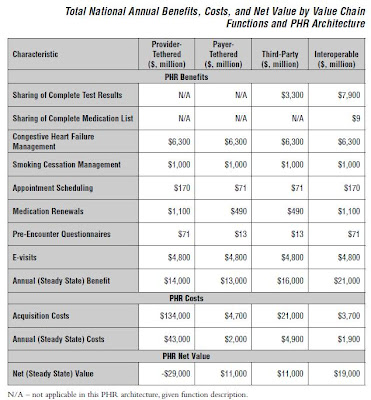
Four of these functions contribute 95% of the value: Sharing of complete test results ($7.9); Congestive heart failure management ($6.3), e-Visits ($4.8), and Medication renewals ($1.1).
The annual steady state net value for the Interoperable architecture comes in tops at $19 billion, followed by Third-Party and Payer-tethered at $11 billion with Provider-tethered trailing at a whopping negative $29 billion.
So what are the strategic implications for Healthcare Organizations (HCO's)?
Many thanks to Blackford Middleton and CITL for permission to reproduce excerpts from the report.
Architectures
CITL's full report evaluated four different PHR architectures: 1) Provider-tethered, 2) Payer-tethered, 3) Third party and 4) Interoperable.
Tethered architectures refer to providers or payers providing the data integration to the PHR. The Third Party architecture refers to manual aggregation of health information but without the ability to integrate back to the clinical and administrative systems "in their native formats". In the Interoperable architecture, patient information flows into the PHR using standards based health information exchange from sources throughout the region and from there can be machine interpreted by the clinical and administrative systems.

Costs
The Provider-tethered architecture provides a limited view of the patient, compared to an interoperable regional approach. This architecture also requires a very large number of implementations to support 80% PHR adoption:
- Provider - 26,000
- Payer - 706
- Third Party - 3
- Interoperable - 428
The number of implementations is a major factor driving the total national installation costs.


Savings
The CITL value chain model is used to estimate the value of the PHR functions including:
1. Information Sharing
1a. Complete Test results
1b. Complete Medication lists
2. Information Self-management
2a. Congestive Heart Failure Management
2b. Smoking Cessation Management
3. Information Exchange 3a. Appointment Scheduling
3b. Medication Renewals
3c. Pre-Encounter Questionnaire
3d. e-Visits

Four of these functions contribute 95% of the value: Sharing of complete test results ($7.9); Congestive heart failure management ($6.3), e-Visits ($4.8), and Medication renewals ($1.1).
The annual steady state net value for the Interoperable architecture comes in tops at $19 billion, followed by Third-Party and Payer-tethered at $11 billion with Provider-tethered trailing at a whopping negative $29 billion.

News Analysis
So what are the strategic implications for Healthcare Organizations (HCO's)?
- HCO's won't be able to carry this on their shoulders - - the costs are prohibitive.
- HCO's will need to ensure that their clinical and administrative systems can interoperate using national standards and can participate in regional health information exchange initiatives.
- HCO's should look to collaborate and invest in PHR's that are building towards an interoperable standards-based technology platform and are able to connect with multiple providers in the region.
- HCO's will need to develop strategies which distinguish between the 1) Personal Health Record (patient-centered) and 2) the portals which connect the HCO to the patient/consumer (HCO-centered).
Many thanks to Blackford Middleton and CITL for permission to reproduce excerpts from the report.
Subscribe to:
Posts (Atom)





