The New York Academy of Medicine and the National Coalition on Care Coordination (N3C) have released their report on the Promise of Care Coordination. Lead author Dr. Randall Brown reviewed best practices among 20 care coordination programs nationally focusing on the chronically ill. His work on care coordination and disease management includes leading two recent evaluations of demonstrations funded by the Centers for Medicare & Medicaid Services, resulting in four reports to congress on these programs’ effects on service use, costs, quality of care, and patients’ and physicians’ satisfaction with care.

Randy Brown graciously took the time to sit down with Healthcare Technology News to discuss his findings regarding "
Models that Decrease Hospitalizations and Improve Outcomes for Medicare Beneficiaries with Chronic Illnesses" (links here to
executive summary and
full report).
HTN: Many physicians all share one common complaint: that the way care is delivered today is incredibly fragmented. Can you give us some idea of the magnitude of the problem?
Randy Brown: Mai Pham, a colleague of mine at a Mathematica subsidiary, the Center for Health Care Strategies, has done some very interesting work that illustrates the difficult, seemingly impossible, task that physicians face in trying to coordinate the care of their patients. First, she showed that the typical (median) Medicare beneficiary with chronic illnesses saw 7 different physicians during the course of a year. This does not include non-MD medical professionals at skilled nursing facilities or home health agencies who treated the patient. We have done some work of our own and found even higher numbers of physicians seeing a given patient with Congestive Heart Failure (CHF), Coronary Artery Disease (CAD), or diabetes—our estimate was 12 physicians. Gerry Anderson at Hopkins had a similar estimate.
Dr. Pham also looked at it from the doctor’s perspective across the full case load they have and found some startling numbers—her research showed that the median number of different physicians seen by a given physician’s Medicare patients during the course of a year is 229. That means
a typical physician would need to coordinate with 229 different physicians during the course of a year (just for their Medicare patients), with many of these requiring multiple contacts because they see the physician’s patients multiple times throughout the year.
These hard data illustrate just how fragmented care is, and what a monumental task it would be for physicians to coordinate it on their own.
HTN: You looked at many different models to coordinate care. What were the keys to success? Randy Brown: Across a range of rigorous studies we examined or conducted ourselves, we found some common features among the most successful programs. Most of our inferences were drawn from about 20 demonstration programs we have evaluated. Unsuccessful programs also had some of these features, but not all of them, and in some cases didn’t implement them as intensively. Here’s what we found: First, in the successful programs the care coordinators saw patients in-person fairly frequently—about once a month actually—in addition to telephonic contacts. Second, the successful programs targeted people with a substantial risk of hospitalization in the coming year. Third, care coordinators were co-located with the patients’ primary physicians, so they knew and trusted each other, and had frequent opportunities for interacting informally and exchanging information on a patient. Fourth, the successful programs tried to assign the same care coordinator to all of a physician’s patients in the program, to minimize the number of different people the physician had to interact with, and to build trust and familiarity. Fifth, the most effective programs had timely information on when patients were admitted to a hospital, so they could quickly begin working on the new needs the patient would have and capitalize on the learning opportunity presented by the crisis that got them admitted to the hospital. Sixth, the most effective models had the most well-designed and implemented patient education interventions of the programs we evaluated. And last but not least, the two most successful programs were (with one exception) the only ones out of 12 programs for which we had survey data for which the proportion of treatment group patients reporting someone had taught them how to take their medications correctly was significantly higher than the proportion of the corresponding control group reporting they received such guidance.
HTN: What were some of the metrics that defined success?Randy Brown: We defined “success” as a program that reduced hospitalizations or reduced Medicare expenditures, over a followup period of at least one year. We did not count as successes programs that only improved clinical indicators or patient satisfaction. While these types of improvements are obviously important, settling for only those types of gains would be setting the bar too low. We can and we should reduce the high rate of preventable hospitalizations.
HTN: What innovations did you find in the enabling technologies that seem promising?Randy Brown: Actually, we found nothing in the way of technologies that distinguished successful from unsuccessful programs. That’s not to say that having EMRs or PHRs would be a waste of money; clearly, it would be helpful for all providers to be able to see a patient’s test results and recent visits and other physicians’ notes about the patient. But it wasn’t the factor that distinguished the successful and unsuccessful programs in our studies or others I’ve seen. That may be because few of the programs really had strong EHRs.
Some of the programs used heart monitors or home reporting devices for some of their patients. But again, we found no strong association between such innovations and outcomes. Other unpublished work I’ve seen suggests that there may be some potential there, but it remains to be proven in rigorous trials.
HTN: What are the possibilities and limitations of the Patient Centered Medical Home?
Randy Brown: Medical homes have a number of features that we find are associated with successful care coordination—in-person contacts between care coordinators and patients, co-location of care coordinators and patients’ physicians, and care coordinators potentially having access to timely information on when patients are admitted to a hospital or emergency room. But two issues could limit their effectiveness. First, medical homes will need to reflect some of the other lessons learned about what constitutes effective care coordination as well, like the need for a strong educational intervention (especially around how to take their medications properly), effective monitoring of patients between office visits, a patient-centered focus, teaching patients (and/or their caregivers) how to self-manage their care, effective care planning, and availability of social supports to identify and address problems of depression, isolation, and unmet needs for basic goods and services like transportation or food. Yet these are not required features of a medical home. And even if they were, practices need to know how to implement these factors into their medical home interventions in ways that will be both efficacious and efficient. The second major problem with medical homes as currently designed is targeting. Practices participating in CMS’s medical home demonstration will receive monthly fees for virtually all of their Medicare patients. While all patients should have a usual source of care, many do not need the medical home level of intensity. The diffusion of effort and payment makes it virtually certain that the intervention will not generate net savings, and may not even generate some gross savings in Medicare expenditures before fees. It would seem to be more important to focus efforts and resources on the 20 percent or so of patients who really are at high risk of hospitalization, and really need a medical home level of engagement. That could be made clear to practices by restricting medical home payments to patients who met those criteria (and making that rate higher than the highest of the 4 categories currently planned).
HTN: There are so many physicians practicing in small groups that are challenged to coordinate care. What do they do?Randy Brown: Good question. About 45 percent of all physicians in the country practice solo or with one other physician. There’s no way they have the scale of operations to meet the criteria to be a medical home on their own, or to provide care coordination services, which are not covered by Medicare. But if a tightly defined care coordination benefit were covered by Medicare, they could get such services for their patients from a local hospital, academic medical center, home health agency, or clinic that decided to offer such a program to any patient in the community who met the eligibility criteria. North Carolina has a program like this.
HTN: Tell us about CMS’s Care Transitions Project.Randy Brown: This new project was just announced by CMS a few weeks ago, on April 13. Essentially, the QIOs (Quality Improvement Organizations) are tasked with providing assistance to 14 communities around the country to help them reduce their hospital readmission rates, and improve transitions between various types of settings (hospitals, nursing facilities, rehab hospitals, home health care). Nationally, 18% of all Medicare beneficiaries who are admitted to a hospital are readmitted within 30 days after discharge, and three-fourths of these readmits are for preventable reasons. Patients are discharged to home not fully understanding the self-care they are supposed to practice, their new medication regimen, the diet they are supposed to adhere to, what activity level is recommended for them and when they can increase it, symptoms that could indicate a possible problem for which they should be seen immediately, or the importance of making and keeping a followup appointment. At the time they are discharged, they and their family caregivers are confused and bombarded with information, of which they often absorb very little. Transitional care programs, such as those developed by Mary Naylor at University of Pennsylvania school of nursing or Eric Coleman at the University of Colorado, are designed to help patients overcome these problems. They’ve been shown to be very successful in reducing readmissions for patients with chronic illnesses, in well-designed clinical trials.
The idea of the Care Transitions program is to help communities develop solutions that address the factors that lead to high hospital readmissions in their own environment—it’s not a one-size-fits-all solution across the country. The QIO’s will have Care Transitions experts in each of the 14 communities who will organize these efforts. While this idea might not have been too attractive to hospitals in the past, because it would result in lost revenue from those readmissions, President Obama has proposed new rules that would no longer reward hospitals for unplanned readmissions. So the Care Transitions program may be considerably more attractive to hospitals now. You can learn more about it at the
Care Transitions website.
HTN: You make the point that not only are readmissions a problem, but in many cases so are the original admission. How significant an opportunity is there for improvement?Randy Brown: Many of the hospitalizations for patients with chronic illnesses like CHF, CAD or Chronic Obstructive Pulmonary Disease (COPD) are preventable if patients received better care and more appropriate medications, and adhered better to their physician’s prescribed regimens for diet, exercise, medications and self-care. The proportion of hospitalizations that are preventable (they’re also called ambulatory sensitive conditions, because they are sometimes attributable to inadequate ambulatory care) is high, and varies across conditions. For Congestive Heart Failure, half of all hospital admissions are considered potentially preventable. Efforts to reduce preventable hospitalization across a range of conditions may be especially cost-effective as beneficiaries who had such events accounted for about 17% of all Medicare reimbursement for inpatient, outpatient, and physician services in one 1998 study (Culler, Parchman, and Przybylski). So there is substantial opportunity for reductions in these admissions among patients with serious chronic conditions, without having to wait for one to occur before you intervene. To give you another feel for the potential, we found when looking at the most successful programs in the Medicare Coordinated Care demonstration that hospitalizations for patients with heart disease were reduced by 17 percent, with essentially none of the this reduction being due to lower rates of short term readmissions.
HTN: Does talk of care coordination paper over a deeper problem with our care delivery organization and incentives?Randy Brown: Yes, it seems pretty clear that our systems are not designed to encourage providers to minimize the need for expensive procedures. Rewards to providers are proportional to the amount of services they provide, rather than the quality and efficiency of the care they deliver. Notice that I said quality and efficiency of care—there are a number of fairly new pay-for-performance efforts out there that reward providers for improved quality, as measured by things like the proportion of their patients receiving preventive care. While improving such indicators is a good thing, it doesn’t focus on coordinating care to reduce the need for hospitalizations, which is the more urgent need and the only focus that is likely to start reducing the rate of growth of medical costs in the near term. And the example I mentioned above concerning hospitals being a bit wary of big efforts to reduce readmissions is another illustration of perverse incentives in our system. Fortunately, incentives can be changed to increase payments to providers whose patients use relatively low levels of expensive services while maintaining or improving the quality of care and patient well-being, and decreasing payments to providers whose patients use relatively high levels of such services. These payments would have to account for differences in severity of illness and comorbidities across providers, but a variety of methods for doing that exist. CMS is funding some research now to lay the groundwork for such payment methods and to disseminate information to physicians about the Medicare cost per episode of care for their own patients relative to that for similar patients seen by other physicians in the same geographic area, and to that of physicians nationally. It will be interesting to see how physicians respond to this information—they’ve never had such feedback before.
We clearly need multiple approaches to address the problems we have; there’s no single magic bullet.
HTN: It seems so obvious that “high touch” methods would be important to patient outcomes. Why is it so rarely used? And how do these best practice high touch methods differ from the services offered by disease management companies?Randy Brown: High touch care requires a lot of labor, and labor is expensive. The nursing shortage has exacerbated the problem—experienced nurses are hard to find and costly. In our study of 15 Medicare Coordinated Care demonstration programs we found that the programs in which the care coordinators had the most frequent in person contacts tended to be the ones with the largest reductions in hospitalizations. They averaged nearly 1 in person contact per patient per month. That is in stark contrast to the almost solely telephonic contacts by most disease management companies. Those programs have long claimed that they generate large reductions in hospitalizations. Nearly all of those claims are based on deeply flawed studies. When we conducted randomized trials of these disease management programs for Medicare, we found no effects on hospitalizations for any of them. The lack of in person contacts means that the patients tend not to take the care coordinator that seriously, or trust them. It’s just a disembodied voice at the other end of the line. While the patients love the attention, the nurse care coordinator may not be getting their message across. Care coordinators whose only contact with patients is telephonic can’t see the patients’ faces or body language, to see whether they are really grasping the message; they can’t observe loose rugs in the house or the absence of grab bars in the shower or the stock of junk food on the counter or the sallow skin of a decompensating patient; and maybe most importantly, they can’t establish that trust that comes from face to face contact with a medical professional who actually lays hands on them. So the high touch approach is the only one that really seems to be effective, but it isn’t cheap. That’s why one of the biggest challenges for care coordination programs is to learn how to generate more efficiently the favorable impacts we’ve seen in the most effective programs. Since one of our goals has to be to generate some net savings for Medicare and other payers, it isn’t enough to reduce hospitalizations—we have to be able to do it in a cost-effective manner. That will require triaging patients by their level of need for intensive care coordination, and possibly discharging some; using in person contacts enough to produce the savings while not relying too heavily on them over time for all patients; and investigating the use of lower cost staff, such as LPNs and social workers for some of the care coordination work.
BioRandall S. Brown (Ph.D. Economics, University of Wisconsin) is a Vice President and Director of Health Research at Mathematica Policy Research in Princeton, NJ. Over the past 25 years, Dr. Brown has designed and led evaluations of some of the nation’s largest demonstration programs in both care coordination and long term care. He is currently leading several ongoing studies of these programs to develop lessons about how to improve outcomes for Medicare beneficiaries with chronic illnesses. In the long term care area, he led the evaluation of the Cash and Counseling Demonstration, for which he and his MPR colleagues won the AcademyHealth 2009 Impact Award. He currently is Principal Investigator for the Money Follows the Person program evaluation. His most prominent earlier work includes leading large-scale evaluations of the Medicare managed care program, the expansion of Medicaid benefits to low-income families, and the National Channeling Demonstration.

 Wall Street Journal reports on an "affordable fix for modernizing medical records", the VA's Vista system.
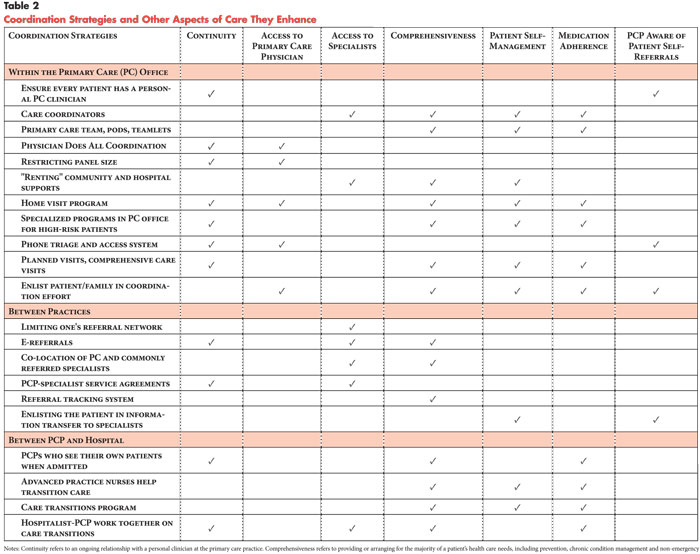 Coordination of Care by Primary Care Practices: Strategies, Lessons and Implications reports that "while there was no single recipe for coordination ... some cross-cutting lessons were identified, such as the value of a commitment to interpersonal continuity of care as a foundation for coordination." Medical home initiatives "if aligned with payment incentives ... have the potential to increase quality and satisfaction among patients and providers by helping to move the health care delivery system toward better coordinated care."





