
Showing posts with label NCVHS. Show all posts

Thursday, May 7, 2009

The Week in Review - May 7, 2009

AHRQ reports on "Innovations in Using Health IT for Chronic Disease Management" across a portfolio of health IT applications including clinical decision support, health information exchange, telehealth and hospital information systems. "We found no dominant technology application... The portfolio demonstrates that a variety of health IT applications have the potential to transform the quality and safety of care for some of the Nation’s most severely ill patients. Despite several challenges associated with developing and implementing health IT for chronic disease management, information technology can be used to improve clinical processes. Technology also can facilitate better knowledge sharing and support improved communication and coordination across care settings."

NCVHS hears from leaders on the definition of meaningful use including physicians, the Markle Foundation (and 60 supporting organizations), Agency for Healthcare Research and Quality (AHRQ), College of Healthcare Information Management Executives (CHIME), American Medical Informatics Association (AMIA), HIMSS and a broad range of other industry leaders. Carolyn Clancy, AHRQ Director, says that healthcare organizations should prepare now by using health registries to manage the health information of patients with chronic diseases.

Wall Street Journal reports on an "affordable fix for modernizing medical records", the VA's Vista system.

Dr. David Blumenthal, National Coordinator for Health IT, believes that healthcare technology has not advanced sufficiently "when left exclusively to the private sector, so there is a public role."

American Public Media's Markeplace reports that investment in "health care information technology is holding its own. Investors are following the $20 billion in President Obama's stimulus plan to upgrade and modernize health records."

The Use of Health IT in Crisis Control interviews Dr. Nathaniel Hupert, Director of The Preparedness Modeling Unit for The Centers for Disease Control and Prevention (CDC) and Associate Professor of public health and medicine at Weill Cornell Medical College.
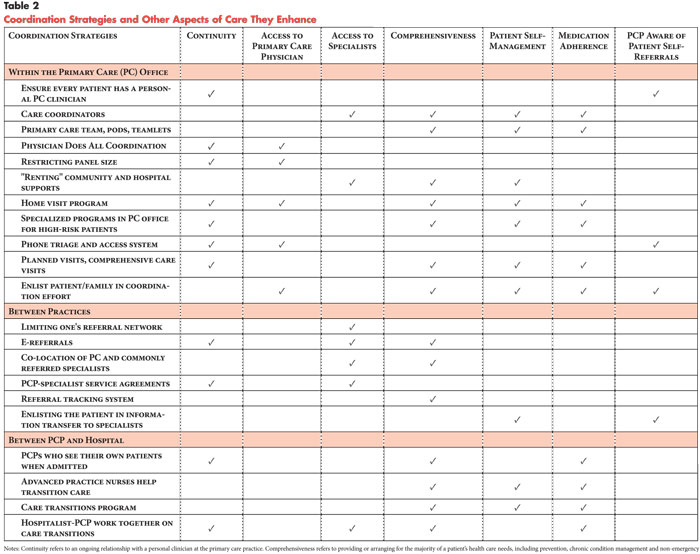

Coordination of Care by Primary Care Practices: Strategies, Lessons and Implications reports that "while there was no single recipe for coordination ... some cross-cutting lessons were identified, such as the value of a commitment to interpersonal continuity of care as a foundation for coordination." Medical home initiatives "if aligned with payment incentives ... have the potential to increase quality and satisfaction among patients and providers by helping to move the health care delivery system toward better coordinated care."

Archives of Internal Medicine reports that "computerized medication reconciliation tool and process redesign were associated with a decrease in unintentional medication discrepancies with potential for patient harm. Software integration issues are likely important for successful implementation of computerized medication reconciliation tools."

Health Care Policy and Marketplace Review has maintained a laser focus on the need for healthcare reform to result in real savings. In his latest post, Bob Laszewski contends that "health care reform means fixing the system so we stop spending/wasting so much more than every other industrial nation on health care thereby making our system more affordable and effective." In earlier posts, he referenced two December 2008 CBO reports on the potential savings associated with various reform programs: Key Issues in Analyzing Major Health Insurance Proposals and Budget Options Volume 1 Health Care. "If the CBO just rolls over and lets Congress make up excuses just to spend more for health care we will not have reform--we will only have a bigger fiscal disaster on our hands. How do you reform entitlements by pretending?"

The AMA announces initial partner agreements to provide a secure AMA portal offering a variety of practice management services.

Computer modeling predicts the spread of swine flu. One of the algorithms is rooted in human contact models derived from Where's George? which tracks the passage of one dollar bills from person to person.

HealthMap provides a global disease alert map, including tracking of swine

Thursday, April 30, 2009

The Week in Review - April 30, 2009

In a report to the SAS Healthcare and Life Science Executive Conference, John Halamka contends that there are many challenges for the implementation and use of the EHR's nationally. "First, there is not a single set of standards for identifying medical information, meaning physicians, insurers, pharmacists and others involved would have trouble communicating with each other electronically... At the same time, technology needs to be developed to maximize ease of use for physicians... 'Putting servers and exchanges into doctors offices is not going to work,' Halamka said, suggesting a better model is using regional health-care information technology centers that use cloud computing systems to work with doctors."

Nothing like the threat of a pandemic... The Senate (finally) confirms Kathleen Sebelius for Secretary of Health and Human Services. The Wall Street Journal reports that "she was sworn in hours later and quickly went to work on the swine-flu outbreak... She'll also guide a health-care overhaul that the White House and Congress are pledging to enact this year."

Joseph Conn reports on the NCVHS hearing on meaningful use. "The NCVHS got a lot more to chew on—a daylong discourse on the ills of the nation’s healthcare system and a broad overview of what role health information technology might play in healthcare reform." Article at Modern Healthcare (subscription required).

NPR's On Point features the push for e-Health records, the concerns about doctor-patient privacy and the costs to implement these systems.

Business Week features the Dubious Promise of Digitial Medicine. Business Week reports that "industry leaders are pushing expensive systems with serious shortcomings, some doctors say. The high cost and questionable quality of products currently on the market are important reasons why barely 1 in 50 hospitals has a comprehensive electronic records system..."

Diagnosis: Inaccuracy - - Boston Globe editorial on the use of billing codes as clinical content in the PHR. And a summary of editorials on electronic health records from the AMA.

Friday, November 21, 2008

The Lighter Side of NCVHS

So who says that the complex and important work of the National Committee on Vital and Health Statistics (NCVHS) can’t also be light-hearted?

The following are transcript excerpts from the NCVHS full committee meeting on September 16-17, 2008. The award for the best one-liner goes to Larry Green, University of Colorado.


MR. REYNOLDS: … I would ask that if you have any conflicts of interest related to any issues coming before us today would you please so publicly indicate during your introduction. I have no conflicts.

** A number of other participants introduce themselves having no conflicts. **

MS. MCCALL: Carol McCall. I am with Humana, member of the committee, no known conflicts.

MR. HOUSTON: No known conflicts, you sound like an attorney. John Houston, University of Pittsburg, and member of the committee, no known conflicts either.

.....

DR. MIDDLETON: I think we are allowed three newbie questions right?

MR. REYNOLDS: No, you are not new anymore Blackford. If you go back and read the early minutes of today's meeting you are no longer new.
.....

MS. TRUDEL: … Both of those standards underwent significant revision as a result of the first round of pilots and we are very much hoping that both or at least one of them will be in a place where we can move forward.

MR. REYNOLDS: Let me just volunteer a comment: Hot dog that is great!

..…

DR. TANG: The other piece is data. … Data might be the third dimension to this matrix and I think it will relate very tightly to the data stewardship presentation … How does NCVHS with it's policy focus and data middle name fit into this matrix? …

MR. REYNOLDS: Did all of you notice that since Paul's part of the committee that he is now given the committee a middle name? I am not sure we have adopted that yet, but we have noted that the comment was made.

..…

MR. WALLEN: … you've beaten the PHR and the EHR to death, and so I won't go into any of that.

MR. BLAIR: But you noticed they're not dead yet.

..…

DR. GREEN: I'd like to ask a two-part question. One is in this area, the personal health record, what's going on in mental health? Secondly, with your example, when you are sequestering information that say relates to mental health, depression, you don't know you're depressed, the way you use SNOMED to search the record for this, could you say a little bit more about how you actually managed to succeed in sequestering the fact that this person has depression given that that word might appear in a lot of places?

DR. CARR: Can you speak up, Larry?

MS. GREENBERG: Could you speak up a bit?

DR. GREEN: I could, but I'm finished.

..…

DR. FRANCIS: … it's actually possible to identify some categories of sensitive information, and do it in a quite fine-grained way which I think is nifty. …

MS. GREENBERG: “Nifty” is in fact the correct technical term.

..…

DR. CARR: … the next one is data integrity. I know that's a word that Bill always struggles with, but it's really a statistical concept not an ethical one.

..…

DR. STEINDEL: … we need the one-page picture, and we ought to look at it that way.

MS. MCCALL: I'm in just ecstatic agreement.

..…

** The meeting continues the next morning with another round of introductions. Everyone says “no conflicts”, until: **

MR. HOUSTON: John Houston, University of Pittsburgh Medical Center, member of the Committee, and no conflicts, no known conflicts.

MS. MCCALL: In his subconscious there are many. Carol McCall, Humana, member of the Committee, no conflicts.
