by John Halamka, Life as Healthcare CIO
Doug Fridsma and I were asked to brief the HIT Policy Committee about the current activities of the HIT Standards Committee, ensuring coordination as we all work to finalize Meaningful Use Stage 2.
We used this presentation, which covers three major themes:
*Meaningful Use Stage 2 gap analysis work
*The Standards Summer Camp Activities
*The Standards and Interoperability Framework activities
Doug started by reiterating the guiding principles of the HIT Standards Committee which essentially translate into
"We will select no standard before its time"
Doug reflected on the way we select standards, assigning each requirement to one of four "buckets"
a. Functional criteria only – no standards are needed
b. Sufficient standards and implementation guides are available
c. Existing standards are available but not implementation guides
d. No standards or implementation guides are available
He discussed early work to place proposed Meaningful Use Stage 2 policy goals into these 4 buckets.
Since many of the Stage 2 goals will not have supporting standards and implementation guides in time for the regulations, it's like that some of stage 2 will be described using functional criteria and not standards. What does that mean? Here's an example
Electronic medication administration records (EMAR) are unlikely to require a specific bar code format. Instead, it will be sufficient to require that a certified application be capable of 5 functions
*Generate alert for wrong patient
*Generate alert for wrong medication
*Record the dose and route
*Record the provider administering the medication
*Record the time/date the medication was administered
Implementation details will be left to the creativity of the marketplace.
I described the Standards Summer Camp schedule and offered updates on
• Metadata
• Patient Matching
• ePrescribing
• Surveillance Implementation Guide
• NwHIN
Doug completed the presentation by describing the Standards and Interoperability Framework Projects
*CDA consolidation
*Transitions of Care
*Lab Results reporting
*Provider directories
*Distributed query (Using a web browser to query multiple databases such as is done with Shrine/I2B2 )
We took questions from the committee including how best to develop drug/drug interaction standards, how the policy committee can best work with the standards committee by providing requirements early and often, and how we can all plan for the future of stage 3.
A great meeting!
Showing posts with label HIT Policy Committee. Show all posts
Showing posts with label HIT Policy Committee. Show all posts
Thursday, July 7, 2011


Tuesday, December 7, 2010
Quality Measures Workgroup Seeks Comment on Clinical Quality Measures Concepts for Stage 2 and Stage 3 Meaningful Use
by David Lansky Chair of the Quality Measures Workgroup
The HIT Policy Committee (a federal advisory committee that advises the U.S. Department of Health and Human Services) formed the Quality Measures Workgroup to recommend new clinical quality measures to leverage the evolving health IT infrastructure. The Quality Measures Workgroup is developing recommendations on clinical quality measures for Stage 2 and Stage 3 Meaningful Use. The Workgroup was divided into five tiger teams to focus on the following measure domains: Patient and Family Engagement, Clinical Appropriateness / Efficiency, Care Coordination, Patient Safety, and Population and Public Health.These domains are broadly aligned with the National Priorities Partnership Framework for health quality, and the five pillars of Meaningful Use – improving safety, quality, efficiency, and health disparities; engaging patients and families; improving care coordination; improving population health; and ensuring adequate privacy and security protections.
The tiger teams proposed important measure concepts for each of their domain areas. The teams then presented these recommendations in a report, “Tiger Team’s Summary Report,” which was submitted to the Quality Measures Workgroup on October 28, 2010.
After reviewing the tiger teams’ recommendations, the Workgroup revised and consolidated the measure concepts and now requests public comment on the measure concepts proposed within this document: Measure Concept List [XLS - 28KB]. The Workgroup requests general comments and specific examples of measures for each measure concept that fit the following criteria:
- HIT-sensitive—Capable of being built into electronic health record (EHR) systems with implementation of relevant health IT functions (e.g., clinical decision support) that result in improved outcomes and/or clinical performance.
- Parsimonious—Applies across multiple types of providers, care settings and conditions.
- Demonstrates preventable burden—Supports potential improvements in population health and reduces burden of illness.
- Assesses health risk status and outcomes—Supports assessment of patient health risks that can be used for risk adjusting other measures, and assessing changes in outcomes, including general cross-cutting measures of risk status and functional status and condition-specific measures.
- Longitudinal—Enables assessment of longitudinal, condition-specific, patient-focused episodes of care.
Comments to the workgroup can be submitted at the following link: https://www.altarum.net/survey/qmrfc.aspx  . Comments will be accepted until December 23, 2010. For a more detailed description of each measure concept, please see the following attachment, Measure Concept List – Detailed Descriptions [PDF - 105 KB] .
Your comments will inform the work of the HIT Policy Committee in supporting the development of HIT-sensitive clinical quality measures; these comments are important to shaping public policy on the future of e-measure development. Your responses are greatly appreciated.
Thank you.
David Lansky, Chair
Quality Measures Workgroup
Wednesday, September 9, 2009
EHR Certification and Transition Steps Defined
On September 3, the Certification Commission for Healthcare Information Technology (CCHIT) unveiled their plans for certification under ARRA. CCHIT plans two program concepts: 1) comprehensive certification which meets or exceeds federal standards and and 2) modular certification related to security, privacy and interoperability meeting federal standards.
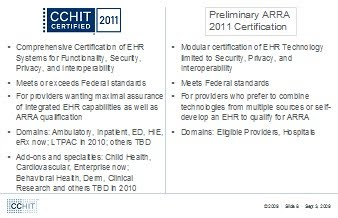 Federal standards for HHS Certification will mean that a system meets the "minimum government requirements for security, privacy, and interoperability, and that the system is able to produce the Meaningful Use results that the government expects." HHS Certification will not be a 'seal of approval' nor an indication of the relative value of systems.
CCHIT's action were in response to ONC's Certification and Adoption Workgroup recommendations presented at the August 14 HIT Policy Committee meeting.
The Certification and Adoption Workgroup's recommendations include:
Unlike CCHIT today, certification criteria should be established independently of the organizations performing the certification. Multiple certification organizations will be allowed to perform testing after they become accredited. Vendors need certification from any one testing organization.
Wes Rishel (Gartner) has argued that "when the choice of certifiers is made only by the vendor, not the organization that relies on the certificate, this creates an inevitable pressure to be the certifying organization that is the least thorough in its process"... "Arguably, if physicians could chose the certifying organization they would not pick the one with weakest accreditation. After all, they have to live with and use the product. But under the “any certifying organization will do” approach, this is not the option that will be presented to physicians. They will be asked to choose among products each of which is rated by several organizations, some of which are focused on the baseline requirements for certification and others of which use any number of criteria for judging products."
As such, accreditation is a lynch pin in the Workgroup's recommendations to "insure that multiple certification entities use identical criteria and provide a 'level playing field' so that all certification organizations offer the same level of scrutiny."
HHS Certification would also serve as qualification for the Stark exception.
Providers would be allowed to achieve meaningful use through use of certified components.
In one sure-to-be-controversial recommendation, the Workgroup recommended that the “lock down” requirements of EHR software should be removed to address concerns of the Open Source community.
Self-developed software may also be certified, on a site by site basis.
The certification transition "includes a concept of 'Preliminary HHS Certification' so that vendors, who take a risk on the content of the final regulations, can be ready as quickly as possible when final regulatory approval is obtained" which should be valid through 2011."
"This certification is called “preliminary” because the meaningful use criteria and the certification criteria will not yet have completed their paths through the regulatory process.
When the regulatory process is completed for Meaningful Use, presumably in early 2010, then, if necessary, establish a short “regulatory gap certification” for any necessary changes from preliminary certifications. After completing this “regulatory gap certification”, the National Coordinator should certify those products as qualifying under the statute, with a goal of having HHS Certified products in the marketplace in early 2010."
"For vendors who already completed CCHIT 2008 certification, we recommend providing an optional shorter, expedited process. Request that CCHIT submit, as soon as possible, a proposal for “2008 Gap Certification,” which will apply only to vendors who already completed 2008 Certification. The 2008 Gap Certification must cover any missing privacy capabilities (e.g., audit trails, consent) required by statute It must also cover capabilities for Meaningful Use, and expanded interoperability capabilities. Once approved by ONC, the completion of 2008 Gap Certification should also qualify products for “Preliminary HHS Certification.” Those products will be required to complete the “Regulatory Gap Certification Process” before the National Coordinator similarly certifies those products. Working with CCHIT and the Policy Committee, the ONC should investigate whether similar gap certifications are appropriate for products that achieved 2007 certification."
Federal standards for HHS Certification will mean that a system meets the "minimum government requirements for security, privacy, and interoperability, and that the system is able to produce the Meaningful Use results that the government expects." HHS Certification will not be a 'seal of approval' nor an indication of the relative value of systems.CCHIT's action were in response to ONC's Certification and Adoption Workgroup recommendations presented at the August 14 HIT Policy Committee meeting.
The Certification and Adoption Workgroup's recommendations include:
- Focus Certification on Meaningful Use
- Leverage Certification process to improve progress on Security, Privacy, and Interoperability
- Improve objectivity and transparency of the certification process
- Expand Certification to include a range of software sources: Open source, self-developed, etc.
- Develop a Short-Term Certification Transition plan
Unlike CCHIT today, certification criteria should be established independently of the organizations performing the certification. Multiple certification organizations will be allowed to perform testing after they become accredited. Vendors need certification from any one testing organization.
Wes Rishel (Gartner) has argued that "when the choice of certifiers is made only by the vendor, not the organization that relies on the certificate, this creates an inevitable pressure to be the certifying organization that is the least thorough in its process"... "Arguably, if physicians could chose the certifying organization they would not pick the one with weakest accreditation. After all, they have to live with and use the product. But under the “any certifying organization will do” approach, this is not the option that will be presented to physicians. They will be asked to choose among products each of which is rated by several organizations, some of which are focused on the baseline requirements for certification and others of which use any number of criteria for judging products."
As such, accreditation is a lynch pin in the Workgroup's recommendations to "insure that multiple certification entities use identical criteria and provide a 'level playing field' so that all certification organizations offer the same level of scrutiny."
HHS Certification would also serve as qualification for the Stark exception.
Providers would be allowed to achieve meaningful use through use of certified components.
In one sure-to-be-controversial recommendation, the Workgroup recommended that the “lock down” requirements of EHR software should be removed to address concerns of the Open Source community.
Self-developed software may also be certified, on a site by site basis.
The transition
The certification transition "includes a concept of 'Preliminary HHS Certification' so that vendors, who take a risk on the content of the final regulations, can be ready as quickly as possible when final regulatory approval is obtained" which should be valid through 2011."
"This certification is called “preliminary” because the meaningful use criteria and the certification criteria will not yet have completed their paths through the regulatory process.
When the regulatory process is completed for Meaningful Use, presumably in early 2010, then, if necessary, establish a short “regulatory gap certification” for any necessary changes from preliminary certifications. After completing this “regulatory gap certification”, the National Coordinator should certify those products as qualifying under the statute, with a goal of having HHS Certified products in the marketplace in early 2010."
"For vendors who already completed CCHIT 2008 certification, we recommend providing an optional shorter, expedited process. Request that CCHIT submit, as soon as possible, a proposal for “2008 Gap Certification,” which will apply only to vendors who already completed 2008 Certification. The 2008 Gap Certification must cover any missing privacy capabilities (e.g., audit trails, consent) required by statute It must also cover capabilities for Meaningful Use, and expanded interoperability capabilities. Once approved by ONC, the completion of 2008 Gap Certification should also qualify products for “Preliminary HHS Certification.” Those products will be required to complete the “Regulatory Gap Certification Process” before the National Coordinator similarly certifies those products. Working with CCHIT and the Policy Committee, the ONC should investigate whether similar gap certifications are appropriate for products that achieved 2007 certification."
Tuesday, June 16, 2009
Meaningful Use: "It's not about the HIT"
The HIT Policy Committee Meaningful Use Workgroup presented today its vision and recommendations for meaningful use of electronic health records.
Here's an 'early look' at the draft meaningful use criteria presented by co-chairs Paul Tang and Farzad Mostashari. Paul Tang emphasized the focus on "patient-centeredness" and quality, saying "It's not about the HIT".
The workgroup has also published a more detailed meaningful use matrix with the roadmap through 2015. The progression starts with a focus on information capture and sharing in 2011. By 2013, meaningful use is expanded to include advanced care processes with decision support and by 2015 is expanded to embrace improvements in outcomes.


Here's an 'early look' at the draft meaningful use criteria presented by co-chairs Paul Tang and Farzad Mostashari. Paul Tang emphasized the focus on "patient-centeredness" and quality, saying "It's not about the HIT".
The workgroup has also published a more detailed meaningful use matrix with the roadmap through 2015. The progression starts with a focus on information capture and sharing in 2011. By 2013, meaningful use is expanded to include advanced care processes with decision support and by 2015 is expanded to embrace improvements in outcomes.


Monday, February 2, 2009
$23 Billion HITECH Stimulus: Senate Debate Kicks Off
The Senate debate kicks off today on the Superbowl of stimulus packages including HITECH, the Health Information Technology for Economic and Clinical Health Act.
It will take a carefully calibrated bi-partisan 60% to get past any Senate filibuster. So what will "careful calibration" look like? Imagine the Steelers' blockers making way for James Harrison's explosive 100 yard interception return. Or imagine the ballet of Santonio Holmes hauling in the winning pass in the far corner of the end zone with 35 seconds to go.

If it passes the Senate, it goes to conference committee to finalize the legislation. We can expect that no changes would be made that risk a Senate challenge to the final bill, like the challenge to a Roethlisberger apparent TD that fell short by 2 inches.
With that in mind, if it passes the Senate we can expect to see many of the following elements in the final bill:
Legislative endorsement for key National Health IT organizations
Financial incentives are tied to "meaningful use" of certified EHR's by physicians and hospitals. "Meaningful use" is defined somewhat circularly in the criteria:
Medicare incentives to hospitals (both carrot and stick) are set up in a similar model as physicians, with a more complex calculation and bigger dollars tied to their meaningful use of certified EHR's. Incentives are calculated based on an initial amount ranging from $2 - 4.6 million (based on number of discharges) multiplied by a Medicare share and a declining "transition factor" for each of four years (1, .75, .5, .25).
Medicaid Incentives
100% federally funded Medicaid incentives are included in the legislation, without back-end reduction in Medicaid fees for non-compliance. Eligible Medicaid physicians are non-hospital based with 30% Medicaid patient volume. Eligible hospitals include 1) children's hospitals, 2) acute care hospitals receiving at least 10% Medicaid patient volume and 3) health centers or rural health clinics with at least 30% Medicaid patient volume.
In a look at the slightly smaller house version of this bill, the Congressional Budget Office (CBO) estimates that $19.8 billion will be spent on HITECH which will, among other things, accelerate adoption of EHR's. The acceleration will deliver US health system net savings of 0.3% betweeen 2011 and 2019, or greater than $60 billion in savings. While this is a good return, 0.3% won't by itself substantially dampen the trajectory of health care spending (see Health Care Costs: A Principal Driver of Long-Term Deficits).
The CBO projects that without the stimulus package "about 45% of hospitals and 65% of physicians will have adopted qualifying health IT in 2019. CBO estimates the incentive mechanism would boost these adoption rates to about 70% for hospitals and about 90% for physicians."
CBO's savings estimates are based on the acceleration of benefits including "reducing the number of inappropriate tests and procedures, reducing paperwork and administrative overhead, and decreasing the number of adverse events resulting from medical errors. Health IT could also improve the quality of care provided to patients by improving the information available to clinicians at the time of treatment, by encouraging the use of evidence based medicine, and by helping physicians manage patients with complex, chronic conditions. The use of health IT could also increase some costs because improved adherence to treatment protocols could increase the amount of care provided."
John Glaser has pointed out that "meaningful use" will need to be clearly spelled out in 2009, leaving only one year for implementation in order for physicians and hospitals to realize the full benefit of the incentive programs. "This is a tall order. And it means that providers should start moving now (if they aren’t already) even though the dust has yet to settle on the specifics."
It will take a carefully calibrated bi-partisan 60% to get past any Senate filibuster. So what will "careful calibration" look like? Imagine the Steelers' blockers making way for James Harrison's explosive 100 yard interception return. Or imagine the ballet of Santonio Holmes hauling in the winning pass in the far corner of the end zone with 35 seconds to go.

If it passes the Senate, it goes to conference committee to finalize the legislation. We can expect that no changes would be made that risk a Senate challenge to the final bill, like the challenge to a Roethlisberger apparent TD that fell short by 2 inches.
With that in mind, if it passes the Senate we can expect to see many of the following elements in the final bill:
Legislative endorsement for key National Health IT organizations
- Office of National Coordinator for HIT (ONCHIT)
- HIT Policy and Standards Committees through the National eHealth Collaborative (aka AHIC Successor) subject to ONCHIT endorsement.
- Standards and certifications bodies: While unnamed, the Health Information Technology Standards Panel (HITSP) and the Certification Commission for Health Information Technology (CCHIT) are likely beneficiaries in support of standards and certification requirements.
- Electronic exchange and the enterprise integration and use of health information, including establishment and governance of the nationwide health information network (NHIN)
- Utilization of an electronic health record for each person in the United States by 2014.
- Privacy and security protections for the electronic exchange of personally identifiable health information
- Security methods for authorization, authentication and encryption of health information
- Use of health information technology in improving the quality of health care, reducing medical errors, reducing health disparities, improving public health, and improving the continuity of care among health care settings.
- Evaluation of open source health information technology systems for "federal safety net providers".
Financial incentives are tied to "meaningful use" of certified EHR's by physicians and hospitals. "Meaningful use" is defined somewhat circularly in the criteria:
- Use of "EHR technology in a meaningful manner" (which for physician incentives shall include the use of e-prescribing).
- Electronic exchange of health information to improve the quality of care such as promoting coordination of care.
- Reporting on clinical quality measures (which shall become more stringent over time).
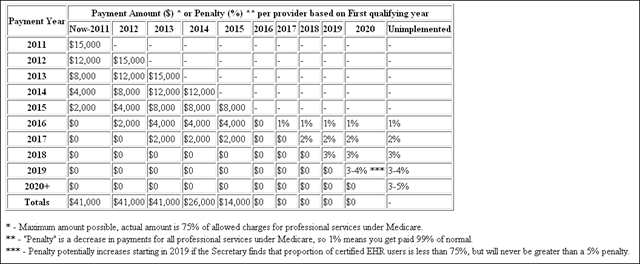
- The Carrot: $41,000 in Medicare payments per eligible physician: Year 1 - $15,000; Year 2 - $12,000; Year 3 - $8,000; Year 4 - $4,000; Year 5 -$2,000. If Year 1 for a professional is 2011 or 2012, then the Year 1 payment is $18,000. No incentive payments if first adopting in 2015. No incentive payments after 2015. Exceptions for rural physicians and later adopters are also specified.
- The Stick: Fee schedule reductions will apply to physicians not using certified EHR technology starting in 2015, with fee schedule reductions of 1% in 2015, 2% in 2016 and 3% in 2017 and beyond.
- These incentives do not apply to hospital-based physicians
- For a summary of this, HISTalk just published a table of bonuses and penalties.
Medicare incentives to hospitals (both carrot and stick) are set up in a similar model as physicians, with a more complex calculation and bigger dollars tied to their meaningful use of certified EHR's. Incentives are calculated based on an initial amount ranging from $2 - 4.6 million (based on number of discharges) multiplied by a Medicare share and a declining "transition factor" for each of four years (1, .75, .5, .25).
Medicaid Incentives
100% federally funded Medicaid incentives are included in the legislation, without back-end reduction in Medicaid fees for non-compliance. Eligible Medicaid physicians are non-hospital based with 30% Medicaid patient volume. Eligible hospitals include 1) children's hospitals, 2) acute care hospitals receiving at least 10% Medicaid patient volume and 3) health centers or rural health clinics with at least 30% Medicaid patient volume.
News Analysis - HITECH's Impact
In a look at the slightly smaller house version of this bill, the Congressional Budget Office (CBO) estimates that $19.8 billion will be spent on HITECH which will, among other things, accelerate adoption of EHR's. The acceleration will deliver US health system net savings of 0.3% betweeen 2011 and 2019, or greater than $60 billion in savings. While this is a good return, 0.3% won't by itself substantially dampen the trajectory of health care spending (see Health Care Costs: A Principal Driver of Long-Term Deficits).
The CBO projects that without the stimulus package "about 45% of hospitals and 65% of physicians will have adopted qualifying health IT in 2019. CBO estimates the incentive mechanism would boost these adoption rates to about 70% for hospitals and about 90% for physicians."
CBO's savings estimates are based on the acceleration of benefits including "reducing the number of inappropriate tests and procedures, reducing paperwork and administrative overhead, and decreasing the number of adverse events resulting from medical errors. Health IT could also improve the quality of care provided to patients by improving the information available to clinicians at the time of treatment, by encouraging the use of evidence based medicine, and by helping physicians manage patients with complex, chronic conditions. The use of health IT could also increase some costs because improved adherence to treatment protocols could increase the amount of care provided."
John Glaser has pointed out that "meaningful use" will need to be clearly spelled out in 2009, leaving only one year for implementation in order for physicians and hospitals to realize the full benefit of the incentive programs. "This is a tall order. And it means that providers should start moving now (if they aren’t already) even though the dust has yet to settle on the specifics."
Subscribe to:
Posts (Atom)