Showing posts with label ONCHIT. Show all posts

Friday, March 20, 2009

HHS Names National Coordinator for Health Information Technology

HHS has named Dr. David Blumenthal to the post of National Coordinator for Health Information Technology.

Blumenthal is an expert in health policy and health care systems and is the founding director for the Institute of Health Policy at Mass General.

According to his bio, "Dr. Blumenthal’s research interests include the extent and consequences of academic-industrial relationships in the life sciences; professionalism and the determinants of physician behavior; the organization and financing of physicians services; the dissemination of health information technology; and quality management in health care organizations." Blumenthal served as Senior Health Advisor to Barack Obama during his campaign.

Monday, February 2, 2009

$23 Billion HITECH Stimulus: Senate Debate Kicks Off

The Senate debate kicks off today on the Superbowl of stimulus packages including HITECH, the Health Information Technology for Economic and Clinical Health Act.

It will take a carefully calibrated bi-partisan 60% to get past any Senate filibuster. So what will "careful calibration" look like? Imagine the Steelers' blockers making way for James Harrison's explosive 100 yard interception return. Or imagine the ballet of Santonio Holmes hauling in the winning pass in the far corner of the end zone with 35 seconds to go.


If it passes the Senate, it goes to conference committee to finalize the legislation. We can expect that no changes would be made that risk a Senate challenge to the final bill, like the challenge to a Roethlisberger apparent TD that fell short by 2 inches.

With that in mind, if it passes the Senate we can expect to see many of the following elements in the final bill:

Legislative endorsement for key National Health IT organizations
  • Office of National Coordinator for HIT (ONCHIT)
  • HIT Policy and Standards Committees through the National eHealth Collaborative (aka AHIC Successor) subject to ONCHIT endorsement.
  • Standards and certifications bodies: While unnamed, the Health Information Technology Standards Panel (HITSP) and the Certification Commission for Health Information Technology (CCHIT) are likely beneficiaries in support of standards and certification requirements.
ONCHIT Strategic Goals
  • Electronic exchange and the enterprise integration and use of health information, including establishment and governance of the nationwide health information network (NHIN)
  • Utilization of an electronic health record for each person in the United States by 2014.
  • Privacy and security protections for the electronic exchange of personally identifiable health information
  • Security methods for authorization, authentication and encryption of health information
  • Use of health information technology in improving the quality of health care, reducing medical errors, reducing health disparities, improving public health, and improving the continuity of care among health care settings.
  • Evaluation of open source health information technology systems for "federal safety net providers".
Meaningful Use

Financial incentives are tied to "meaningful use" of certified EHR's by physicians and hospitals. "Meaningful use" is defined somewhat circularly in the criteria:
  • Use of "EHR technology in a meaningful manner" (which for physician incentives shall include the use of e-prescribing).
  • Electronic exchange of health information to improve the quality of care such as promoting coordination of care.
  • Reporting on clinical quality measures (which shall become more stringent over time).
Physician Incentives for Adoption and Meaningful Use of Certified EHR Technology
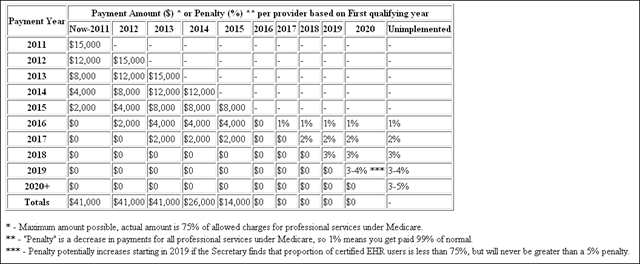
  • The Carrot: $41,000 in Medicare payments per eligible physician: Year 1 - $15,000; Year 2 - $12,000; Year 3 - $8,000; Year 4 - $4,000; Year 5 -$2,000. If Year 1 for a professional is 2011 or 2012, then the Year 1 payment is $18,000. No incentive payments if first adopting in 2015. No incentive payments after 2015. Exceptions for rural physicians and later adopters are also specified.
  • The Stick: Fee schedule reductions will apply to physicians not using certified EHR technology starting in 2015, with fee schedule reductions of 1% in 2015, 2% in 2016 and 3% in 2017 and beyond.
  • These incentives do not apply to hospital-based physicians
  • For a summary of this, HISTalk just published a table of bonuses and penalties.
Hospital Incentives for Adoption and Meaningful Use of Certified EHR Technology

Medicare incentives to hospitals (both carrot and stick) are set up in a similar model as physicians, with a more complex calculation and bigger dollars tied to their meaningful use of certified EHR's. Incentives are calculated based on an initial amount ranging from $2 - 4.6 million (based on number of discharges) multiplied by a Medicare share and a declining "transition factor" for each of four years (1, .75, .5, .25).

Medicaid Incentives

100% federally funded Medicaid incentives are included in the legislation, without back-end reduction in Medicaid fees for non-compliance. Eligible Medicaid physicians are non-hospital based with 30% Medicaid patient volume. Eligible hospitals include 1) children's hospitals, 2) acute care hospitals receiving at least 10% Medicaid patient volume and 3) health centers or rural health clinics with at least 30% Medicaid patient volume.

News Analysis - HITECH's Impact

In a look at the slightly smaller house version of this bill, the Congressional Budget Office (CBO) estimates that $19.8 billion will be spent on HITECH which will, among other things, accelerate adoption of EHR's. The acceleration will deliver US health system net savings of 0.3% betweeen 2011 and 2019, or greater than $60 billion in savings. While this is a good return, 0.3% won't by itself substantially dampen the trajectory of health care spending (see Health Care Costs: A Principal Driver of Long-Term Deficits).

The CBO projects that without the stimulus package "about 45% of hospitals and 65% of physicians will have adopted qualifying health IT in 2019. CBO estimates the incentive mechanism would boost these adoption rates to about 70% for hospitals and about 90% for physicians."

CBO's savings estimates are based on the acceleration of benefits including "reducing the number of inappropriate tests and procedures, reducing paperwork and administrative overhead, and decreasing the number of adverse events resulting from medical errors. Health IT could also improve the quality of care provided to patients by improving the information available to clinicians at the time of treatment, by encouraging the use of evidence based medicine, and by helping physicians manage patients with complex, chronic conditions. The use of health IT could also increase some costs because improved adherence to treatment protocols could increase the amount of care provided."

John Glaser has pointed out that "meaningful use" will need to be clearly spelled out in 2009, leaving only one year for implementation in order for physicians and hospitals to realize the full benefit of the incentive programs. "This is a tall order. And it means that providers should start moving now (if they aren’t already) even though the dust has yet to settle on the specifics."

Tuesday, June 3, 2008

ONC roadmap - On the road to Abilene?

Today, Rob Kolodner, Office of the National Coordinator (ONC) for Health Information Technology, released ONC's strategic plan for the next 5 years.

The ONC synopsis focuses on 2 goals: Patient-focused Health Care and Population Health. ONC defines Patient-focused Health Care as "enabling the transformation to higher quality, more cost-efficient, patient-focused health care through electronic health information access and use by care providers, and by patients and their designees." Population Health "enables the appropriate, authorized, and timely access and use of electronic health information to benefit public health, biomedical research, quality improvement, and emergency preparedness." Themes of privacy and security, interoperability, adoption, and collaborative governance apply to each of these goals.

Critical mass in the use of CPR's combined with exchange of health information between providers and access to information by patients will be facilitated by the Nationwide Health Information Network.

ONC defined the criteria for success as:
  • Health IT becomes common and expected in health care delivery nationwide for all communities, including those caring for underserved or disadvantaged populations;
  • Your health information is available to you and those caring for you so that you receive safe, high quality, and efficient care;
  • You will be able to use information to better determine what choices are right for you with respect to your health and care; and
  • You trust your health information can be used, in a secure environment, without compromising your privacy, to assess and improve the health in your community, measure and make available the quality of care being provided, and support advances in medical knowledge through research.
Is this The road to Abilene? Or the road to a better health system? Will health systems revolt over the massive investments needed to deploy enterprise systems, where many of the benefits don't accrue to the providers? Or can investments and benefits be better aligned? And will Health Information Organizations be sustainable?

There is solid momentum and engagement by HHS, healthcare providers, and healthcare IT companies. As an example of the energy level, CCHIT just reported that they had over twice as many volunteers as available roles in unpaid positions. There's clear value to patients and public health if these goals can be achieved.

Certification Commission for Healthcare Information Technology (CCHIT) chair Mark Leavitt has talked about the critical need to address the mis-aligned costs and benefits in the health system. Leavitt positions CCHIT as the enabler to a more virtuous cycle. The critical ingredient still missing in this equation is provider incentives of sufficient substance to close this loop. Whether this is the Road to Abilene or not, depends on whether providers can buy in at a reasonable sustainable cost.

Thursday, May 29, 2008

Whither the Nationwide Health Information Network?

The Office of the National Coordinator for Health Information Technology has announced the expansion of the participants for the Nationwide Health Information Network (NHIN) trial. The six new awardees join the 9 federal agencies that manage health information that already have NHIN contracts.

So where are NHIN trials headed over the next year?

HHS announced that the trials will address four areas of health information exchange:
  1. Patient lookup and information retrieval
  2. Secure information routing and delivery (including, but not limited to a defined summary patient record)
  3. Provision of data for population uses
  4. Consumer managed access to appropriate information

The trials will test use of the NHIN standards to address these critical areas of health information exchange. The trials will use sample data to avoid any inadvertent issues with privacy and security. The trials are scheduled to complete mid 2009.

The awards are called cooperative agreements and bring together IDN's, state, regional and other health information exchange participants into the NHIN. Some very capable, high profile organizations are the awardees announced by HHS:

  • HealthLINC/Bloomington Hospital
    An e-health collaborative with a multi-stakeholder board of directors consisting of representatives of multiple competing organizations, physicians, and hospitals that serves a ten county area in South Central Indiana with a population of 367,000.

  • Cleveland Clinic
    A multi-specialty multi-facility academic medical system based in Cleveland, Ohio that integrates clinical and hospital care with research and education for 5.3 million patients. Cleveland Clinic facilities include the main, downtown Cleveland campus, nine regional hospitals, a Florida hospital, and 13 northeast Ohio community Family Health Center outpatient clinic locations.

  • Community Health Information Collaborative
    A partnership among hospitals, clinics, long-term care facilities, tribal health facilities, higher education, and public health departments that serve 650,000 patients in a rural, 18-county region in Minnesota.

  • HealthBridge
    The largest and oldest health information exchange located in Cincinnati, Ohio, serving a tri-state region connecting 24 different hospitals and health systems, 17 local health departments, two national and multiple local laboratories, radiology and diagnostic centers, physicians offices, community health center and nursing homes, and currently covering 1.8 million patients.

  • Kaiser Permanente
    The nation's largest private integrated health care delivery organization, serving over 8.7 million members in 10 states and DC.

  • Wright State University
    HealthLink RHIO, West Central Ohio's regional health information exchange, represents hospitals, providers, Medicaid managed care, labs, state and local public health, public schools, social services and safety net providers, and Clark and Champaign County Health Information Exchange, and covers a population of over 500,000.