Showing posts with label American Recovery and Reinvestment Plan. Show all posts

Monday, February 2, 2009

$23 Billion HITECH Stimulus: Senate Debate Kicks Off

The Senate debate kicks off today on the Superbowl of stimulus packages including HITECH, the Health Information Technology for Economic and Clinical Health Act.

It will take a carefully calibrated bi-partisan 60% to get past any Senate filibuster. So what will "careful calibration" look like? Imagine the Steelers' blockers making way for James Harrison's explosive 100 yard interception return. Or imagine the ballet of Santonio Holmes hauling in the winning pass in the far corner of the end zone with 35 seconds to go.


If it passes the Senate, it goes to conference committee to finalize the legislation. We can expect that no changes would be made that risk a Senate challenge to the final bill, like the challenge to a Roethlisberger apparent TD that fell short by 2 inches.

With that in mind, if it passes the Senate we can expect to see many of the following elements in the final bill:

Legislative endorsement for key National Health IT organizations
  • Office of National Coordinator for HIT (ONCHIT)
  • HIT Policy and Standards Committees through the National eHealth Collaborative (aka AHIC Successor) subject to ONCHIT endorsement.
  • Standards and certifications bodies: While unnamed, the Health Information Technology Standards Panel (HITSP) and the Certification Commission for Health Information Technology (CCHIT) are likely beneficiaries in support of standards and certification requirements.
ONCHIT Strategic Goals
  • Electronic exchange and the enterprise integration and use of health information, including establishment and governance of the nationwide health information network (NHIN)
  • Utilization of an electronic health record for each person in the United States by 2014.
  • Privacy and security protections for the electronic exchange of personally identifiable health information
  • Security methods for authorization, authentication and encryption of health information
  • Use of health information technology in improving the quality of health care, reducing medical errors, reducing health disparities, improving public health, and improving the continuity of care among health care settings.
  • Evaluation of open source health information technology systems for "federal safety net providers".
Meaningful Use

Financial incentives are tied to "meaningful use" of certified EHR's by physicians and hospitals. "Meaningful use" is defined somewhat circularly in the criteria:
  • Use of "EHR technology in a meaningful manner" (which for physician incentives shall include the use of e-prescribing).
  • Electronic exchange of health information to improve the quality of care such as promoting coordination of care.
  • Reporting on clinical quality measures (which shall become more stringent over time).
Physician Incentives for Adoption and Meaningful Use of Certified EHR Technology
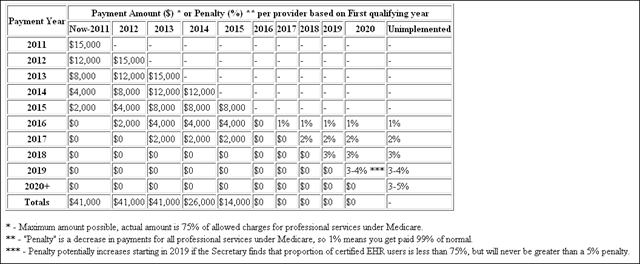
  • The Carrot: $41,000 in Medicare payments per eligible physician: Year 1 - $15,000; Year 2 - $12,000; Year 3 - $8,000; Year 4 - $4,000; Year 5 -$2,000. If Year 1 for a professional is 2011 or 2012, then the Year 1 payment is $18,000. No incentive payments if first adopting in 2015. No incentive payments after 2015. Exceptions for rural physicians and later adopters are also specified.
  • The Stick: Fee schedule reductions will apply to physicians not using certified EHR technology starting in 2015, with fee schedule reductions of 1% in 2015, 2% in 2016 and 3% in 2017 and beyond.
  • These incentives do not apply to hospital-based physicians
  • For a summary of this, HISTalk just published a table of bonuses and penalties.
Hospital Incentives for Adoption and Meaningful Use of Certified EHR Technology

Medicare incentives to hospitals (both carrot and stick) are set up in a similar model as physicians, with a more complex calculation and bigger dollars tied to their meaningful use of certified EHR's. Incentives are calculated based on an initial amount ranging from $2 - 4.6 million (based on number of discharges) multiplied by a Medicare share and a declining "transition factor" for each of four years (1, .75, .5, .25).

Medicaid Incentives

100% federally funded Medicaid incentives are included in the legislation, without back-end reduction in Medicaid fees for non-compliance. Eligible Medicaid physicians are non-hospital based with 30% Medicaid patient volume. Eligible hospitals include 1) children's hospitals, 2) acute care hospitals receiving at least 10% Medicaid patient volume and 3) health centers or rural health clinics with at least 30% Medicaid patient volume.

News Analysis - HITECH's Impact

In a look at the slightly smaller house version of this bill, the Congressional Budget Office (CBO) estimates that $19.8 billion will be spent on HITECH which will, among other things, accelerate adoption of EHR's. The acceleration will deliver US health system net savings of 0.3% betweeen 2011 and 2019, or greater than $60 billion in savings. While this is a good return, 0.3% won't by itself substantially dampen the trajectory of health care spending (see Health Care Costs: A Principal Driver of Long-Term Deficits).

The CBO projects that without the stimulus package "about 45% of hospitals and 65% of physicians will have adopted qualifying health IT in 2019. CBO estimates the incentive mechanism would boost these adoption rates to about 70% for hospitals and about 90% for physicians."

CBO's savings estimates are based on the acceleration of benefits including "reducing the number of inappropriate tests and procedures, reducing paperwork and administrative overhead, and decreasing the number of adverse events resulting from medical errors. Health IT could also improve the quality of care provided to patients by improving the information available to clinicians at the time of treatment, by encouraging the use of evidence based medicine, and by helping physicians manage patients with complex, chronic conditions. The use of health IT could also increase some costs because improved adherence to treatment protocols could increase the amount of care provided."

John Glaser has pointed out that "meaningful use" will need to be clearly spelled out in 2009, leaving only one year for implementation in order for physicians and hospitals to realize the full benefit of the incentive programs. "This is a tall order. And it means that providers should start moving now (if they aren’t already) even though the dust has yet to settle on the specifics."

Thursday, January 15, 2009

Stimulus Draft Calls for $20 Billion Jumpstart To Computerize Health Records

The American Recovery and Reinvestment draft plan circulating in the US House of Representatives includes the following:

  • "Health Information Technology: $20 billion to jumpstart efforts to computerize health records to cut costs and reduce medical errors.
  • Prevention and Wellness Fund: $3 billion to fight preventable chronic diseases, the leading cause of deaths in the U.S., and infectious diseases. Preventing disease rather than treating illnesses is the most effective way to reduce healthcare costs. This includes hospital infection prevention, Preventive Health and Health Services Block Grants for state and local public health departments, immunization programs, and evidence-based disease prevention.
  • Healthcare Effectiveness Research: $1.1 billion for Healthcare Research and Quality programs to compare the effectiveness of different medical treatments funded by Medicare, Medicaid, and SCHIP. Finding out what works best and educating patients and doctors will improve treatment and save taxpayers money.
  • Community Health Centers: $1.5 billion, including $500 million to increase the number of uninsured Americans who receive quality healthcare and $1 billion to renovate clinics and make health information technology improvements. More than 400 applications submitted earlier this year for new or expanded CHC sites remain unfunded.
  • Training Primary Care Providers: $600 million to address shortages and prepare our country for universal healthcare by training primary healthcare providers including doctors, dentists, and nurses as well as helping pay medical school expenses for students who agree to practice in underserved communities through the National Health Service Corps.
  • Indian Health Service Facilities: $550 million to modernize aging hospitals and health clinics and make healthcare technology upgrades to improve healthcare for underserved rural populations."

Update from HISTalk: "The discussion draft ...contains only $2 billion in new funds specific earmarked for healthcare IT, with that entire amount to be managed by the Office of the National Coordinator. The remainder of the $20 billion figure that was quoted for healthcare IT would be distributed by CMS as pay-for-performance incentives that have not yet been defined."

Monday, January 5, 2009

Good Enough? The Debate Over Investments in Healthcare Technology


Are today's healthcare IT systems "good enough"?

David Blumenthal (Harvard Medical School and Institute for Health Policy) said "the debate over whether existing technology is good enough has only emerged recently, with the prospect of a huge national investment in electronic health records. What seems to be happening ... is that passionate health technology advocates fear the country could get locked into an imperfect system."

Healthcare technology interoperability is considered a key component to reduction of administrative costs and improved coordination and continuity of care. Mike Leavitt, Secretary of HHS, contends that "we're already on the road to a system that is universally accessible and secure. Health information experts ... have been working on foundational health IT standards and have made substantial progress."

In Next Steps for Interoperability, John Halamka (Chair of HITSP and CIO for Harvard Medical School and Beth Israel Deaconess) believes that "we can achieve a substantial improvement in care quality and coordination by implementing the systems available now." He posits that the definition of healthcare technology interoperability that is "good enough" includes:
  • "Support for medication interoperability such as e-prescribing linking providers, payers, and pharmacies
  • Support for laboratory and radiology interoperability such as orders and results integration among providers, hospitals and commercial labs
  • Support for seamless electronic interchange between providers and payers for administrative data flows.
In 2009, several EHR vendors will support clinical summary exchange."

Transition into product, and incentive systems for EHR adoption, has been accelerated through certifications including interoperability standards. Mark Leavitt, Chair of the Certification Commission for Healthcare Technology (CCHIT), recently reported on the existing certification programs, which started with an ambulatory EHR certification program launched in 2006.


According to Mark Leavitt, CCHIT certified product are now required for a number of EHR incentive systems which have developed over the last two years, with total investments exceeding $700 million, including 44 distinct public and private EHR programs and "54 new EHR rollouts, representing 147 hospitals under Stark safe harbor rule." Around 46,000 physicians are eligible for, or have received assistance under these programs.

Take time to parse the following from Mark Leavitt: "That there are no good products is absolutely not the problem".

Secretary Mike Leavitt argues that that Obama's Recovery and Reinvestment Plan should require that investments in health IT systems be certified interoperable. This "could spur a critical mass of the nation's doctors to finally enter the information age... If we're going to build a 21st-century health infrastructure, we need to do it strategically, continuing the careful work on harmonized standards that will create one nationwide, interoperable system. That's the only way to make an investment in health IT produce value for providers and patients and improve the quality of health care overall."

Not everyone is convinced that these investments will pay off. David Kibbe (Senior Advisor to the American Academy of Family Physicians) and Brian Klepper argue that "the easy solution would be to spend most of the health IT funds on EHRs. The EHR industry has made it easy by establishing a mechanism to 'certify' EHR products if they incorporate certain features and functions." Kibbe and Klepper contend that EHRs are expensive, disruptive to implement, with no clear patient safety benefits and are not yet interoperable. "These barriers to adoption are well documented; they form the wall that has kept physician EHR adoption overall to less than 25 percent in this country. Even if a hefty federal subsidy reduced the exorbitant cost of the EHRs, many practices would suffer severe negative business impacts, and primary care access could temporarily be reduced on a national scale."

In the meantime, some healthcare organizations are waiting on the sidelines for the federal Recovery and Reinvestment Plan to be enacted before making new health IT investments.

Link here for more on the "Good Enough" debate in Healthcare Technology.

Saturday, January 3, 2009

Obama To Invest In Healthcare Technology

In Barack Obama's January 3rd radio address, he affirmed his intention to invest in healthcare technology as part of an American Recovery and Reinvestment Plan. His goal is to "make strategic investments that will serve as a down payment on our long-term economic future." He listed five areas of focus including renewable energy, infrastructure, healthcare technology, education and tax relief.

"To save not only jobs, but money and lives, we will update and computerize our health care system to cut red tape, prevent medical mistakes, and help reduce health care costs by billions of dollars each year. "

The full text of his address follows:

"As the holiday season comes to end, we are thankful for family and friends and all the blessings that make life worth living. But as we mark the beginning of a new year, we also know that America faces great and growing challenges – challenges that threaten our nation's economy and our dreams for the future. Nearly two million Americans have lost their jobs this past year – and millions more are working harder in jobs that pay less and come with fewer benefits. For too many families, this new year brings new unease and uncertainty as bills pile up, debts continue to mount and parents worry that their children won't have the same opportunities they had.

However we got here, the problems we face today are not Democratic problems or Republican problems. The dreams of putting a child through college, or staying in your home, or retiring with dignity and security know no boundaries of party or ideology.

These are America's problems, and we must come together as Americans to meet them with the urgency this moment demands. Economists from across the political spectrum agree that if we don't act swiftly and boldly, we could see a much deeper economic downturn that could lead to double digit unemployment and the American Dream slipping further and further out of reach.

That's why we need an American Recovery and Reinvestment Plan that not only creates jobs in the short-term but spurs economic growth and competitiveness in the long-term. And this plan must be designed in a new way – we can't just fall into the old Washington habit of throwing money at the problem. We must make strategic investments that will serve as a down payment on our long-term economic future. We must demand vigorous oversight and strict accountability for achieving results. And we must restore fiscal responsibility and make the tough choices so that as the economy recovers, the deficit starts to come down. That is how we will achieve the number one goal of my plan – which is to create three million new jobs, more than eighty percent of them in the private sector.

To put people back to work today and reduce our dependence on foreign oil tomorrow, we will double renewable energy production and renovate public buildings to make them more energy efficient. To build a 21st century economy, we must engage contractors across the nation to create jobs rebuilding our crumbling roads, bridges, and schools. To save not only jobs, but money and lives, we will update and computerize our health care system to cut red tape, prevent medical mistakes, and help reduce health care costs by billions of dollars each year. To make America, and our children, a success in this new global economy, we will build 21st century classrooms, labs, and libraries. And to put more money into the pockets of hardworking families, we will provide direct tax relief to 95 percent of American workers.

I look forward to meeting next week in Washington with leaders from both parties to discuss this plan. I am optimistic that if we come together to seek solutions that advance not the interests of any party, or the agenda of any one group, but the aspirations of all Americans, then we will meet the challenges of our time just as previous generations have met the challenges of theirs.

There is no reason we can't do this. We are a people of boundless industry and ingenuity. We are innovators and entrepreneurs and have the most dedicated and productive workers in the world. And we have always triumphed in moments of trial by drawing on that great American spirit – that perseverance, determination and unyielding commitment to opportunity on which our nation was founded. In this new year, let us resolve to do so once more. Thank you."