
 |
| Please join members of the Nationwide Health Information Network technical team for a special information session on implementing Nationwide Health Information Network specifications. This orientation will bring together technical consultants, entities that have implemented the specifications, and organizations just starting the process of implementation in an informative exchange of best practices and a robust question and answer session. When: Wednesday, January 26, 2011; 3:00-4:00 p.m. EST Dial-in: 1-877-218-2835 Meeting ID: 6174296 For more information, email bechang@deloitte.com |
Showing posts with label NHIN. Show all posts
Showing posts with label NHIN. Show all posts
Monday, January 24, 2011
Nationwide Health Information Network Session - Information Session


Tuesday, May 18, 2010
NHIN: No 'One-Size-Fits-All'
Dr. David Blumenthal, National Coordinator for Health IT (ONC) has published an open letter on the Nationwide Health Information Network.
___________________________________
There Is No ‘One-Size-Fits-All’ in Building a Nationwide Health Information Network
 Private and secure health information exchange enables information to follow the patient when and where it is needed for better care. The Federal government is working to enable a wide range of innovative and complementary approaches that will allow secure and meaningful exchange within and across states, but all of our efforts must be grounded in a common foundation of standards, technical specifications, and policies. Our efforts must also encourage trust among participants and provide assurance to consumers about the security and privacy of their information. This foundation is the essence of the Nationwide Health Information Network (NHIN).
The NHIN is not a network per se, but rather a set of standards, services, and policies that enable the Internet to be used for the secure exchange of health information to improve health and health care. Different providers and consumers may use the Internet in different ways and at different levels of sophistication. To make meaningful use possible, including the necessary exchange of information, we need to meet providers where they are, and offer approaches that are both feasible for them and support the meaningful use requirements of the Centers for Medicare & Medicaid Services (CMS) Electronic Health Record Incentives Programs. As with the Internet, it is likely that what is today considered “highly sophisticated” will become common usage. Moreover, users may engage in simpler exchange for some purposes and more complex exchange for others.
Current NHIN exchange capabilities are the result of a broad and sustained collaboration among Federal agencies, large provider organizations, and a variety of state and regional health information organizations that all recognized a need for a high level of interoperable health information exchange that avoided “one-off” approaches. Based on this pioneering work, a subset of these organizations is now actively exchanging information. This smaller group currently includes the Department of Defense, Social Security Administration, Veterans Health Administration, Kaiser Permanente, and MedVirginia. They initially came together to show, on a pilot scale, that this type of highly evolved exchange was possible. Having succeeded, they continue to expand the level of exchange among their group and with their own respective partners in a carefully phased way to demonstrate and learn from these widening patterns of exchange. The robust exchange occurring at this level has several key attributes, including the:
To enable a wide variety of providers – from small practices to large hospitals – to become meaningful users of electronic health records in 2011, we need to ensure the availability of a reliable and secure “entry level” exchange option that aligns with the long-range information exchange vision we have for our nation. Such an option should balance the need for a consistent level of interoperability and security across the exchange spectrum with the reality that not all users are at the same point on the path to comprehensive interoperability. In an effort to provide the best customer service possible, the Office of the National Coordinator for Health IT (ONC) will consider what a complete toolkit would be for all providers who want to accomplish meaningful health information exchange.
Broadening the use of the NHIN to include a wider variety of providers and consumers who may have simpler needs for information exchange, or perhaps less technically sophisticated capabilities, is critical to bolstering health information exchange and meeting our initial meaningful use requirements. Building on the solid foundation established through the current exchange group mentioned above and the recommendations of the HIT Policy Committee (which originated with the Committee’s NHIN Workgroup), ONC is exploring this expansion of NHIN capabilities to find solutions that will work across different technologies and exchange models.
The newly launched NHIN Direct Project is designed to identify the standards and services needed to create a means for direct electronic communication between providers, in support of the 2011 meaningful use requirements. It is meant to enhance, not replace, the capabilities offered by other means of exchange. An example of this type of exchange would be a primary care physician sending a referral and patient care summary to a specialist electronically.
We are on an aggressive timeline to define these specifications and standards and to test them within real-world settings by the end of 2010. Timing is critical so that we may provide this resource to a broader array of participants in health information exchange as a wave of new, meaningful users prepare to qualify for incentives provided for in the HITECH Act and ultimately defined by CMS. This model for exchange will meet current provider needs within the broader health care community, complement existing NHIN exchange capabilities, and strengthen our efforts toward comprehensive interoperability across the nation.
A natural evolution in NHIN capabilities to support a variety of health information exchange needs is being reinforced by trends that are leading us toward widespread multi-point interoperability. The current movement toward consolidation in health care, coupled with health reform’s encouragement of bundled payments for coordinated care, will mean more providers need it. Quality improvement, public health, research, and a learning health care system all require it. Ultimately, simple exchange will be part of a package of broader functions that allows any provider, and ultimately consumers, to exchange information over the Internet, enabled by NHIN standards, services, and policies.
Your continued input will help guide us toward and maintain a direction that is in harmony with the rapid innovations in health IT today. The NHIN Direct Project will conduct an open, transparent, and collaborative process throughout its development by using a community wiki, blogs, and open source implementation already available on the project’s website (http://nhindirect.org). I encourage you to participate through the website, via public participation at the implementation group meetings, and by deploying and testing the resulting standards and specifications. For those of you who are participants in the current exchange group, I urge you to take every opportunity to share your experiences. Lessons learned from the NHIN Direct Project and the exchange group will inform the evolution of the NHIN as new uses and users come forward, and as continued innovation occurs to meet the growing needs of our community.
As we head into the next stage in the development of nationwide health information exchange, we should all take a moment to reflect on how far we have come and evaluate our plans for the future. ONC is committed to providing resources and guidance to stakeholders at all levels of exchange through HITECH programs, such as the Health IT Regional Extension Centers, the national Health IT Research Center, and the State Health Information Exchange Program. As you assess your own needs for exchange, please take advantage of the many Federal resources available to you on the ONC website and the online resources of the programs mentioned above, as well as through the “NHIN University” education program hosted by our public-private partner, the National eHealth Collaborative.
We have done a great deal of work in the short period of time since the passage of the HITECH Act. We at ONC appreciate your willingness to stay engaged and involved in every step of our journey, and we look forward to our continuing collaboration to improve the health and well-being of our nation.
___________________________________
There Is No ‘One-Size-Fits-All’ in Building a Nationwide Health Information Network

The NHIN is not a network per se, but rather a set of standards, services, and policies that enable the Internet to be used for the secure exchange of health information to improve health and health care. Different providers and consumers may use the Internet in different ways and at different levels of sophistication. To make meaningful use possible, including the necessary exchange of information, we need to meet providers where they are, and offer approaches that are both feasible for them and support the meaningful use requirements of the Centers for Medicare & Medicaid Services (CMS) Electronic Health Record Incentives Programs. As with the Internet, it is likely that what is today considered “highly sophisticated” will become common usage. Moreover, users may engage in simpler exchange for some purposes and more complex exchange for others.
Current NHIN exchange capabilities are the result of a broad and sustained collaboration among Federal agencies, large provider organizations, and a variety of state and regional health information organizations that all recognized a need for a high level of interoperable health information exchange that avoided “one-off” approaches. Based on this pioneering work, a subset of these organizations is now actively exchanging information. This smaller group currently includes the Department of Defense, Social Security Administration, Veterans Health Administration, Kaiser Permanente, and MedVirginia. They initially came together to show, on a pilot scale, that this type of highly evolved exchange was possible. Having succeeded, they continue to expand the level of exchange among their group and with their own respective partners in a carefully phased way to demonstrate and learn from these widening patterns of exchange. The robust exchange occurring at this level has several key attributes, including the:
- Ability to find and access patient information among multiple providers;
- Support for the exchange of information using common standards; and
- Documented understanding of participants, enabling trust, such as the Data Use and Reciprocal Support Agreement (DURSA).
Not every organization and provider, however, needs or is ready for this kind of health information exchange today. Nor do the 2011 meaningful use requirements set forth by CMS in the recent proposed rule require it. Direct, securely routed information exchange may meet the current needs of some providers for their patients and their practices, such as receiving lab results or sending an electronic prescription.
To enable a wide variety of providers – from small practices to large hospitals – to become meaningful users of electronic health records in 2011, we need to ensure the availability of a reliable and secure “entry level” exchange option that aligns with the long-range information exchange vision we have for our nation. Such an option should balance the need for a consistent level of interoperability and security across the exchange spectrum with the reality that not all users are at the same point on the path to comprehensive interoperability. In an effort to provide the best customer service possible, the Office of the National Coordinator for Health IT (ONC) will consider what a complete toolkit would be for all providers who want to accomplish meaningful health information exchange.
Broadening the use of the NHIN to include a wider variety of providers and consumers who may have simpler needs for information exchange, or perhaps less technically sophisticated capabilities, is critical to bolstering health information exchange and meeting our initial meaningful use requirements. Building on the solid foundation established through the current exchange group mentioned above and the recommendations of the HIT Policy Committee (which originated with the Committee’s NHIN Workgroup), ONC is exploring this expansion of NHIN capabilities to find solutions that will work across different technologies and exchange models.
The newly launched NHIN Direct Project is designed to identify the standards and services needed to create a means for direct electronic communication between providers, in support of the 2011 meaningful use requirements. It is meant to enhance, not replace, the capabilities offered by other means of exchange. An example of this type of exchange would be a primary care physician sending a referral and patient care summary to a specialist electronically.
We are on an aggressive timeline to define these specifications and standards and to test them within real-world settings by the end of 2010. Timing is critical so that we may provide this resource to a broader array of participants in health information exchange as a wave of new, meaningful users prepare to qualify for incentives provided for in the HITECH Act and ultimately defined by CMS. This model for exchange will meet current provider needs within the broader health care community, complement existing NHIN exchange capabilities, and strengthen our efforts toward comprehensive interoperability across the nation.
A natural evolution in NHIN capabilities to support a variety of health information exchange needs is being reinforced by trends that are leading us toward widespread multi-point interoperability. The current movement toward consolidation in health care, coupled with health reform’s encouragement of bundled payments for coordinated care, will mean more providers need it. Quality improvement, public health, research, and a learning health care system all require it. Ultimately, simple exchange will be part of a package of broader functions that allows any provider, and ultimately consumers, to exchange information over the Internet, enabled by NHIN standards, services, and policies.
Your continued input will help guide us toward and maintain a direction that is in harmony with the rapid innovations in health IT today. The NHIN Direct Project will conduct an open, transparent, and collaborative process throughout its development by using a community wiki, blogs, and open source implementation already available on the project’s website (http://nhindirect.org). I encourage you to participate through the website, via public participation at the implementation group meetings, and by deploying and testing the resulting standards and specifications. For those of you who are participants in the current exchange group, I urge you to take every opportunity to share your experiences. Lessons learned from the NHIN Direct Project and the exchange group will inform the evolution of the NHIN as new uses and users come forward, and as continued innovation occurs to meet the growing needs of our community.
As we head into the next stage in the development of nationwide health information exchange, we should all take a moment to reflect on how far we have come and evaluate our plans for the future. ONC is committed to providing resources and guidance to stakeholders at all levels of exchange through HITECH programs, such as the Health IT Regional Extension Centers, the national Health IT Research Center, and the State Health Information Exchange Program. As you assess your own needs for exchange, please take advantage of the many Federal resources available to you on the ONC website and the online resources of the programs mentioned above, as well as through the “NHIN University” education program hosted by our public-private partner, the National eHealth Collaborative.
Tuesday, June 16, 2009
ONC to Host CONNECT Open Source Seminar
The Office of the National Coordinator for Health Information Technology (ONC) has announced the agenda for the June 29-30 open source CONNECT Seminar '09 in Washington D.C.
CONNECT is an on-ramp to the Nationwide Health Information Network (NHIN), a network of networks for health information exchanges, providers, payers, and other stakeholders enabling standards-based connectivity and information sharing.
CONNECT is an open source connectivity solution built for use by 20 federal agencies to securely link their systems to the NHIN. Earlier this year, CONNECT was released to the public including:
- The NHIN Gateway is used to locate patients at other health organizations within the NHIN, request and receive documents associated with the patient, create audit logs of these transactions, authenticate network participants, formulate and evaluate authorizations for the release of medical information, and honor consumer preferences for sharing their information.
- The Enterprise Service Component includes a Master Patient Index (MPI), Document Registry and Repository, Authorization Policy Engine, Consumer Preferences Manager, HIPAA-compliant Audit Log and a software development kit for developing adapters to plug in existing systems such as electronic health record solutions to support the secure exchange of health information across the NHIN.
- The Universal Client Framework is used to develop applications using the Enterprise Service Component.
Sunday, December 14, 2008
NHIN Forum to Demonstrate AHIC priorities
On December 15-16, seven AHIC priority use cases will be demonstrated as part of the Nationwide Health Information Network (NHIN) December forum.

In a recent briefing, Charles Friedman Deputy National Coordinator for Healthcare IT provided an update on the progress of the Nationwide Health Information Network (NHIN) and the NHIN Trial Implementation Demonstration. The ONC briefing document reports that "the NHIN is being built on the Internet to provide a safe and secure way for health-related organizations to interconnect – bridging various technologies, approaches and geographies. Some of the defining characteristics of the NHIN is that:

The ONC briefing emphasized the results of the "NHIN Cooperative on specifications and trust agreements. They achieved consensus and established a common and replicable way (based upon standards) to interconnect - irrespective of a particular technology or solution. Their work forms the foundation that will enable others to join the NHIN over time. "
The ONC briefing described the NHIN Trial Implementation Demonstration's support for:

In a recent briefing, Charles Friedman Deputy National Coordinator for Healthcare IT provided an update on the progress of the Nationwide Health Information Network (NHIN) and the NHIN Trial Implementation Demonstration. The ONC briefing document reports that "the NHIN is being built on the Internet to provide a safe and secure way for health-related organizations to interconnect – bridging various technologies, approaches and geographies. Some of the defining characteristics of the NHIN is that:
- It is a network of networks
- It has no national data store or centralized systems
- It has no national patient identifier
- It consists of standards, implementation guidelines, and specific testing abilities to measure conformance. Together, they represent kind of a shared “dial-tone” that allows diverse organizations using different architectures and technologies to exchange health information, safely and securely. The NHIN technology is being built to permit various policy options, and will continue to adapt as those policies evolve."

The ONC briefing emphasized the results of the "NHIN Cooperative on specifications and trust agreements. They achieved consensus and established a common and replicable way (based upon standards) to interconnect - irrespective of a particular technology or solution. Their work forms the foundation that will enable others to join the NHIN over time. "
The ONC briefing described the NHIN Trial Implementation Demonstration's support for:
- the patient (emergency care, transfer of care, wounded warrior)
- consumer preferences (opt in/out of information exchange, others)
- business use (authorized release of information to Social Security for disability determination).
Tuesday, July 29, 2008
Mobilizing Personal Health Information - Consumer Perspective
How will consumers "mobilize" their personal health information?
On July 29, the American Health Information Community (AHIC, "The Community") examined how consumers may access, use and share their personal health information (PHI). This article highlights the consumer perspective.

The utility service model consolidates multiple data sources into a secure repository available to multiple applications and services. This model scores very well, with the notable exception of portability which is "under development". Moore scored the utility service model as the only approach with the potential for high rates of adoption.
Consumer Interest
Carol Diamond of Markle Foundation's Connecting for Health organization surveyed public attitudes towards Personal Health Records (PHR). Markle's survey found only 13.5% of respondents very interested in using a free web-based PHR and another third somewhat interested.
Markle contends that the establishment of privacy and information practices are critical to consumer PHR adoption.

Markle's Connecting for Health Common Framework and Framework for Networked Personal Health Information define clear "price of admission" requirements for PHR adoption, but are they sufficient to achieve adoption?
Standards and Interoperability
Connectivity with healthcare organizations will be required to make PHR's easy to access and manage. Jeff Blair, Lovelace Clinic, made the case for the Nationwide Health Information Network and standards based interoperability as foundational elements to achieve adoption.
Editorial comment: Where are the incentives?
The one missing ingredient in all of this: financial incentives for patients and providers. Why are payers and employers more interested in PHR adoption? They are dealing with the pocketbook issues of how population health affects their P&L.
On July 29, the American Health Information Community (AHIC, "The Community") examined how consumers may access, use and share their personal health information (PHI). This article highlights the consumer perspective.
Utility Service Model
John Moore from Chilmark Research compared several business models for PHI delivery. These include: 1) Consumer approach to manage health, 2) Employer and healthplan approach to reduce costs and manage risks, 3) Provider approach for consumer (patient) retention, and 4) Utility service model approach to "create an ecosystem".
John Moore from Chilmark Research compared several business models for PHI delivery. These include: 1) Consumer approach to manage health, 2) Employer and healthplan approach to reduce costs and manage risks, 3) Provider approach for consumer (patient) retention, and 4) Utility service model approach to "create an ecosystem".
The utility service model consolidates multiple data sources into a secure repository available to multiple applications and services. This model scores very well, with the notable exception of portability which is "under development". Moore scored the utility service model as the only approach with the potential for high rates of adoption.
Consumer Interest
Carol Diamond of Markle Foundation's Connecting for Health organization surveyed public attitudes towards Personal Health Records (PHR). Markle's survey found only 13.5% of respondents very interested in using a free web-based PHR and another third somewhat interested.
Markle contends that the establishment of privacy and information practices are critical to consumer PHR adoption.
Markle's Connecting for Health Common Framework and Framework for Networked Personal Health Information define clear "price of admission" requirements for PHR adoption, but are they sufficient to achieve adoption?
Standards and Interoperability
Connectivity with healthcare organizations will be required to make PHR's easy to access and manage. Jeff Blair, Lovelace Clinic, made the case for the Nationwide Health Information Network and standards based interoperability as foundational elements to achieve adoption.
Editorial comment: Where are the incentives?
The one missing ingredient in all of this: financial incentives for patients and providers. Why are payers and employers more interested in PHR adoption? They are dealing with the pocketbook issues of how population health affects their P&L.
Tuesday, June 3, 2008
ONC roadmap - On the road to Abilene?
Today, Rob Kolodner, Office of the National Coordinator (ONC) for Health Information Technology, released ONC's strategic plan for the next 5 years.
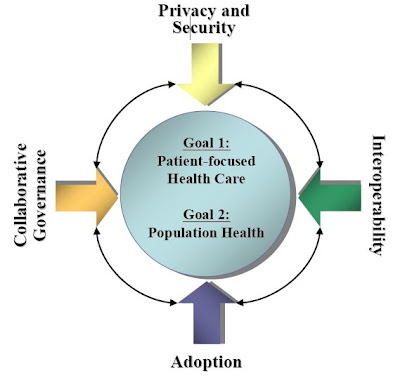 The ONC synopsis focuses on 2 goals: Patient-focused Health Care and Population Health. ONC defines Patient-focused Health Care as "enabling the transformation to higher quality, more cost-efficient, patient-focused health care through electronic health information access and use by care providers, and by patients and their designees." Population Health "enables the appropriate, authorized, and timely access and use of electronic health information to benefit public health, biomedical research, quality improvement, and emergency preparedness." Themes of privacy and security, interoperability, adoption, and collaborative governance apply to each of these goals.
 Critical mass in the use of CPR's combined with exchange of health information between providers and access to information by patients will be facilitated by the Nationwide Health Information Network.
ONC defined the criteria for success as:
There is solid momentum and engagement by HHS, healthcare providers, and healthcare IT companies. As an example of the energy level, CCHIT just reported that they had over twice as many volunteers as available roles in unpaid positions. There's clear value to patients and public health if these goals can be achieved.
 Certification Commission for Healthcare Information Technology (CCHIT) chair Mark Leavitt has talked about the critical need to address the mis-aligned costs and benefits in the health system. Leavitt positions CCHIT as the enabler to a more virtuous cycle. The critical ingredient still missing in this equation is provider incentives of sufficient substance to close this loop. Whether this is the Road to Abilene or not, depends on whether providers can buy in at a reasonable sustainable cost.
 The ONC synopsis focuses on 2 goals: Patient-focused Health Care and Population Health. ONC defines Patient-focused Health Care as "enabling the transformation to higher quality, more cost-efficient, patient-focused health care through electronic health information access and use by care providers, and by patients and their designees." Population Health "enables the appropriate, authorized, and timely access and use of electronic health information to benefit public health, biomedical research, quality improvement, and emergency preparedness." Themes of privacy and security, interoperability, adoption, and collaborative governance apply to each of these goals.
 Critical mass in the use of CPR's combined with exchange of health information between providers and access to information by patients will be facilitated by the Nationwide Health Information Network.
ONC defined the criteria for success as:
- Health IT becomes common and expected in health care delivery nationwide for all communities, including those caring for underserved or disadvantaged populations;
- Your health information is available to you and those caring for you so that you receive safe, high quality, and efficient care;
- You will be able to use information to better determine what choices are right for you with respect to your health and care; and
- You trust your health information can be used, in a secure environment, without compromising your privacy, to assess and improve the health in your community, measure and make available the quality of care being provided, and support advances in medical knowledge through research.
There is solid momentum and engagement by HHS, healthcare providers, and healthcare IT companies. As an example of the energy level, CCHIT just reported that they had over twice as many volunteers as available roles in unpaid positions. There's clear value to patients and public health if these goals can be achieved.
 Certification Commission for Healthcare Information Technology (CCHIT) chair Mark Leavitt has talked about the critical need to address the mis-aligned costs and benefits in the health system. Leavitt positions CCHIT as the enabler to a more virtuous cycle. The critical ingredient still missing in this equation is provider incentives of sufficient substance to close this loop. Whether this is the Road to Abilene or not, depends on whether providers can buy in at a reasonable sustainable cost.
Monday, June 2, 2008
Making Sense of National Healthcare IT
Avance Health Analysis
Recent news of HITSP's submissions to The Community (AHIC) June meeting, prompted a reader to ask: How do the various national healthcare initiatives (AHIC, HITSP, HHS, CCHIT and NHIN) fit together?
 Is the relationship between these organizations Rube Goldberg-esque? Or is there some more coherent design?
The mission of American Health Information Community ("The Community" or AHIC) is to provide "input and recommendations to the Department of Health and Human Services (HHS) on how to make health records digital and interoperable, and assure that the privacy and security of those records are protected in a smooth, market-led way." AHIC is presently reorganizing itself to ensure its viability beyond the term of the current administration, by establishing "AHIC 2.0" as a sustainable public-private organization. AHIC is the focal point for guidance to HHS on priorities for interoperability and develops the use cases for these priorities.
The Healthcare Information Technology Standards Panel (HITSP) mission is to "harmonize and integrate standards that will meet clinical and business needs for sharing information among organizations and systems." HITSP takes its guidance on priorities and use case definition from AHIC and proposes standards (like those to be presented today at the AHIC June 2008 meeting) to the HHS Secretary.
The HHS Secretary can accept the recommendations which starts the clock on a one year cycle of testing and implementation. At the end of this cycle, the HHS Secretary can choose to "recognize" these standards. Once standards are recognized, by Executive Order, they are incorporated into new Federal Systems and Healthcare Contracts.
Recognition of these standards also serves as input to the Certification Commission for Healthcare Information Technology (CCHIT). CCHIT is a recognized certification body (RCB) for Electronic Health Records (EHR) with the goal of accelerating EHR adoption. CCHIT establishes its roadmap and criteria for Electronic Health Records based in part on the recognized standards from the HHS Secretary.
These recognized interoperability standards are also incorporated by the Nationwide Health Information Network (NHIN), a network of networks promoting Health Information Exchange.
Recent news of HITSP's submissions to The Community (AHIC) June meeting, prompted a reader to ask: How do the various national healthcare initiatives (AHIC, HITSP, HHS, CCHIT and NHIN) fit together?
Is the relationship between these organizations Rube Goldberg-esque? Or is there some more coherent design?The mission of American Health Information Community ("The Community" or AHIC) is to provide "input and recommendations to the Department of Health and Human Services (HHS) on how to make health records digital and interoperable, and assure that the privacy and security of those records are protected in a smooth, market-led way." AHIC is presently reorganizing itself to ensure its viability beyond the term of the current administration, by establishing "AHIC 2.0" as a sustainable public-private organization. AHIC is the focal point for guidance to HHS on priorities for interoperability and develops the use cases for these priorities.
The Healthcare Information Technology Standards Panel (HITSP) mission is to "harmonize and integrate standards that will meet clinical and business needs for sharing information among organizations and systems." HITSP takes its guidance on priorities and use case definition from AHIC and proposes standards (like those to be presented today at the AHIC June 2008 meeting) to the HHS Secretary.
The HHS Secretary can accept the recommendations which starts the clock on a one year cycle of testing and implementation. At the end of this cycle, the HHS Secretary can choose to "recognize" these standards. Once standards are recognized, by Executive Order, they are incorporated into new Federal Systems and Healthcare Contracts.
Recognition of these standards also serves as input to the Certification Commission for Healthcare Information Technology (CCHIT). CCHIT is a recognized certification body (RCB) for Electronic Health Records (EHR) with the goal of accelerating EHR adoption. CCHIT establishes its roadmap and criteria for Electronic Health Records based in part on the recognized standards from the HHS Secretary.
These recognized interoperability standards are also incorporated by the Nationwide Health Information Network (NHIN), a network of networks promoting Health Information Exchange.
Thursday, May 29, 2008
Whither the Nationwide Health Information Network?
 The Office of the National Coordinator for Health Information Technology has announced the expansion of the participants for the Nationwide Health Information Network (NHIN) trial. The six new awardees join the 9 federal agencies that manage health information that already have NHIN contracts.
So where are NHIN trials headed over the next year?
HHS announced that the trials will address four areas of health information exchange:
- Patient lookup and information retrieval
- Secure information routing and delivery (including, but not limited to a defined summary patient record)
- Provision of data for population uses
- Consumer managed access to appropriate information
The trials will test use of the NHIN standards to address these critical areas of health information exchange. The trials will use sample data to avoid any inadvertent issues with privacy and security. The trials are scheduled to complete mid 2009.
The awards are called cooperative agreements and bring together IDN's, state, regional and other health information exchange participants into the NHIN. Some very capable, high profile organizations are the awardees announced by HHS:
HealthLINC/Bloomington Hospital
An e-health collaborative with a multi-stakeholder board of directors consisting of representatives of multiple competing organizations, physicians, and hospitals that serves a ten county area in South Central Indiana with a population of 367,000.Cleveland Clinic
A multi-specialty multi-facility academic medical system based in Cleveland, Ohio that integrates clinical and hospital care with research and education for 5.3 million patients. Cleveland Clinic facilities include the main, downtown Cleveland campus, nine regional hospitals, a Florida hospital, and 13 northeast Ohio community Family Health Center outpatient clinic locations.Community Health Information Collaborative
A partnership among hospitals, clinics, long-term care facilities, tribal health facilities, higher education, and public health departments that serve 650,000 patients in a rural, 18-county region in Minnesota.HealthBridge
The largest and oldest health information exchange located in Cincinnati, Ohio, serving a tri-state region connecting 24 different hospitals and health systems, 17 local health departments, two national and multiple local laboratories, radiology and diagnostic centers, physicians offices, community health center and nursing homes, and currently covering 1.8 million patients.Kaiser Permanente
The nation's largest private integrated health care delivery organization, serving over 8.7 million members in 10 states and DC.Wright State University
HealthLink RHIO, West Central Ohio's regional health information exchange, represents hospitals, providers, Medicaid managed care, labs, state and local public health, public schools, social services and safety net providers, and Clark and Champaign County Health Information Exchange, and covers a population of over 500,000.
Subscribe to:
Posts (Atom)





