Tuesday, March 17, 2009

Not If, But When

In their March 16 edition, the American Medical News (published by the AMA) reports that it is "no longer a question of 'if'" physicians should invest in health care information technology. Bonuses to physicians are maximized if certified EHR's are operational by 2011 or 2012.

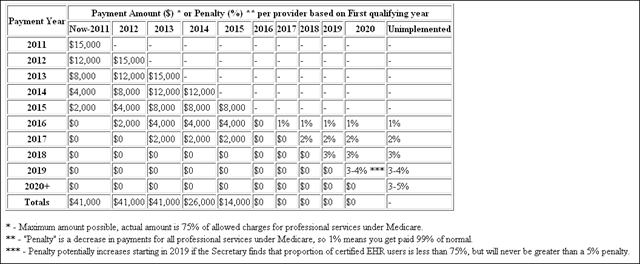
The lead highlights the significant financial benefit for physicians who "must act quickly to achieve the biggest benefit and avoid penalties." And contrary to many reports, AMNews gets it right in describing the payment of $35 billion in Medicare and Medicaid physician incentives. The net $20 billion normally associated with the health care technology stimulus includes the offsetting penalties that begin in 2016.

For the full explanation of bonuses and penalties (pdf) click on the graphic below:

Sunday, March 15, 2009

Getting By or Getting Better?

There are 20 billion reasons to be hopeful about the passage of the stimulus plan’s HITECH provisions. Certainly the plan will drive greater physician and hospital adoption of EHR's and will ultimately help improve coordination of care across health care settings. The CBO believes that there is a roughly 3:1 financial return on this investment. That’s all good news.

But will the stimulus plan provide the lift that hospitals and systems need to realize the full potential of EHR’s, improving outcomes and reducing costs? Or will hospitals do just enough to justify reimbursement and to avoid future fee penalties?

The investment and implementation choices that are made today will be with us for a very long time. And there is reason to be concerned with the outcome.

I recently spoke with the president of a publicly traded large healthcare tech company that does business with most hospitals in the US. I asked for his take on the stimulus program and its effect on his business. His response was that the stimulus plan was certainly needed, but was insufficient to restore hospital capital spending on technology. His view is that the US Treasury's plan for the capital markets is much more critical to financial recovery in healthcare.

The best way to test this hypothesis is with the credit rating agencies that evaluate risk and financial health of healthcare organizations. Fitch Ratings recently released their special report on 2009 Nonprofit Hospitals and Healthcare Systems Outlook which found that hospitals "will be severely tested and under intense pressure over the next 12- 18 months."

The outlook is "negative" (a very strong word for a credit ratings agency) based on "constrained access to capital, a deteriorating payor mix, elevated interest rates, severe investment losses, ... increasing uncompensated care and higher capital costs." They forecast that government reimbursement will remain constrained by the economic crisis, employers will continue to shift healthcare costs to employees and small employers will face greater challenges providing healthcare for their employees. "These factors, coupled with increasing unemployment and declining utilization will likely depress operating profitability well into 2010... Economic stimulus initiatives and healthcare reform efforts could be beneficial over the longer term but are not expected to provide significant immediate relief."

Financial market conditions including swap risk, the collapse of variable-rate demand bonds, the lack of fixed-rate debt, pension fund obligations and higher capital interest costs are all contributing to reduced liquidity for hospitals.

For many hospitals, the level of days cash on hand, a key financial operating metric, has fallen 20-30% from 2007 to 2008. In addition, hospitals are facing operating pressure related to increases in uncompensated care and declining utilization, which is expected to reduce profitability for 18-36 months. Fitch expects that hospitals will respond by "curtailing or deferring capital spending, reducing staffing, cutting costs to bolster profitability... (and) anticipates these actions to continue throughout 2009..."

Hospitals can expect "volumes to continue declining as consumers delay or postpone non-urgent procedures and as unemployment levels continue to rise." While reimbursement levels should be adequate, hospitals should anticipate "continued increases in bad debts and charity care..." A recent AMA study on the impact of the economic crisis on hospitals reinforces many of these findings.

Fitch contends that hospitals are going to need to focus more on driving revenue and productivity gains. (For examples of these initiatives, see High Margin Revenue Cycle Strategies.) Reflective of a more strategic view of healthcare technology, "the degree to which providers have invested in health information technology can also influence Fitch’s assessment of long term viability."

Fitch concludes that "while much work remains to be done in defining, funding and implementing meaningful change in the healthcare industry, a common theme of various federal and state reform proposals centers on creating payment incentives that encourage value – the delivery of effective, appropriate care in an efficient manner."

With this backdrop, it’s easy to imagine a few scenarios where hospitals treat healthcare technology as a strategic enabler, and many other scenarios where hospitals work to just get by, doing enough to reap the financial reward but no more.

In one of its few moments of inspiration, Congress gave HHS the authority to define "meaningful use" of healthcare technology. The "meaningful use" metric determines whether providers are paid for their EHR investments.

Historian Paul Johnson said that "the word 'meaningful' when used today is nearly always meaningless." Given the many pressures on hospitals to just get by, this one key definition, and the way it is operationalized, may define the trajectory, results, patient outcomes and costs that we live with for years to come.

Thursday, March 12, 2009

The Week in Review - March 12, 2009

A look back at some of the best news stories (and some entertaining diversions) from the week in health care.


Aspirational goals and a lion's roar at the summit. The knives stayed sheathed through this opening act.

The coming ICE age in healthcare technology - a terrific article by futurist Mark Anderson

What aisle are your EHR's in?

A CEO talks about the economy and its effect on the medical center. Up to $20 million in operating losses means job cuts - - just not sure how many.

Will hospitals address EHR "meaningful use" by getting by or getting better? Meditech Community Bulletin gets the scoop on a future Healthcare Technology News article.

Telehealth: Is there a "doctor in the mouse"?

"Combating alert fatigue" in e-prescribing.

Not sure what sort of crowd is going to show up... The latest medical wiki has big names behind it and social networking baked in.

Highlights of medical news of the obvious.

Grand Rounds is published at DocGurley.com and highlights a "glimpse at the horror show that is ICD-10 (undoubtedly R-rated due to inappropriate complexity)."

LOL Award - First place goes to HISTalk (Inga) for: "Finally, I just want to know if it was a man or a woman who created this product."

Sunday, March 8, 2009

The Uninsured Crisis

Health Care Reform is a critical and central topic to our national financial well-being, the health of the population at large and the health of our industry. As such, Healthcare Technology News will cover news on Health Care Reform

The Institute of Medicine has released the pre-publication version of America's Uninsured Crisis: Consequences for Health and Health Care. The IOM Committee on Health Insurance Status and Its Consequences found that the country is "caught in a downward spiral: health insurance coverage is declining and will continue to decline."

Some of the committee's key findings include that
  • "Health insurance coverage in the US is declining and the situation will get worse. The crisis is engulfing employer-sponsored insurance, the cornerstone of private health coverage, and also threatens expansion in public coverage.
  • Despite the availability of some safety net services, there is a chasm between health care needs and access to effective health care services for uninsured children and adults. Health insurance coverage in the United States is integral to individuals' personal well-being and health.
  • Local health care delivery appears to be vulnerable to the financial pressures associated with high community-level uninsurance rates. Analyses commissioned by the committee and other recent research strongly suggest that when community-level insurance rates are relatively high, insured adults are more likely to have difficulties obtaining needed health care."
This last finding is counter-intuitive and the process by which this occurs is not well understood by the committee. Nevertheless the committee found that "higher community uninsurance is negatively associated with several well-validated indicators of access to and satisfaction with health care for privately insured adults including having a place to go when sick, having a doctor's visit, visiting a doctor for routine preventive care and seeing a specialist when needed..."

The report also refers to the Center for Studying Health System Change which found that "problems in local health care delivery - not necessarily attributable to uninsurance - can be intensified by higher uninsurance rates. For example, providers and capital investment tend to locate ... away from communities with high uninsurance...", among other factors.

The committee concludes that the US must work "on an urgent basis to achieve health insurance coverage for everyone and, in order to make that coverage sustainable, to reduce the costs of health care and the rate of increase in per capita health care spending."

Link here to IOM's report brief on "America's Uninsured Crisis".

Thursday, March 5, 2009

ICD-10 Regulations Are Final (again)

Upon taking office, White House Chief of Staff Rahm Emanuel called for a regulatory review that included ICD-10 and related transactions. That review is complete and the regulations stand as originally issued.

The March 5th notice from CMS states that "a determination has been made that the effective date will not be extended and the comment period will not be reopened for either of these rules. The first rule finalizes new code sets to be used for reporting diagnoses and procedures on health care transactions. This final rule replaces the ICD-9-CM code sets, developed nearly 30 years ago, with greatly expanded ICD-10 code sets. The second final rule adopts updated versions of the standards governing electronic transactions under the authority of HIPAA. The updated versions replace the current standards and will promote greater use of electronic transactions... The final rules provide compliance dates of Jan. 1, 2012 for the transaction standards and Oct. 1, 2013 for the ICD-10 code set."

For a more in-depth review of regulations, see ICD-10: No Time to Relax.

The Week in Review - March 5, 2009

This is a new segment looking back at some of the best news stories (and some entertaining diversions) from the week in health care.
_____________________________

So why is reforming health care so important or so hard?

The "other woman" of health care reform: Nancy-Ann DeParle.

Twittering in health care, seriously?

Obama's health care budget: kicking the can down the road? Or a down-payment on a reform?

Timing is everything. As Obama's budget is released, the Institute of Medicine reports on the chasm between health care needs and access to health care for the uninsured. And the ramifications? "Needless illness, suffering and even death".

A windy city look at the evolutionary changes happening across the healthcare spectrum: Crains (registration required) opines on Medical Evolution.

The latest Grand Rounds is published, featuring a Healthcare Technology News piece on health care IT's impact on complications, mortality and cost (it's all good).

Health care systems: Do they lead or lag the financial industry in analytics? John Halamka unleashes (gently) in Business Week.

For the strangest health care non-story of the week: In a sidebar column, CDC reports that "alleged beer pong / herpes simplex study is a hoax". The Colbert Report delivers further insight (warning R-rated):


Tuesday, March 3, 2009

Revenue Cycle Tightens for Physician Practices

by Vic Arnold, Managing Partner, A2M Resources

The current economic problems reported through the media are having an impact on healthcare that is profound. Large institutions in all parts of the country are announcing layoffs, reporting revenue declines and halting plans to build new facilities. Closer to home, physician practices are seeing a rise in ‘non-traditional' self pay patients as patients lose their jobs and move to COBRA or self pay status. Recent studies by the Institute of Medicine have even shown that the rise in the un-insured is impacting whole communities in a very negative way.

Efforts to 'improve the revenue cycle' are too often started after things are so bad that only radical (and expensive) change must be made and, money that could have been made is lost.

In the current economic environment, the need to maintain a well structured revenue cycle (meaning maintaining efficient and effective patient financial management, business office and contracts management functions) is in sharp focus.

Here are ten signs that the revenue cycle needs a tuneup:

1. The billing manager does not have an active performance improvement plan in place to achieve industry standard metrics such as: Days in A/R > 90, Charge Lag Variance Analysis, Net Collection Rate, and Write offs as a percent of the total A/R.

2. The claims payment first pass rate is less than 85%.

3. The electronic remits are less than 70% of total payments posted.

4. The billing office does more things than the following core needs:
  • Charge Management & Edit Resolution
  • Claim Production & Payor Claims Filing
  • Payment Posting & Credit Balances
  • Insurance Balance Follow Up
  • Self Pay Follow Up
  • IT functions to support the revenue cycle
5. The compliance plan has not had an external review by a competent firm or attorney in more than 3 years.

6. The charge master and charge forms (including electronic tools) have not been updated in more than 6 months.

7. The staffing plan for the revenue cycle has not been moved to a mathematically driven model based on transaction volume.

8. Payor meetings and reimbursement/contract reviews are not being done monthly/quarterly.

9. IT Vendors have not been on site to work with the staff in more than 90 days.

10. Cash collections have dropped more than 5% year over year and contracts have not been reviewed in over 6 months.

Given the economic climate, practices need to zero in and make a concerted effort to generate more revenue off the same level of physician productivity. Within the bounds of the compliance rules, physician groups should focus on the natural tendency of all systems (and the revenue cycle is a system) to go retrograde over time.

Saturday, February 28, 2009

Obama to Name Kathleen Sebelius to HHS


Kansas Governor Kathleen Sebelius will be tapped on Monday to be Secretary of Health and Human Services (HHS).

Barack Obama will highlight her bipartisanship, executive experience and independent-minded insurance experience. Unlike the previous nominee, Sebelius has not worked in Washington which will test her capacity to guide plans to overhaul the US health care system. And unlike the previous nominee, Sebelius will be nominated for Secretary of HHS only and not the health care role within the White House which is thought to be reserved for someone with the Washington background needed to drive Obama's health care legislation.

Sebelius has a Masters in Public Administration at the University of Kansas. For 8 years she served as a Kansas legislator. In 1994 she won election as Insurance Commissioner where she worked for the next 8 years. Sebelius developed a reputation for staying independent from the insurance companies and even halted a planned merger of the powerful Kansas Blue Cross and Blue Shield.

In 2002 Sebelius became the Democractic governor of a very red state. Her bipartisan appeal contributed to her re-election in 2006 by a wide margin. She remains a highly popular governor.

Thursday, February 19, 2009

Best Links to HITECH

To understand the implications of the stimulus legislation on health IT in 3 clicks or less, here are the places to turn:

Health Care and the American Recovery and Reinvestment Act. New England Journal of Medicine. 2/17/2009.

Stimulus Bill dramatically modifies HIPAA rules. Wisconsin Technology Network. 2/18/2009

A Shared Vision and Roadmap for Health IT. By the chairs of the National eHealth Collaborative, HITSP and CCHIT. 2/10/2009.

Monday, February 9, 2009

Reductions in Mortality, Complications and Cost Linked to Healthcare Technology

On January 26, the Archives of Internal Medicine published a study on Clinical Information Technologies and Inpatient Outcomes which found that greater automation of hospital information was linked with reductions in mortality, complications and costs.

The study was conducted in 41 Texas hospitals representing a cross-section of hospital types and sizes with data on 167,233 patients over the age of 50.

The key finding: “Hospitals with automated notes and records, order entry, and clinical decision support had fewer complications, lower mortality rates, and lower costs.” The study does not conclude that there is any causal relationship from technology to outcomes and cost, but does describe the very strong correlation between them.

One of the study's authors, Dr. Ruben Amarasingham, Associate Chief of Medicine for Parkland Health and Hospital System, graciously agreed to sit down with Healthcare Technology News (HTN) to describe these results.


HTN: Congratulations on your study - - very compelling results, on such a large scale.

Amarasingham: Thank you very much. We think its one of the largest studies to evaluate the relationship between technology, clinical effectiveness and cost. We looked at this using a new framework for measuring health information technology, the Clinical Information Technology Assessment Tool (CITAT).

HTN: Can you explain CITAT? Please break it down for us.

Amarasingham: We started to develop the tool 5 years ago, starting in 2003. When we looked at HIS systems, we found that there was no good method to evaluate hospitals against each other. If hospitals say they've implemented an EMR, it's impossible to know if the definitions, functionality, usability and maturation are the same across hospitals. We therefore started with a universe of activities that physicians do in a hospital - - thousands of activities. If the activity is electronic, regardless of the specific software/technology, we asked physicians how would they respond to the following:

1) Do you have electronic support for this activity?

2) Do you know how to use the technology for this activity?

3) Do you choose to use the technology for this activity?

From that we created an instrument based on what we, and others, thought were the most important clinical activities and scaled a hospital based on whether its physicians are using the technology. We set a very high bar – the hospital needed to have the technology and the physician not only needed to know how to use the technology, but then had to choose to use it over other processes (like falling back to paper or having an assistant deal with the technology). It’s entirely possible for a hospital to spend millions and still fail on these criteria.

HTN: What piqued your interest in this?

Amarasingham: I'm an inpatient physician myself so it is a natural set of questions to ask. As a Robert Woods Johnson Clinical Scholar at Johns Hopkins, my mentors pushed me to define how to quantitatively measure information technology and the effect on clinical outcomes. Many of the technology studies were worrisome - it was not clear that the technology measure could be generalized. There was less attention to real usability. After studying the human factors research, particularly Vimla Patel's work at Columbia, it became clear that these three criteria of physician use were very important. We published an earlier study that described and validated the CITAT tool.

HTN: The data is so compelling regarding the reductions in mortality and complications. Do you have any sense for the key drivers?

Amarasingham: We suggest some possibilities in our paper. Smaller earlier studies found similar reductions and specifically examined in qualitative ways how technology might mediate these outcomes. I think that hospital medicine is extraordinarily complex with ever more studies and more innovations. Every day physicians are presented with multiple choices of treatment and diagnostics. Which parameters should be monitored? How do we track an illness over time? Information systems help manage all the information that is available in terms of decision support.

On top of the knowledge explosion, care is increasingly fragmented. There are multiple teams of physicians and para-physicians, shift work, etc. - - a growing and large number of actors just within the theater of medicine. A good IT system may help coordinate care; becoming perhaps a member of the team by helping to facilitate communication among staff who are working different shifts and schedules. In my opinion, the coordination of care makes an enormous difference in an increasingly fragmented medical system.

Good information systems also possess a certain degree of artificial intelligence. Physicians may not track the small trends in the patient’s condition. Presenting alerts and information in an objective way that may help physicians know where to look is so important. Conversely, poorly constructed systems have the potential to be harmful.

HTN: Why wasn’t Length of Stay related to use of technology?

Amarasingham: Length of Stay (LOS) is probably at the lowest it could be in American hospitals. A 2005 National Discharge Survey examined LOS over 30 years. It has been systematically driven down by a number of pressures, including attention by payers and regulators. Given the very small lengths of stay, it's possible that information technology provides efficiencies but not enough to change an already low LOS.

HTN: You published a report earlier this year which found that academic affiliation and larger IT operating, capital, and staff budgets are associated with more highly automated clinical information systems. Basic conclusion: more investment, more highly automated systems – simple. So why in this study do you find that higher levels of automation of test results, order entry and decision support are all contributing to lower costs? It seems almost contradictory.

Amarasingham: Great question. We found the hospitals that had better use of information technology had lower cost per hospitalization, adjusted for patient severity of illness. It may be that you need a certain economy of scale to implement these systems. Once you have those systems in place your per hospitalization costs are reduced - - overwhelmingly lower. We adjusted for a lot of the characteristics that are typically associated with the higher costs that makes this a robust finding. When you are seeing a patient and have a breadth of options - if you have really sophisticated decision support that is easy to use - - that tool may become an effective agent to help physicians make clinically sound choices that also control costs.

HTN: How much does the effective and extensive use of automation relate to the degree to which physicians are employees of the HCO?

Amarasingham: We didn't look at that particularly. We did look at the hospital organization. We found that the benefits cut across all hospital types. Regardless of the physician practice model, these benefits accrue to the hospital. It’s clearly a challenge for hospitals to ensure that training is provided and protocols followed. If the physicians aren't motivated and engaged with design and training, there’s the potential for very poor outcomes. We didn't look at nursing in our study, but the same applies there as well.

HTN: The stimulus package includes the HITECH Act which includes provisions for federal payments by Medicare and Medicaid for the “meaningful use” of EHRs. As I listen to you talk about CITAT, it strikes me that is exactly what CITAT is measuring.

Amarasingham: Great point. Measuring the presence of technologies would be an inadequate measure. CITAT evaluates whether the 1) technology is present in the organization, 2) the physicians have the know-how to use the technology and 3) the physicians choose to use it over other methods. Government will need to measure some sort of effectiveness outcome like this. Our research suggests that investment in healthcare technology is a wise investment. But it needs to be adopted properly. If it is rushed, not focusing on the socio-technical environment that we discuss in the paper, it could be ineffective. By setting a standard around meaningful use, I think HITECH would be headed in the right direction.

Monday, February 2, 2009

$23 Billion HITECH Stimulus: Senate Debate Kicks Off

The Senate debate kicks off today on the Superbowl of stimulus packages including HITECH, the Health Information Technology for Economic and Clinical Health Act.

It will take a carefully calibrated bi-partisan 60% to get past any Senate filibuster. So what will "careful calibration" look like? Imagine the Steelers' blockers making way for James Harrison's explosive 100 yard interception return. Or imagine the ballet of Santonio Holmes hauling in the winning pass in the far corner of the end zone with 35 seconds to go.


If it passes the Senate, it goes to conference committee to finalize the legislation. We can expect that no changes would be made that risk a Senate challenge to the final bill, like the challenge to a Roethlisberger apparent TD that fell short by 2 inches.

With that in mind, if it passes the Senate we can expect to see many of the following elements in the final bill:

Legislative endorsement for key National Health IT organizations
  • Office of National Coordinator for HIT (ONCHIT)
  • HIT Policy and Standards Committees through the National eHealth Collaborative (aka AHIC Successor) subject to ONCHIT endorsement.
  • Standards and certifications bodies: While unnamed, the Health Information Technology Standards Panel (HITSP) and the Certification Commission for Health Information Technology (CCHIT) are likely beneficiaries in support of standards and certification requirements.
ONCHIT Strategic Goals
  • Electronic exchange and the enterprise integration and use of health information, including establishment and governance of the nationwide health information network (NHIN)
  • Utilization of an electronic health record for each person in the United States by 2014.
  • Privacy and security protections for the electronic exchange of personally identifiable health information
  • Security methods for authorization, authentication and encryption of health information
  • Use of health information technology in improving the quality of health care, reducing medical errors, reducing health disparities, improving public health, and improving the continuity of care among health care settings.
  • Evaluation of open source health information technology systems for "federal safety net providers".
Meaningful Use

Financial incentives are tied to "meaningful use" of certified EHR's by physicians and hospitals. "Meaningful use" is defined somewhat circularly in the criteria:
  • Use of "EHR technology in a meaningful manner" (which for physician incentives shall include the use of e-prescribing).
  • Electronic exchange of health information to improve the quality of care such as promoting coordination of care.
  • Reporting on clinical quality measures (which shall become more stringent over time).
Physician Incentives for Adoption and Meaningful Use of Certified EHR Technology
  • The Carrot: $41,000 in Medicare payments per eligible physician: Year 1 - $15,000; Year 2 - $12,000; Year 3 - $8,000; Year 4 - $4,000; Year 5 -$2,000. If Year 1 for a professional is 2011 or 2012, then the Year 1 payment is $18,000. No incentive payments if first adopting in 2015. No incentive payments after 2015. Exceptions for rural physicians and later adopters are also specified.
  • The Stick: Fee schedule reductions will apply to physicians not using certified EHR technology starting in 2015, with fee schedule reductions of 1% in 2015, 2% in 2016 and 3% in 2017 and beyond.
  • These incentives do not apply to hospital-based physicians
  • For a summary of this, HISTalk just published a table of bonuses and penalties.
Hospital Incentives for Adoption and Meaningful Use of Certified EHR Technology

Medicare incentives to hospitals (both carrot and stick) are set up in a similar model as physicians, with a more complex calculation and bigger dollars tied to their meaningful use of certified EHR's. Incentives are calculated based on an initial amount ranging from $2 - 4.6 million (based on number of discharges) multiplied by a Medicare share and a declining "transition factor" for each of four years (1, .75, .5, .25).

Medicaid Incentives

100% federally funded Medicaid incentives are included in the legislation, without back-end reduction in Medicaid fees for non-compliance. Eligible Medicaid physicians are non-hospital based with 30% Medicaid patient volume. Eligible hospitals include 1) children's hospitals, 2) acute care hospitals receiving at least 10% Medicaid patient volume and 3) health centers or rural health clinics with at least 30% Medicaid patient volume.

News Analysis - HITECH's Impact

In a look at the slightly smaller house version of this bill, the Congressional Budget Office (CBO) estimates that $19.8 billion will be spent on HITECH which will, among other things, accelerate adoption of EHR's. The acceleration will deliver US health system net savings of 0.3% betweeen 2011 and 2019, or greater than $60 billion in savings. While this is a good return, 0.3% won't by itself substantially dampen the trajectory of health care spending (see Health Care Costs: A Principal Driver of Long-Term Deficits).

The CBO projects that without the stimulus package "about 45% of hospitals and 65% of physicians will have adopted qualifying health IT in 2019. CBO estimates the incentive mechanism would boost these adoption rates to about 70% for hospitals and about 90% for physicians."

CBO's savings estimates are based on the acceleration of benefits including "reducing the number of inappropriate tests and procedures, reducing paperwork and administrative overhead, and decreasing the number of adverse events resulting from medical errors. Health IT could also improve the quality of care provided to patients by improving the information available to clinicians at the time of treatment, by encouraging the use of evidence based medicine, and by helping physicians manage patients with complex, chronic conditions. The use of health IT could also increase some costs because improved adherence to treatment protocols could increase the amount of care provided."

John Glaser has pointed out that "meaningful use" will need to be clearly spelled out in 2009, leaving only one year for implementation in order for physicians and hospitals to realize the full benefit of the incentive programs. "This is a tall order. And it means that providers should start moving now (if they aren’t already) even though the dust has yet to settle on the specifics."