Saturday, February 28, 2009

Obama to Name Kathleen Sebelius to HHS


Kansas Governor Kathleen Sebelius will be tapped on Monday to be Secretary of Health and Human Services (HHS).

Barack Obama will highlight her bipartisanship, executive experience and independent-minded insurance experience. Unlike the previous nominee, Sebelius has not worked in Washington which will test her capacity to guide plans to overhaul the US health care system. And unlike the previous nominee, Sebelius will be nominated for Secretary of HHS only and not the health care role within the White House which is thought to be reserved for someone with the Washington background needed to drive Obama's health care legislation.

Sebelius has a Masters in Public Administration at the University of Kansas. For 8 years she served as a Kansas legislator. In 1994 she won election as Insurance Commissioner where she worked for the next 8 years. Sebelius developed a reputation for staying independent from the insurance companies and even halted a planned merger of the powerful Kansas Blue Cross and Blue Shield.

In 2002 Sebelius became the Democractic governor of a very red state. Her bipartisan appeal contributed to her re-election in 2006 by a wide margin. She remains a highly popular governor.

Thursday, February 19, 2009

Best Links to HITECH

To understand the implications of the stimulus legislation on health IT in 3 clicks or less, here are the places to turn:

Health Care and the American Recovery and Reinvestment Act. New England Journal of Medicine. 2/17/2009.

Stimulus Bill dramatically modifies HIPAA rules. Wisconsin Technology Network. 2/18/2009

A Shared Vision and Roadmap for Health IT. By the chairs of the National eHealth Collaborative, HITSP and CCHIT. 2/10/2009.

Monday, February 9, 2009

Reductions in Mortality, Complications and Cost Linked to Healthcare Technology

On January 26, the Archives of Internal Medicine published a study on Clinical Information Technologies and Inpatient Outcomes which found that greater automation of hospital information was linked with reductions in mortality, complications and costs.

The study was conducted in 41 Texas hospitals representing a cross-section of hospital types and sizes with data on 167,233 patients over the age of 50.

The key finding: “Hospitals with automated notes and records, order entry, and clinical decision support had fewer complications, lower mortality rates, and lower costs.” The study does not conclude that there is any causal relationship from technology to outcomes and cost, but does describe the very strong correlation between them.

One of the study's authors, Dr. Ruben Amarasingham, Associate Chief of Medicine for Parkland Health and Hospital System, graciously agreed to sit down with Healthcare Technology News (HTN) to describe these results.


HTN: Congratulations on your study - - very compelling results, on such a large scale.

Amarasingham: Thank you very much. We think its one of the largest studies to evaluate the relationship between technology, clinical effectiveness and cost. We looked at this using a new framework for measuring health information technology, the Clinical Information Technology Assessment Tool (CITAT).

HTN: Can you explain CITAT? Please break it down for us.

Amarasingham: We started to develop the tool 5 years ago, starting in 2003. When we looked at HIS systems, we found that there was no good method to evaluate hospitals against each other. If hospitals say they've implemented an EMR, it's impossible to know if the definitions, functionality, usability and maturation are the same across hospitals. We therefore started with a universe of activities that physicians do in a hospital - - thousands of activities. If the activity is electronic, regardless of the specific software/technology, we asked physicians how would they respond to the following:

1) Do you have electronic support for this activity?

2) Do you know how to use the technology for this activity?

3) Do you choose to use the technology for this activity?

From that we created an instrument based on what we, and others, thought were the most important clinical activities and scaled a hospital based on whether its physicians are using the technology. We set a very high bar – the hospital needed to have the technology and the physician not only needed to know how to use the technology, but then had to choose to use it over other processes (like falling back to paper or having an assistant deal with the technology). It’s entirely possible for a hospital to spend millions and still fail on these criteria.

HTN: What piqued your interest in this?

Amarasingham: I'm an inpatient physician myself so it is a natural set of questions to ask. As a Robert Woods Johnson Clinical Scholar at Johns Hopkins, my mentors pushed me to define how to quantitatively measure information technology and the effect on clinical outcomes. Many of the technology studies were worrisome - it was not clear that the technology measure could be generalized. There was less attention to real usability. After studying the human factors research, particularly Vimla Patel's work at Columbia, it became clear that these three criteria of physician use were very important. We published an earlier study that described and validated the CITAT tool.

HTN: The data is so compelling regarding the reductions in mortality and complications. Do you have any sense for the key drivers?

Amarasingham: We suggest some possibilities in our paper. Smaller earlier studies found similar reductions and specifically examined in qualitative ways how technology might mediate these outcomes. I think that hospital medicine is extraordinarily complex with ever more studies and more innovations. Every day physicians are presented with multiple choices of treatment and diagnostics. Which parameters should be monitored? How do we track an illness over time? Information systems help manage all the information that is available in terms of decision support.

On top of the knowledge explosion, care is increasingly fragmented. There are multiple teams of physicians and para-physicians, shift work, etc. - - a growing and large number of actors just within the theater of medicine. A good IT system may help coordinate care; becoming perhaps a member of the team by helping to facilitate communication among staff who are working different shifts and schedules. In my opinion, the coordination of care makes an enormous difference in an increasingly fragmented medical system.

Good information systems also possess a certain degree of artificial intelligence. Physicians may not track the small trends in the patient’s condition. Presenting alerts and information in an objective way that may help physicians know where to look is so important. Conversely, poorly constructed systems have the potential to be harmful.

HTN: Why wasn’t Length of Stay related to use of technology?

Amarasingham: Length of Stay (LOS) is probably at the lowest it could be in American hospitals. A 2005 National Discharge Survey examined LOS over 30 years. It has been systematically driven down by a number of pressures, including attention by payers and regulators. Given the very small lengths of stay, it's possible that information technology provides efficiencies but not enough to change an already low LOS.

HTN: You published a report earlier this year which found that academic affiliation and larger IT operating, capital, and staff budgets are associated with more highly automated clinical information systems. Basic conclusion: more investment, more highly automated systems – simple. So why in this study do you find that higher levels of automation of test results, order entry and decision support are all contributing to lower costs? It seems almost contradictory.

Amarasingham: Great question. We found the hospitals that had better use of information technology had lower cost per hospitalization, adjusted for patient severity of illness. It may be that you need a certain economy of scale to implement these systems. Once you have those systems in place your per hospitalization costs are reduced - - overwhelmingly lower. We adjusted for a lot of the characteristics that are typically associated with the higher costs that makes this a robust finding. When you are seeing a patient and have a breadth of options - if you have really sophisticated decision support that is easy to use - - that tool may become an effective agent to help physicians make clinically sound choices that also control costs.

HTN: How much does the effective and extensive use of automation relate to the degree to which physicians are employees of the HCO?

Amarasingham: We didn't look at that particularly. We did look at the hospital organization. We found that the benefits cut across all hospital types. Regardless of the physician practice model, these benefits accrue to the hospital. It’s clearly a challenge for hospitals to ensure that training is provided and protocols followed. If the physicians aren't motivated and engaged with design and training, there’s the potential for very poor outcomes. We didn't look at nursing in our study, but the same applies there as well.

HTN: The stimulus package includes the HITECH Act which includes provisions for federal payments by Medicare and Medicaid for the “meaningful use” of EHRs. As I listen to you talk about CITAT, it strikes me that is exactly what CITAT is measuring.

Amarasingham: Great point. Measuring the presence of technologies would be an inadequate measure. CITAT evaluates whether the 1) technology is present in the organization, 2) the physicians have the know-how to use the technology and 3) the physicians choose to use it over other methods. Government will need to measure some sort of effectiveness outcome like this. Our research suggests that investment in healthcare technology is a wise investment. But it needs to be adopted properly. If it is rushed, not focusing on the socio-technical environment that we discuss in the paper, it could be ineffective. By setting a standard around meaningful use, I think HITECH would be headed in the right direction.

Monday, February 2, 2009

$23 Billion HITECH Stimulus: Senate Debate Kicks Off

The Senate debate kicks off today on the Superbowl of stimulus packages including HITECH, the Health Information Technology for Economic and Clinical Health Act.

It will take a carefully calibrated bi-partisan 60% to get past any Senate filibuster. So what will "careful calibration" look like? Imagine the Steelers' blockers making way for James Harrison's explosive 100 yard interception return. Or imagine the ballet of Santonio Holmes hauling in the winning pass in the far corner of the end zone with 35 seconds to go.


If it passes the Senate, it goes to conference committee to finalize the legislation. We can expect that no changes would be made that risk a Senate challenge to the final bill, like the challenge to a Roethlisberger apparent TD that fell short by 2 inches.

With that in mind, if it passes the Senate we can expect to see many of the following elements in the final bill:

Legislative endorsement for key National Health IT organizations
  • Office of National Coordinator for HIT (ONCHIT)
  • HIT Policy and Standards Committees through the National eHealth Collaborative (aka AHIC Successor) subject to ONCHIT endorsement.
  • Standards and certifications bodies: While unnamed, the Health Information Technology Standards Panel (HITSP) and the Certification Commission for Health Information Technology (CCHIT) are likely beneficiaries in support of standards and certification requirements.
ONCHIT Strategic Goals
  • Electronic exchange and the enterprise integration and use of health information, including establishment and governance of the nationwide health information network (NHIN)
  • Utilization of an electronic health record for each person in the United States by 2014.
  • Privacy and security protections for the electronic exchange of personally identifiable health information
  • Security methods for authorization, authentication and encryption of health information
  • Use of health information technology in improving the quality of health care, reducing medical errors, reducing health disparities, improving public health, and improving the continuity of care among health care settings.
  • Evaluation of open source health information technology systems for "federal safety net providers".
Meaningful Use

Financial incentives are tied to "meaningful use" of certified EHR's by physicians and hospitals. "Meaningful use" is defined somewhat circularly in the criteria:
  • Use of "EHR technology in a meaningful manner" (which for physician incentives shall include the use of e-prescribing).
  • Electronic exchange of health information to improve the quality of care such as promoting coordination of care.
  • Reporting on clinical quality measures (which shall become more stringent over time).
Physician Incentives for Adoption and Meaningful Use of Certified EHR Technology
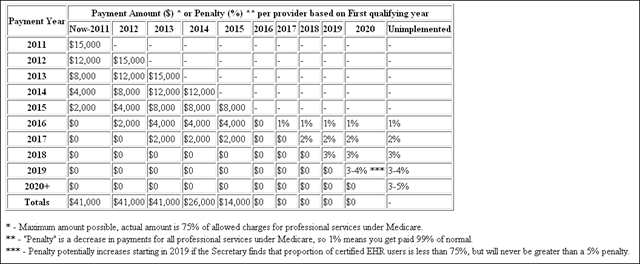
  • The Carrot: $41,000 in Medicare payments per eligible physician: Year 1 - $15,000; Year 2 - $12,000; Year 3 - $8,000; Year 4 - $4,000; Year 5 -$2,000. If Year 1 for a professional is 2011 or 2012, then the Year 1 payment is $18,000. No incentive payments if first adopting in 2015. No incentive payments after 2015. Exceptions for rural physicians and later adopters are also specified.
  • The Stick: Fee schedule reductions will apply to physicians not using certified EHR technology starting in 2015, with fee schedule reductions of 1% in 2015, 2% in 2016 and 3% in 2017 and beyond.
  • These incentives do not apply to hospital-based physicians
  • For a summary of this, HISTalk just published a table of bonuses and penalties.
Hospital Incentives for Adoption and Meaningful Use of Certified EHR Technology

Medicare incentives to hospitals (both carrot and stick) are set up in a similar model as physicians, with a more complex calculation and bigger dollars tied to their meaningful use of certified EHR's. Incentives are calculated based on an initial amount ranging from $2 - 4.6 million (based on number of discharges) multiplied by a Medicare share and a declining "transition factor" for each of four years (1, .75, .5, .25).

Medicaid Incentives

100% federally funded Medicaid incentives are included in the legislation, without back-end reduction in Medicaid fees for non-compliance. Eligible Medicaid physicians are non-hospital based with 30% Medicaid patient volume. Eligible hospitals include 1) children's hospitals, 2) acute care hospitals receiving at least 10% Medicaid patient volume and 3) health centers or rural health clinics with at least 30% Medicaid patient volume.

News Analysis - HITECH's Impact

In a look at the slightly smaller house version of this bill, the Congressional Budget Office (CBO) estimates that $19.8 billion will be spent on HITECH which will, among other things, accelerate adoption of EHR's. The acceleration will deliver US health system net savings of 0.3% betweeen 2011 and 2019, or greater than $60 billion in savings. While this is a good return, 0.3% won't by itself substantially dampen the trajectory of health care spending (see Health Care Costs: A Principal Driver of Long-Term Deficits).

The CBO projects that without the stimulus package "about 45% of hospitals and 65% of physicians will have adopted qualifying health IT in 2019. CBO estimates the incentive mechanism would boost these adoption rates to about 70% for hospitals and about 90% for physicians."

CBO's savings estimates are based on the acceleration of benefits including "reducing the number of inappropriate tests and procedures, reducing paperwork and administrative overhead, and decreasing the number of adverse events resulting from medical errors. Health IT could also improve the quality of care provided to patients by improving the information available to clinicians at the time of treatment, by encouraging the use of evidence based medicine, and by helping physicians manage patients with complex, chronic conditions. The use of health IT could also increase some costs because improved adherence to treatment protocols could increase the amount of care provided."

John Glaser has pointed out that "meaningful use" will need to be clearly spelled out in 2009, leaving only one year for implementation in order for physicians and hospitals to realize the full benefit of the incentive programs. "This is a tall order. And it means that providers should start moving now (if they aren’t already) even though the dust has yet to settle on the specifics."

Monday, January 26, 2009

High Margin Revenue Cycle Strategies

In this deepening economic crisis, growth strategies may seem less important than defensive strategies and cost reduction. But not to the CEO's of most healthcare organizations.

Stephen Forney is the guy CEO's have turned to, to go find the money. His talent for digging out dollars and doing so quickly has established a national reputation. His track record includes multiple success stories increasing net revenue and EBITDA by double-digits. You've got to love his current job title at Ardent: VP Margin Development.

His recent article (co-author Bill Phillips) on the "10 Critical Growth Strategies Healthcare Executives Must Know" was just published in the January issue of Healthcare Executive by the American College of Healthcare Executives. The growth strategies include:
  1. Acquisitions
  2. Unique Customer Services
  3. Practice Services
  4. Margin Development by Physician and/or Product Line
  5. Transfer DRG Underpayments
  6. Medicaid Eligibility
  7. Noncontract Claims
  8. Motor Vehicle Accident and Workers' Compensation Claims
  9. Managed Care Denials
  10. Managed Care Underpayments
Stephen graciously lent his insights to Healthcare Technology News.


HTN: The article talks about about three different stallers or stoppers that are signals that new growth strategies should be employed: 1) Shrinkage or shift in the profit pool; 2) Direct threat from a competitor with a new business model; 3) Growth simply stalls out. Which of these represent the greatest impact or threat to most healthcare organizations?

STEPHEN FORNEY: The scenario representing the greatest impact or threat to most healthcare organizations is that growth simply stalls out. This situation can have myriad causes. An organization can have constraint issues (i.e., not enough resources to handle growth), a community can see demographic shifts/declines, or broader economic trends (e.g., the current recession) can curtail growth.

HTN: What are some of the unique innovations in Customer Service that you think are particularly powerful in today's market?

STEPHEN FORNEY: Single call scheduling and pre-authorization programs are particularly powerful customer service enhancements in today’s market. There are many steps required to make sure a patient is ready for service (especially in a managed care environment), but most of these steps should be transparent to the patient. Information gathering should be complete to ensure proper scheduling/authorization/billing and minimize additional patient contacts. Best practice organizations are allowing on-line scheduling from patients and physician offices which greatly minimizes the back-and-forth phone calls typical in this process.

HTN: Building practice services based on best practice capabilities is an easy lever to throw. Whenever HCO's integrate, the first thing to get integrated is laundry services and maybe IT. Many times that's as far as it goes. Which practice services are most successful and most likely to generate a meaningful return?

STEPHEN FORNEY: The most beneficial services for HCOs to integrate are patient financial services (PFS) functions, materials management, transcription/coding, and managed care contracting. These areas can most easily benefit from economies of scale in an operational perspective and from increased leverage in a negotiating perspective. Additionally, internal /external best practices are easiest to adopt across organizations in these areas due to their non-clinical nature. Finally, these areas represent significant control over an organization’s cash flow, which provides an environment in which even small improvements can yield large returns.

HTN: You argue that healthcare leaders "need to review service margins for individual physicians, practices and departments to identify patterns and see where imporvements can be made." What are some of the resources that can help healthcare executives to integrate margin analysis into their physician and service line management?

STEPHEN FORNEY: The primary resource that would help healthcare executives integrate margin analysis into management practice is a formalized process for decision making that includes margin analysis. While advanced information systems can certainly assist in measuring physician/service line margins, too much emphasis is placed on such systems when trying to make financial decisions. There are many organizations with relatively unsophisticated information systems that have well developed processes for margin analysis. These organizations simply place an appropriate emphasis on margin analysis as a decision making tool.

Additionally, contract management and product line analysis systems are now readily available at multiple price points and levels of sophistication. Excepting the smallest facilities, most organizations would benefit from investing in such systems.

HTN: Are many HCO's aware of the opportunity with Transfer DRG underpayments? It seems like such low hanging fruit. Can you walk us through this strategy?

STEPHEN FORNEY: The opportunity with Transfer DRG underpayments does not enjoy a high degree of awareness with HCOs. In summary, Medicare reduces payment for any inpatient stay falling under a transfer DRG when that patient is transferred to a PPS post-acute facility before they have incurred a length of stay equal to that DRG’s GMLOS minus one day. These patients usually are transferred to a SNF or Home Health environment.

However, a significant percentage of patients transferred to these environments do not receive the designated level of care within the window defined in the Medicare regulations (three days). The payment for these patients should be the same as if they were discharged home. Medicare does not have an edit in place with the fiscal intermediaries to disburse underpayments relating to such transfers (they do have an edit for overpayments). This annual impact can easily run into six to seven figures for medium to large health systems.

HTN: Assisting patients to apply for Medicaid coverage eligibility is a public good and a great revenue producer. However, there is a growing hospital payment shortfall relative to costs for Medicare and Medicaid. Properly executed, this strategy exacerbates this public policy issue. Where do you think this is headed?

STEPHEN FORNEY: I think this could definitely contribute to a higher Medicaid spend than might exist otherwise and this could be problematic for a state that cannot generate appropriate revenues to cover the additional expense. In all likelihood, states would compensate over the long term by modifying Medicaid benefits or raising taxes.

HTN: You argue that HCO's can increase noncontract claims revenue by 100%, which is 10-15% of total claims volume. That's real money that the payers are not going to give up on easily. What's your experience negotiating to eliminate third party discounts from payer contracts?

STEPHEN FORNEY: My experience with eliminating third party discounts is that it is possible and that “rental networks” have little leverage with providers. Such networks do not steer business and, therefore, have no ability to affect a provider’s volumes. In effect, the discount being given is being listed as “in-network” with a payor. Given the absence of steerage, this benefit is of dubious value.

The sole value of these networks is to provide a framework for multiple small volume insurers to pay a provider. This warrants a small discount (5-10%) if coupled with appropriate prompt pay language. However, all such agreements should be at the same discount. Third Party Administrators (that represent small volume insurers) will have access to multiple networks and will access a provider under the most advantageous terms.

HTN: Motor vehicle accident and workers' comp claim requirements can differ by state. You suggested that sufficient resources be allocated to ensure this is handled correctly due to the substantial volume represented by these claims. What kinds of technologies and services are available to support this state-by-state claims management?

STEPHEN FORNEY: There are numerous outsource vendors that provide expertise in managing MVA and Worker’s Compensation claims. Utilizing a vendor to provide this type of service can be cost effective for some organizations. The alternative is to develop appropriate expertise in-house by hiring experienced, or training, personnel.

HTN: You identified 5 common reasons for denials including lack of pre-authorization, ineligibility, bad information including codes, uncovered services and claims not timely. There are services and software to address these issues. So how can denials management continue to be in such sorry shape across the healthcare spectrum?

STEPHEN FORNEY: Denials management remains problematic across the healthcare spectrum primarily because healthcare systems do not place sufficient emphasis on securing complete, accurate information prior to the provision of patient service/discharge. Most of the issues relating to denials can be resolved by developing solid Patient Access processes (including a QA function) centered around pre-registration, pre-authorization, and insurance verification. In addition to the processes, success requires absolute commitment from Senior Leadership in a facility/organization. Frequently, Senior Leadership inadvertently supports a breakdown in these processes by placing too great an emphasis on throughput at the expense of gathering complete information.

HTN: You've found that periodic auditing and the use of a "belt and suspenders" approach - - a second contract module - - can help to drive recovery of managed care underpayments. In your experience, is this sustainable?

STEPHEN FORNEY: There is a small level of sustainability with a second contract module. Presumably, an organization would modify the configuration(s) in its first contract module after finding recoveries with a second contract module. Each successive iteration would decrease the impact of the second contract module. However, it would continue to provide a check on new/revised contracts and is relatively low cost.

HTN: So where to begin? It's sure to be situational. But where have you had the greatest success?

STEPHEN FORNEY: I have had the greatest success by focusing in on margins by product line and looking at managed care processes for opportunity. These areas represent the potential for significant savings / incremental revenue in a short period of time. They also require an in-depth review of processes within an organization that can lead to other significant areas for margin improvement.

Saturday, January 24, 2009

New Never Events

In a sobering reminder of the challenges in eliminating preventable errors, on January 15 CMS issued three national coverage determinations (NCD) to protect patients from preventable surgical errors. These "never events" apply to surgical or other invasive procedures (sometimes collectively called "wrong site errors") including: CMS referenced a 2007 article estimating that wrong site errors might occur “once each year in a 300-bed hospital' and "surgeons who work on symmetrical structures may have a 1 in 4 chance to be involved in a wrong-site error during their careers." A 2006 study reported finding these errors in 1 of 112,994 operations. Finally, the 2006 AHRQ study reported that these errors "are extremely rare and major injury from them is even rarer."

To put the study's definition of "extremely rare" in perspective: the FAA's operational error rate (i.e., allowing two planes to be too close together) is 31% better (1 in 149,074 operations).

Effective immediately, Medicare does not cover these events, which apply to hospitals, doctors and "any other health care providers and suppliers involved in the erroneous surgeries. " This is a change in coverage limitations from some other 'never events', which had applied to hospitals only.

CMS, in an apparent moment of dark humor, stated that "instructions for processing such claims will occur at a later date." Yet CMS is quite serious about this, as only 11 states prohibit wrong-site billing.

Stories involving wrong site procedures regularly make the news such as this three time occurrence of wrong site brain surgery in Rhode Island (link on the picture):


References

Clarke J, Johnston J and Finley E. Getting Surgery Right. Annals of Surgery. 2007;246:395-405.

Kwaan M, Studdert D, Zinner M and Gawande A. Incidence, Patterns and Prevention of Wrong-Site Surgery. Archives of Surgery. 2006;141:353-358.

Monday, January 19, 2009

ICD-10: No Time to Relax

Final rules were published on January 16 for ICD-10 codes and the related electronic transactions. The relaxed compliance dates offer no reason to relax.

ICD-10

The health care industry will switch to ICD-10 on October 1, 2013. Encounters and discharges occurring before October 1, 2013 will use ICD-9, and those occurring on or after that date will use ICD-10. The final rule suggests that compliance activities (gap analysis, design, development, internal testing) should begin in January 2011.

The fundamental driver for ICD-10 is financial - - the inability for ICD-9 to support the growing number of high-priced medical procedures. For more on this, see "More Painful than an Insect Bite? ICD-10 Cost-Benefit for Healthcare Providers".

ICD-10 will be used where ICD-9 is used today. More specifically, ICD-10-CM (Clinical Modification) will be used for diagnosis coding and ICD-10-PCS (Procedure Coding System) will be used for inpatient hospital procedure coding. CPT and HCPCS codes will continue to be used in an ambulatory setting.

According to HHS, ICD-10 will:
  • "Support value-based purchasing and Medicare’s anti-fraud and abuse activities by accurately defining services and providing specific diagnosis and treatment information;
  • Support comprehensive reporting of quality data;
  • Ensure more accurate payments for new procedures, fewer rejected claims, improved disease management, and harmonization of disease monitoring and reporting worldwide; and
  • Allow the United States to compare its data with international data to track the incidence and spread of disease and treatment outcomes..."

In a bit of a stretch, HHS contends that "ICD-10 will also improve claims processing and payment, and, through the use of health care technology that utilizes ICD-10, assist health care practitioners in making treatment decisions by more precisely matching diagnoses and procedures to the appropriate code. For example:

  • Pressure ulcers are a common condition in elderly Medicare beneficiaries with chronic illnesses. Under the current ICD-9-CM system, health care practitioners can identify the severity or location of a pressure ulcer but the coding system cannot link those elements if the patient has more than one ulcer. Under a single ICD-10 code, a patient’s medical history will identify the severity and location of each pressure ulcer;
  • ICD-9 has only one code for angioplasty, the widely used procedure for widening a narrowed or obstructed blood vessel. ICD-10 provides 1,170 coded descriptions, with a granularity that pinpoints the location of the blockage and the device used for each patient;
  • ICD-9 codes do not provide sufficient detail to distinguish whether a condition occurred on a patient’s left or right side. ICD-10 will improve care by providing that basic type of information; and
  • ICD-9 includes separate codes for medication errors and other external causes of injury, which are reported separately from the actual condition. Under ICD-10, information about medication errors and external causes of injury will be embedded in the code for the condition. Therefore a single, more informative code will provide a ready source of information to help medical professionals prevent medical errors and improve quality of care."
PQRI and other quality measures will also be affected by these standards. CMS makes it clear in the final rule that there will be ICD-10 updates to the quality measures in regulations to follow.

CDC and CMS are good sources of information on ICD-10-CM and ICD-10-PCS guidelines and cross-mappings, even including a mapping from ICD-10 (international) to ICD-10 (U.S.).


Electronic Transactions

The HIPAA electronic transaction standards also get a refresh with a compliance date of January 1, 2012. The 5010 version supports the ICD-10 code sets and applies to claims, remittance, eligibility, referrals/authorization, and other transactions . In addition to ICD-10 support, 5010 changes "include structural, front matter, technical, and data content improvements... (and) addresses ... unmet business needs including ... providing on institutional claims an indicator for conditions that were 'present on admission.' " The target date for covered entities to complete internal testing is December 2010, so testing among trading partners can begin January 2011.

The NCPDP standard for electronic pharmacy-related transactions is upgraded to version D.0 to better support Medicare's Part D prescription drug benefit claims processing, including coordination of benefits. The compliance data is also January 1, 2012. In addition, Version D.0:
  • "Provides more complete eligibility information for Medicare Part D and other insurance coverage;
  • Better identifies patient responsibility, benefits stages, and coverage gaps on secondary claims; and
  • Facilitates the billing of multiple ingredients in processing claims for compounded drugs."
A Medication subrogation standard is adopted with the same compliance date as the other transactions for all but small health plans (the subrogation process allows Medicaid to recover payments from a payer that has primary financial responsibility).

Costs and Benefits

CMS estimated costs and benefits as follows (click on the picture to expand):


News Analysis

Eight years after the original HIPAA rule was issued, use of electronic transactions remains stubbornly and abysmally low (see Healthcare's Indefensible Administrative Costs). This suggests a major industry challenge in updating the electronic transactions and preparing for cutover to ICD-10.

Systems changes will be required across the health system to accommodate the coordinated cutover of the electronic transactions. Then, on a single date for the industry, process and system changes will go into effect to support two code sets (ICD-9 for events before the date and ICD-10 after). Many systems will require iterative major upgrades to effectively support these requirements, each with full deployment to their customer base in fairly tight timeframes.

This suggests a level of execution and capability that has only happened once before. That event was Y2K - - which caused one CEO to ruefully recount how he gave his CIO an unlimited budget, yet the CIO managed to exceed it. And which will now cause healthcare technology companies to ponder how they avoid a repeat of the sales collapse that immediately followed.

Thursday, January 15, 2009

Stimulus Draft Calls for $20 Billion Jumpstart To Computerize Health Records

The American Recovery and Reinvestment draft plan circulating in the US House of Representatives includes the following:

  • "Health Information Technology: $20 billion to jumpstart efforts to computerize health records to cut costs and reduce medical errors.
  • Prevention and Wellness Fund: $3 billion to fight preventable chronic diseases, the leading cause of deaths in the U.S., and infectious diseases. Preventing disease rather than treating illnesses is the most effective way to reduce healthcare costs. This includes hospital infection prevention, Preventive Health and Health Services Block Grants for state and local public health departments, immunization programs, and evidence-based disease prevention.
  • Healthcare Effectiveness Research: $1.1 billion for Healthcare Research and Quality programs to compare the effectiveness of different medical treatments funded by Medicare, Medicaid, and SCHIP. Finding out what works best and educating patients and doctors will improve treatment and save taxpayers money.
  • Community Health Centers: $1.5 billion, including $500 million to increase the number of uninsured Americans who receive quality healthcare and $1 billion to renovate clinics and make health information technology improvements. More than 400 applications submitted earlier this year for new or expanded CHC sites remain unfunded.
  • Training Primary Care Providers: $600 million to address shortages and prepare our country for universal healthcare by training primary healthcare providers including doctors, dentists, and nurses as well as helping pay medical school expenses for students who agree to practice in underserved communities through the National Health Service Corps.
  • Indian Health Service Facilities: $550 million to modernize aging hospitals and health clinics and make healthcare technology upgrades to improve healthcare for underserved rural populations."

Update from HISTalk: "The discussion draft ...contains only $2 billion in new funds specific earmarked for healthcare IT, with that entire amount to be managed by the Office of the National Coordinator. The remainder of the $20 billion figure that was quoted for healthcare IT would be distributed by CMS as pay-for-performance incentives that have not yet been defined."

Tuesday, January 13, 2009

Health Care Costs: A Principal Driver of Long-Term Deficits

On January 13, Barack Obama's nominee for Director of the Office of Management and Budget, Peter Orszag, testified that health care costs are a "principal driver of our long-term deficits".

Orszag advocated for "expanding the use of health information technology (IT) and electronic medical records, which is a necessary, but not sufficient, measure to improving the quality and efficiency of the health care system". Orszag outlined other steps that can contribute to reductions in health care costs including research on comparative effectiveness of treatment options, incentives for "better care rather than more care", and incentives for prevention and healthy living.

Orszag, a recent director of the Congressional Budget Office, is well respected in economic and political circles. His pronouncements regarding the impact of health information technology bring gravitas to this discussion.


Orszag's discussion of health care costs follows:

"The principal driver of our long-term deficits is rising health care costs... Let me provide just one telling fact: If costs per enrollee in our two main federal health care programs, Medicare and Medicaid, grow at the same rate as they have for the past 40 years, those two programs will increase from about five percent of GDP to 20 percent by 2050. That’s roughly the entire size of the federal government today. (As the Congressional Budget Office and others have noted, there are reasons to expect cost growth to slow in the future relative to the past even in the absence of policy changes. But the point remains that slowing health care cost growth is key to our fiscal future.)

Rising costs for Medicare and Medicaid, in turn, reflect rising health care costs across the public and private sectors. Therefore, we need to be thinking about ways to slow overall health care cost growth, rather than just reducing the rate of growth in Medicare and Medicaid. Indeed, were we to try to slow Medicare and Medicaid spending alone without slowing the rate of growth in health care costs system-wide, we would simply create massive access problems for Medicare and Medicaid beneficiaries, since providers would be increasingly unwilling to serve those populations relative to others. Medicare and Medicaid policy changes can help to lead the way. But those changes will not be sustainable over time unless they also help to drive down cost growth in the rest of the system.

Improving the efficiency of the health system, however, has benefits that extend well beyond the budget. Health care costs are already imposing severe burdens on state governments – on average, health care absorbs about a third of state budgets, even more than is taken up by education. Moreover, health care costs are reducing workers’ takehome pay to a degree that is both unnecessarily large and perhaps under-appreciated.

There is a ray of hope. We appear to have massive opportunities to reduce health care costs without harming health outcomes. Significant evidence suggests that higher cost does not always mean higher-quality care. As I have noted before, perhaps the most compelling evidence of this fact is that per-capita health care spending varies widely across the United States, but the very substantial variation in cost per beneficiary is not correlated with overall health outcomes. Thus, embedded in the country’s fiscal challenge and the current burdens on state governments and workers are opportunities to reduce costs without impairing health outcomes overall.

Some of the many steps that would help to improve the efficiency of the health system include the following:


  • expanding the use of health information technology (IT) and electronic medical records, which is a necessary, but not sufficient, measure to improving the quality and efficiency of the health care system;

  • expanding research on “comparative effectiveness” of different options for treating a given medical condition, which could provide information on both medical benefits as well as costs;

  • providing financial incentives for better care rather than more care (currently, financial incentives for providers and patients encourage or facilitate expensive treatment and procedures, even when there is little evidence that they are more effective than existing therapies); and

  • providing incentives for prevention (such as immunizations and screening tests) and healthy living (such as avoiding obesity and smoking) so that people have fewer health care problems throughout their lives."

Friday, January 9, 2009

Good Enough? The IOM Report on Technology for Effective Health Care

On January 9, 2009, an Institute of Medicine / National Research Council report (Computational Technology for Effective Health Care: Immediate Steps and Strategic Directions) reviewed use of healthcare information technology at a number of sites including Partners HealthCare, the University of Pittsburgh Medical Center, HCA Tristar, Intermountain Healthcare, the Palo Alto Medical Foundation, the University of California (San Francisco), Vanderbilt University Medical Center, San Francisco General Hospital, and the Veterans Administration.

The report says in part that "the committee observed a number of success stories in the implementation of health care IT. But although seeing these successes was encouraging, they fall far short, even in the aggregate, of what is needed to support the IOM’s vision of quality health care. IT-related activities of health professionals observed by the committee in these institutions were rarely well integrated into clinical practice. Health care IT was rarely used to provide clinicians with evidence-based decision support and feedback; to support data-driven process improvement; or to link clinical care and research. Health care IT rarely provided an integrative view of patient data. Care providers spent a great deal of time in electronically documenting what they did for patients, but these providers often said that they were entering the information to comply with regulations or to defend against lawsuits, rather than because they expected someone to use it to improve clinical care. Health care IT implementation time lines were often measured in decades, and most systems were poorly or incompletely integrated into practice."

"Although the use of health care IT is an integral element of health care in the 21st century, the current focus of the health care IT efforts that the committee observed is not sufficient to drive the kind of change in health care that is truly needed. The nation faces a health care IT chasm that is analogous to the quality chasm highlighted by the IOM over the past decade. So that the nation can cross the health care IT chasm, the committee advocates re-balancing the portfolio of investments in health care IT to place a greater emphasis on providing cognitive support for health care providers, patients, and family caregivers; observing proven principles for success in designing and implementing IT; and accelerating research related to health care in the computer and social sciences and in health/biomedical informatics."

Link here for more on the "Good Enough" debate in Healthcare Technology.

Monday, January 5, 2009

Good Enough? The Debate Over Investments in Healthcare Technology


Are today's healthcare IT systems "good enough"?

David Blumenthal (Harvard Medical School and Institute for Health Policy) said "the debate over whether existing technology is good enough has only emerged recently, with the prospect of a huge national investment in electronic health records. What seems to be happening ... is that passionate health technology advocates fear the country could get locked into an imperfect system."

Healthcare technology interoperability is considered a key component to reduction of administrative costs and improved coordination and continuity of care. Mike Leavitt, Secretary of HHS, contends that "we're already on the road to a system that is universally accessible and secure. Health information experts ... have been working on foundational health IT standards and have made substantial progress."

In Next Steps for Interoperability, John Halamka (Chair of HITSP and CIO for Harvard Medical School and Beth Israel Deaconess) believes that "we can achieve a substantial improvement in care quality and coordination by implementing the systems available now." He posits that the definition of healthcare technology interoperability that is "good enough" includes:
  • "Support for medication interoperability such as e-prescribing linking providers, payers, and pharmacies
  • Support for laboratory and radiology interoperability such as orders and results integration among providers, hospitals and commercial labs
  • Support for seamless electronic interchange between providers and payers for administrative data flows.
In 2009, several EHR vendors will support clinical summary exchange."

Transition into product, and incentive systems for EHR adoption, has been accelerated through certifications including interoperability standards. Mark Leavitt, Chair of the Certification Commission for Healthcare Technology (CCHIT), recently reported on the existing certification programs, which started with an ambulatory EHR certification program launched in 2006.


According to Mark Leavitt, CCHIT certified product are now required for a number of EHR incentive systems which have developed over the last two years, with total investments exceeding $700 million, including 44 distinct public and private EHR programs and "54 new EHR rollouts, representing 147 hospitals under Stark safe harbor rule." Around 46,000 physicians are eligible for, or have received assistance under these programs.

Take time to parse the following from Mark Leavitt: "That there are no good products is absolutely not the problem".

Secretary Mike Leavitt argues that that Obama's Recovery and Reinvestment Plan should require that investments in health IT systems be certified interoperable. This "could spur a critical mass of the nation's doctors to finally enter the information age... If we're going to build a 21st-century health infrastructure, we need to do it strategically, continuing the careful work on harmonized standards that will create one nationwide, interoperable system. That's the only way to make an investment in health IT produce value for providers and patients and improve the quality of health care overall."

Not everyone is convinced that these investments will pay off. David Kibbe (Senior Advisor to the American Academy of Family Physicians) and Brian Klepper argue that "the easy solution would be to spend most of the health IT funds on EHRs. The EHR industry has made it easy by establishing a mechanism to 'certify' EHR products if they incorporate certain features and functions." Kibbe and Klepper contend that EHRs are expensive, disruptive to implement, with no clear patient safety benefits and are not yet interoperable. "These barriers to adoption are well documented; they form the wall that has kept physician EHR adoption overall to less than 25 percent in this country. Even if a hefty federal subsidy reduced the exorbitant cost of the EHRs, many practices would suffer severe negative business impacts, and primary care access could temporarily be reduced on a national scale."

In the meantime, some healthcare organizations are waiting on the sidelines for the federal Recovery and Reinvestment Plan to be enacted before making new health IT investments.

Link here for more on the "Good Enough" debate in Healthcare Technology.