Thursday, April 9, 2009

The Week in Review - April 9, 2009

A look back at some of the best news stories (and some entertaining diversions) from the week in health care.
________________

Florida Times-Union reports on slow costly transition to electronic medical records.

New York Times editorial weighs in on the "miles to go on e-health records".

iHealthBeat reports on remote patient monitoring and its use for chronic diseases (see above).

Time Magazine contributor Dr. Scott Haig challenges Electronic Medical Records, calling them the "wrong prescription" to reduce health-care costs.

"Two-thirds of U.S. hospitals have made significant progress toward implementing comprehensive electronic health records, HIMSS Analytics contends. The assertion comes in reaction to a recent report in the New England Journal of Medicine that claimed only 1.5% of hospitals have a comprehensive EHR in place."

Why don't the HIPAA rules apply to Google and Microsoft?

Open-source gateway software for the nationwide health information network released by the Office of the National Coordinator for Health IT.

PHR's and portals are up and comers - - but just not quite yet.

Tuesday, April 7, 2009

How Hard Can It Be To Coordinate Care?

There's one patient, one primary care physician and a couple other providers, right?

Not from the perspective of the physician who has to coordinate with 229 providers across 114 practices. A recent article in the Annals of Internal Medicine spells out the challenge.

Dr. Mai Pham is the Senior Health Researcher and Co-Director for Quantitative Research at the Center for Studying Health System Change. She was the principal investigator for "Primary Care Physicians' Links to Other Physicians Through Medicare Patients: The Scope of Coordination of Care".

Mai recently sat down with Healthcare Technology News to talk about the study and its implications for healthcare reform.

HTN: Please tell us about the Center for Studying Health System Change. With all the work on health care reform, what will this next year bring?

Mai Pham: HSC is a non-partisan, health policy research organization in Washington that focuses on understanding how health policy decisions affect people and health care markets. The coming months obviously will generate a lot of debate on the issues we’re interested in. I think it will be interesting to see how policymakers balance the desire to broaden insurance coverage versus the need to rein in costs and at least begin to tackle re-design of the health care delivery system.

HTN: You just completed a study which found that the typical primary care doctor may need to coordinate care with 229 doctors across 117 different practices. That’s an eye-popping statistic.

Mai Pham: It really is very daunting. We worked hard to keep our estimates on the conservative side – we focused only on Medicare patients and only physicians. If you consider younger patients and important providers like nurse practitioners, those numbers would be even larger. We imagine that a primary care doctor wouldn’t necessarily be able to name all the other doctors in his or her “peer network.”

HTN: The reality is that doctors can’t stay meaningfully in touch with this many providers, right?

Mai Pham: It is possible that physicians manage to exchange some clinical information most of the time, with the peers that they know about. But it seems far less likely either (1) that they know who all their peers are since Medicare patients can self-refer to any physician and don’t necessarily tell their primary care doctor about all their other providers; or (2) that all these physician peers can really engage in meaningful, shared decision-making, which I think is one of the tougher tasks in coordinating care.

HTN: So what happens today? And what should be happening?

Mai Pham: My guess about what’s happening today is that both patients and physicians feel overwhelmed by the fragmented nature of care and care relationships. Often it will seem to them that it’s not possible for anyone to really steer the ship in a way that is consistent with a patient’s needs and preferences. I think a more ideal situation might be one in which a patient identifies a single practice as their “medical home,” and is honest with that practice about care that they seek elsewhere. Then the medical home would have a reciprocal responsibility to choose their peers carefully based on those peers’ demonstrated willingness to communicate and coordinate with them, explain to patients why they prefer some peers to others, and not least – get paid to do that coordination work, which they don’t have under fee-for-service structures.

HTN: Since your study was limited to fee-for-service Medicare patients and didn’t consider non-physician providers, it’s likely that the actual number of provider links is greater than the median 229. Care to guess how much greater?

Mai Pham: I don’t think it would be as large as double, because Medicare patients will tend to be sicker and require more different physicians than will other patients, but I think it would be noticeably larger, especially for family practitioners who also need pediatric consultants. Let’s just say I pale at the thought….

HTN: You suggest that this fragmentation of care might be effectively addressed by formalizing relationships and tying payment to “peer webs”. Can you explain the peer web concept?

Mai Pham: Other terms that try to capture the same concept include “medical neighborhood” and “peer networks.” The concept is that no physician has sole influence over their patients’ care. Even if I am the main provider for my patient, their “medical home” if you will, I need to coordinate shared decision-making with all the other providers who also treat my patient. If you extend that one “web” for one patient to all of my core patients, you start to see the complexity of my total “peer web.” It’s really about shouldering the burden of care coordination as a primary care doctor.

HTN: You found that patients are seeing “7 different physicians from 4 different practices in a given year, and care of patients with multiple chronic illnesses is even more fragmented.” What does this fragmentation of care mean to the patient? Will peer webs help?

Mai Pham: For patients, I think it means a lot of mental energy goes into navigating the system, having potentially redundant conversations with different physicians, and in the end, not necessarily getting the care you need or want because details fall through the cracks. I think rationalizing peer webs can help, if there is an explicit understanding between different physicians and between physicians and patients that “this is what you can expect of me when you send me a referral” or “this is what we will do together when we consult you.”

HTN: What are the implications of your study on the requirements for the Advanced Medical Home?

Mai Pham: I think there is interest in broadening the medical home concept to incorporate this notion of a “medical neighborhood” in a way that sets realistic expectations for how physicians outside of the medical home will behave, and how each physician will be paid to support shared decision-making and effective coordination.

HTN: What other implications does your study have for the health care reform debate now underway?

Mai Pham: I think it is very tempting for reformers to focus on creating “winners,” for example by offering greater access to insurance coverage. The flip side of that is ensuring that once someone has insurance, they can actually get good care. Whether or not they take it as one of the early steps in reform, policymakers will eventually have to confront the need to re-design the care delivery system, or the money we spend on increasing access may not be worth it.

Sunday, April 5, 2009

Mayo Clinic, IBM Launch Open-Source NLP Initiative

On March 31, Mayo Clinic and IBM biomedical informatics researchers announced the formation of the Open Health Natural Language Processing Consortium and donated their systems for natural language processing (NLP) to this open source initiative.

Clinical natural language processing is ideally suited for the large amounts of unstructured text found in clinical notes and reports. NLP systems "categorize and structure it according to standard nomenclature – in this case focusing on terms used in a range of medical specialties – that will ultimately speed data searches for both diagnoses and medical research. These NLP platforms or “pipelines” aid indexing and searching electronic medical records within institutions to quickly find similar cases or conditions, so physicians are not reliant solely on their own clinical experience in analyzing a problem. Researchers may also use these tools to aid retrospective epidemiological studies or do groundwork for new clinical trials."

Dr. Christopher Chute from Mayo Clinic said that up to now "much of information has languished in clinical records in a way that has made it difficult to analyze, interpret or understand across populations of patients. "

The two NLP solutions include clinical notes and pathology reports.

The teams developed methods for extracting information from over 20 million unstructured clinical notes. Physicians can "mine the text for references of specific conditions, drugs, diseases, signs and symptoms; anatomical areas or organs; or treatment procedures."

In addition, they focused on unstructured pathology reports to be able to mine cancer disease characteristics. "The system extracts tumor characteristics, lymph node status and metastatic disease information enabling the automatic computation of cancer stage, which is critical to determine optimal treatment."

Mayo reporting realizing the following benefits:
  • "Physicians can research past records to examine earlier cases of rare conditions, thereby “conferring” with their colleagues across time to aid diagnosis and treatment decisions.
  • Retrospective studies of tissue samples can propel new research findings, as happened with a major breast cancer finding at Mayo in 2008.
  • Enhanced ability to mine data and determine potential study factors or participants has already enabled individualized medicine treatments in psychiatric care."
The Clinical Genomics Collaborative prepared this demonstration.

Thursday, April 2, 2009

The Week in Review - April 2, 2009

A look back at some of the best news stories (and some entertaining diversions) from the week in health care.
________________

All Things Considered reports on Governor Kathleen Sebelius as her HHS nomination faces Senate questioning. Is it a preview to the "looming debate" over health care reform?

The Struggle for Reform - Challenges and Hopes for Comprehensive Health Care Legislation.

The "Right Hospital for You" reports on the top 125 hospitals, with comparative data by region with information on death rate for high risk cases, rate of major complications in cases, % of cases with proper tests and procedures, and ratings by consumers and physicians.

"A new study casts doubt on a hospital safety rating conducted by the Leapfrog Group, a nonprofit business coalition."

Drs. Mandl and Kohane argue that health care information systems should be modular, platform-based and interoperable, rather than monolithic.

In the third such suit against payers, the AMA and state medical associations allege that WellPoint "colluded with database firm Ingenix to fix prices in a multistate scheme to underpay doctors for so-called out-of-network medical care."

Kaiser reports reducing cardiac deaths by 73 percent using an integrated clinical team "connected by technology tools that help them deliver care proven to improve health outcomes. Activities such as lifestyle modification, medication management, patient education, laboratory results monitoring, and management of adverse events."

Wireless technology is used to "remotely monitor heart arrhythmia through personal mobile devices."

Study finds that 1/3 of patient bad debt should have been classified as charity care. "With self-pay portfolio balances rising, regulatory authorities are scrutinizing hospitals’ charity care practices and provisions of community benefit in exchange for tax exemptions. "

An ASQ study finds that "53 percent of hospitals report some level ("minor," "moderate" or "full") of lean deployment, and 42 percent of hospitals report some level of Six Sigma deployment".

DOD and VA partnering on lifetime longitudinal medical record.


Geisinger introduces warranties on heart surgery and "reduces bypass surgery costs by 15%".

The Save $4 Billion campaign is launched using benchmarking to improve visibility of hospitals' relative performance.

Would you pay $60 per year to e-mail your physician?

Budgeting for Change - Obama's Down Payment on Health Care Reform.

Wednesday, April 1, 2009

HHS Makes the Case for Health Reform: The Costs of Inaction

On Monday March 30, the Department of Health and Human Services released their report on The Costs of Inaction - the Urgent Need for Health Reform.

The report lays out the the challenge of controlling health care costs.
  • "Employer-sponsored health insurance premiums have more than doubled in the last 9 years, a rate 6 times faster than cumulative wage increases.1
  • The United States spent approximately $2.2 trillion on health care in 2007, or $7,421 per person.2 This comes to 16.2% of GDP, nearly twice the average of other developed nations.3
  • Health care costs doubled from 1996 to 2006, and are projected to rise to 25% of GDP in 2025 and 49% in 2082.4
  • The proportion of spending attributable to Medicare and Medicaid in the health system is expected to rise from 4 percent of GDP in 2007 to 19 percent of GDP in 2082, making it the principle driving force behind rising federal spending in the decades to come.5
  • Health care costs add $1,525 to the price of every General Motors vehicle. The company spent $4.6 billion on health care in 2007, more than the cost of steel.6
  • As a result of these crushing health care costs, American businesses are losing their ability to compete in the global marketplace. Health care at General Motors puts the company at a $5 billion disadvantage against Toyota, which spends $1,400 less on health care per vehicle.7,8
  • The average cost of an employer-based family insurance policy in 2008 was $12,680, which was nearly the annual earnings of a full-time minimum wage job.9
  • From 2000 to 2008, the percentage of employees with an annual deductible greater than $1000 increased from 1% to 18%. Among small businesses, more than one in three workers must spend at least $1000 out of pocket before their health benefits kick in.10
  • Half of all personal bankruptcies are at least partly the result of medical expenses.11
  • The typical elderly couple may have to save nearly $300,000 to pay for health costs not covered by Medicare alone.12
  • Eight in ten Americans are dissatisfied with the total cost of health care,13 and over half report paying for the cost of a major illness as a major problem.14"

The report cites the "persistent gaps in quality, in spite of the vast resources invested." The US scored a 65 out of 100 on the most recent National Scorecard for Health System Performance reviewing 37 indicators of health system performance.


Rebecca Adelman of HHS, in a companion piece, desribes the increasing problems with health care access. According to the report, "health care costs doubled from 1996 to 2006, and more Americans are being left out of the health care system than ever before. An estimated 87 million people -- one in every three Americans under the age of 65 -- were uninsured at some point in 2007 and 2008."

Monday, March 30, 2009

Chronic Care: Wagner's Chronic Care Model

Over 100 million people in the US are suffering from at least one chronic illness. "Three-quarters of the $2 trillion-plus that we spend on U.S. health care each year goes to paying the bills for chronic illness: cardiovascular and pulmonary disease, cancers, diabetes, arthritis, high blood pressure, depression."

The Chronic Care Model focuses on practice improvement for patient-centered evidence-based proactive care of chronically ill populations.

Science and Society's February 2009 edition features an audio interview with Ed Wagner, the father of the Chronic Care Model. The interview reviews the implications of the chronic care model for "redesigning the health care delivery system, creating a better-prepared practice team, and developing methods for increasing patients’ knowledge, skills, and confidence." Improving Chronic Illness Care provides a video overview of the Chronic Care Model by Dr. Wagner.

1500 medical practices are using the Chronic Care Model. The Chronic Care Model "comprises six interrelated system changes: effective team care; planned interactions; self-management support; community resources; integrated decision support; and patient registries and other supportive information technology (IT)."

From a technology perspective, registries, decision support, patient/provider communication, patient education and information exchange for care coordination are all important enablers. "Registries track patients with specific chronic diseases, helping medical teams to make the most of each office visit and follow evidence-based care guidelines."

The chronic care model is designed to address the deficiencies in current practice of chronic care including:
  • "Rushed practitioners not following established practice guidelines
  • Lack of care coordination
  • Lack of active follow-up to ensure the best outcomes
  • Patients inadequately trained to manage their illness"
Health Affairs January/February edition was dedicated to The Crisis in Chronic Disease. Susan Dentzer finds that "the evidence continues to pile up that the famed Chronic CareModel developed by Ed Wagner and colleagues at Group Health Puget Sound delivers superior patient care and health outcomes. (The evidence is starting to trickle in about the model’s overall cost-effectiveness.)"

In a recent interview, Dr. Ben Littenberg summarized that "the Chronic Care Model is a very influential idea about how to do a good job in taking care of people with ongoing medical problems like high blood pressure, arthritis, and in our case, diabetes. It tells what resources the health care system must have to get the most out of the interaction between the doctor and the patient. These include systems to support clinical decision making, up-to-date and easy-to-use clinical information, reminders, support for patient self-management, and so on. Turning a typical primary care medical office into a fully-functional chronic care model practice is a good thing, but it is complex, expensive and time-consuming. It requires extensive retraining of the physicians, nurses and other staff, installation of comprehensive electronic medical records systems, changes in the way patients and staff interact, and even an overhaul of the way care is paid for. So, very few practices have successfully transformed themselves."

Roberts Wood Johnson had contracted with Rand to evaluate the impact of the Chronic Care model. "Highlights of the findings include:
  • Organizations were able to improve, making an average of 48 changes in 5.8 out of the 6 CCM areas;
  • Patients with diabetes had significant decreases to their risk of cardiovascular disease;
  • CHF pilot patients more knowledgeable and more often on recommended therapy, had 35% fewer hospital days;
  • Asthma and diabetes pilot patients were more likely to receive appropriate therapy.
When contacted a year later, the care teams reported that involvement in the collaboratives was rewarding. Over that year, 82% of sites had sustained the changes and 79% of sites had spread change to other places or diseases."

Dr. Wagner is focusing his current efforts on regional models for chronic care.


The Chronic Care Model was developed in part with support from Robert Woods Johnson grant by Improving Chronic Illness Care with direction and technical assistance from the The MacColl Institute for Healthcare Innovation at the Group Health Center for Health Studies.

Thursday, March 26, 2009

The Week in Review - March 26, 2009

A look back at some of the best news stories (and some entertaining diversions) from the week in health care.
________________

"The number of medically disenfranchised has reached 60 million" according to a report from the National Association of Community Health Centers.

David Blumenthal, the new National Coordinator for Health Information Technology, weighs in on stimulating the adoption of health information technology. John Glaser will join David Blumenthal as an ONC advisor for 6 months, while retaining his role at Partners Healthcare.

Dr. Ashish Jha talks about the conversion to electronic medical records in this NPR interview. He found that "comprehensive" EHR systems are used by only 1.5% of hospitals and only 7.6% of hospitals have a "basic" EHR.

The California HealthCare Foundation releases a report on patient registration kiosks delivering value and increased patient satisfaction. Yet they are adopted by less than 10% of healthcare organizations.

Drs. Bates, Halamka and Middleton make the case for the effectiveness of healthcare technology.

Will IT Save Healthcare? on National Public Radio's "To the Point".

Can technology enable patients to be better advocates for their own care? The Wall Street Journal reports on how patients use "information therapy".

CCHIT plans to accelerate advanced technology certification programs in Clinical Decision Support, Interoperability, Quality and Security in order to better align with the objectives in the ARRA stimulus package.

Monday, March 23, 2009

Chronic Care: Improving Patients' Quality of Life

The March 16 edition of the American Journal of Managed Care reports that a "laboratory-based decision support system designed for low cost and easy integration into primary care... showed significant improvements in clinical care and health care utilization." The study was funded in part by the National Institute of Diabetes and Digestive and Kidney Diseases.

Dr. Ben Littenberg (MD, FACP) is the principal investigator for the study. He is the Henry and Carleen Tufo Professor of Medicine, Professor of Nursing and Director of General Internal Medicine for the University of Vermont College of Medicine. He is also CEO of Vermont Clinical Decision Support which distributes the Vermedx® Diabetes Information System (VDIS), the subject of this study.

Dr. Littenberg sat down with Healthcare Technology News to talk about his findings.

HTN: Can you please talk about Wagner's Chronic Care Model and its influence on your work?

Ben Littenberg: The Chronic Care Model is a very influential idea about how to do a good job in taking care of people with ongoing medical problems like high blood pressure, arthritis, and in our case, diabetes. It tells what resources the health care system must have to get the most out of the interaction between the doctor and the patient. These include systems to support clinical decision making, up-to-date and easy-to-use clinical information, reminders, support for patient self-management, and so on. Turning a typical primary care medical office into a fully-functional chronic care model practice is a good thing, but it is complex, expensive and time-consuming. It requires extensive retraining of the physicians, nurses and other staff, installation of comprehensive electronic medical records systems, changes in the way patients and staff interact, and even an overhaul of the way care is paid for. So, very few practices have successfully transformed themselves. When we designed Vermedx(R), we took as much of the chronic care model as we could while still maintaining very low cost per patient, very little disruption of the clinical work-flow, and no requirement that the practice invest money on computers or other fixed costs.

HTN: What is the current state of technology to assist in the management of diabetes?

Ben Littenberg: Drugs for diabetes have gotten much better in the last 20 years. Also, we know a lot now about how to prevent the complications of diabetes - heart attacks, strokes, kidney failure, blindness, amputations, and so on. However, it takes a lot of very careful attention to lots and lots of data. How high is the blood sugar? When was it measured? When should the cholesterol be tested again? How close is the patient to goal? Office systems have failed to keep up with the needs of the patients and providers. Paper records just don't work well in this setting. A typical laboratory report shows the numeric value of the result and a so-called "normal" range, but it doesn't tell you what the test means or what to do about it.

Most offices have no organized method for keeping track of all the blood and urine tests used in diabetes, let alone a system that reminds the patient when a test is due and even advises the doctor on what to do.

HTN: How is VDIS different?

Ben Littenberg: Vermedx automatically collects the laboratory test results on diabetic patients and reports them to the doctor (or other health care provider). It puts the test results into context, shows trends over time, and suggests actions. It also takes action when a test should have been done, but wasn't. It sends reminders to the practice and letters (from the providers) to the patients encouraging them to get into care. If the test results are very high, it also notifies the patient to get back to the practice to change the care plan. Vermedx also provides a population view of the doctor's entire panel of diabetic patients: who is doing well, who needs help, and how the practice is doing compared to others.

HTN: Your study found a sustained continuing decrease in utilization that is striking. Please tell us about the results.

Ben Littenberg: With NIH funding, we conducted a long-term randomized study of VDIS in community primary care. Over 7,000 patients in 64 practices participated. The patients in that study who received VDIS reported far fewer trips to the Emergency Room, unscheduled hospital admissions and doctor visits than patients who didn't get VDIS. The problem was that we didn't have access to the medical bills in that study. The recent study in the American Journal of Managed Care looked at patients getting Vermedx as part of their usual care and was able to compare the insurance claims paid to other diabetic adults who did not have Vermedx. Before VDIS was available, both groups had steadily rising costs month-by-month. The control patients' claims kept going up, but less than a year after turning on the system, the VDIS patients' claims started going down. The savings were $504 per patient in the first year, went up to $3,563 in year 4, and kept getting better!

HTN: For the VDIS patients, what were the differences in health outcomes?

Ben Littenberg: VDIS patients are much more likely to get their laboratory tests on time. Although they are no more likely to reach goals for blood sugar or cholesterol, they spend less time in the Emergency Room and hospital, which indicates a substantial improvement in quality of life.

HTN: Understanding that your study does not suggest causality between VDIS and utilization, what is your hypothesis about the relationship?

Ben Littenberg: Actually, the first study was randomized and therefore, does provide good evidence of causality. However, nobody is entirely certain how it works. Since the blood test results aren't different, it probably doesn't work by preventing complications. One theory is that improved communications give patients confidence - they know that they will be back in touch with the doctor and don't need to call for every little issue. It's like those reminder postcards to get your car's oil changed. You know you're going to bring the car in soon, so you might be less anxious about getting service right away for some funny noise under the dashboard. Of course, you're also being seen on a schedule - before you have an emergency!

HTN: VDIS sends alerts to both physicians and patients. What is your view of the relative effectiveness of focus on the physician or focus on patient self-management?

Ben Littenberg: They both seem to be valuable. The core idea behind the Chronic Care Model is to activate the patient to get involved in their care AND prepare the practice to meet that patient's needs. Working on both ends of the relationship is much more effective than either one alone.

Friday, March 20, 2009

HHS Names National Coordinator for Health Information Technology

HHS has named Dr. David Blumenthal to the post of National Coordinator for Health Information Technology.

Blumenthal is an expert in health policy and health care systems and is the founding director for the Institute of Health Policy at Mass General.

According to his bio, "Dr. Blumenthal’s research interests include the extent and consequences of academic-industrial relationships in the life sciences; professionalism and the determinants of physician behavior; the organization and financing of physicians services; the dissemination of health information technology; and quality management in health care organizations." Blumenthal served as Senior Health Advisor to Barack Obama during his campaign.

Thursday, March 19, 2009

The Week in Review - March 19, 2009

A look back at some of the best news stories (and some entertaining diversions) from the week in health care.
________________

Is it that "Obama's EHR push (is) not so easy to execute"? Or is it a "bad bet on medical records"? Or is it an "$80 billion exaggeration"?

On the other hand, perhaps it's the "staging (of) a revolution".
________________

It's the right thing to do, but will fee-for-service providers think so?: Technology to "skip the doctor's office".

Employers are intensifying efforts around managing chronic health conditions.

Bargaining down self-pay bills.

Does the bad economy cause patients to A) put off surgery, b) rush to surgery, or c) all of the above?

Massachusetts eHealth Collaborative forms a for-profit subsidiary to advise nationally on EHR implementations, health information exchange and quality reporting with board members including John Glaser and John Halamka.

Health Affairs dedicates an entire issue to stimulating health IT.

And more on the stim package: "Broad federal initiatives for biomedical and comparative effectiveness research, the adoption of health information technology, and the protection of the privacy and security of medical records, the stimulus law should have major and immediate effects."

Northshore UniversityHealth System and Kaiser Permanente hospitals achieve HIMSS Analytics Stage 7 advanced implementation level for the patient record.

Large DNA study of the underpinnings of Parkinson's disease announced by 23andMe.

P4P process and technology adoption "have not translated into breakthrough quality improvements."

And lastly on health care reform, David Kibbe and Brian Klepper describe the "intensifying collapse of the health care system."

Wednesday, March 18, 2009

ARRA's Impact on e-Prescribing

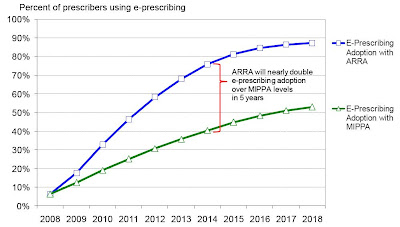
On March 16, Reuters reported the results of a study analyzing the impact of the stimulus package on e-Prescribing. The study predicts that e-prescribing utilization will almost double in five years, compared to what it would have been without ARRA (the Amercian Recovery and Reinvestment Act of 2009).

The study forecasts a striking reduction in adverse drug events of over 3.5 million in 5 years and a half million reduction in hospitalizations. Total savings are forecast to be $56 billion, including federal government savings of $22 billion.

The study was sponsored by an interested party (PCMA) and conducted by Visante.